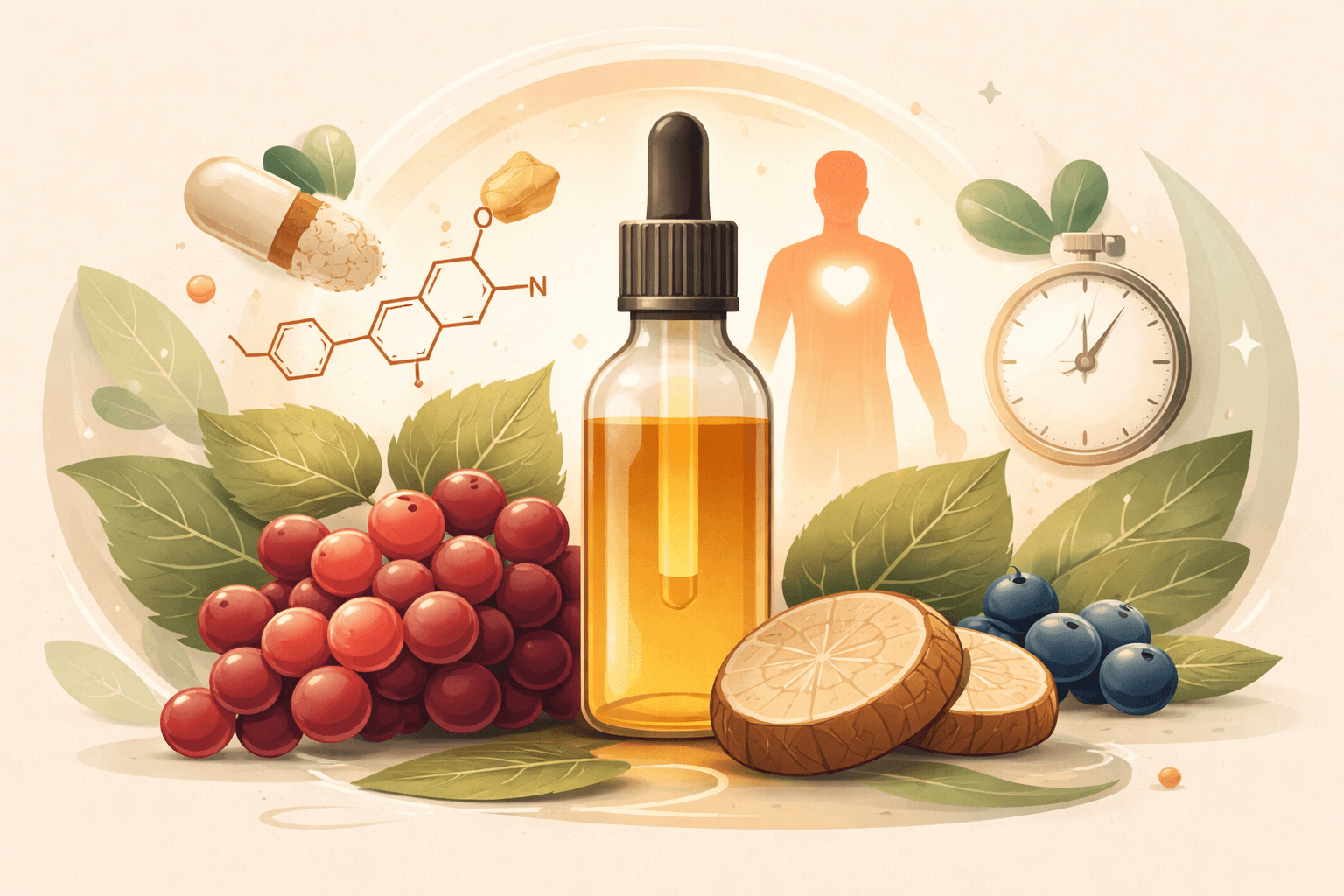
Resveratrol Bioavailability: Why It Matters for Longevity Claims
Resveratrol’s promise meets pharmacokinetics: how low bioavailability shapes human results, what sirtuin research really suggests, and which delivery strategies are emerging.
·7 min read
This content is for informational purposes only and does not constitute medical advice. Always consult a qualified healthcare provider before starting, stopping, or changing any supplement or medication regimen.
Resveratrol Bioavailability: Why It Matters for Longevity Claims
Resveratrol vaulted into the longevity conversation during the “French Paradox” era—when epidemiologists noted France’s relatively low rates of coronary disease despite diets that often included rich foods and red wine. A plant polyphenol concentrated in grape skins (and in Japanese knotweed), resveratrol was later linked to sirtuin activation in laboratory systems, igniting hopes for a caloric-restriction mimetic. But in humans, its promise keeps colliding with a pharmacokinetic roadblock: very low bioavailability. This article focuses on why bioavailability matters for resveratrol’s longevity claims, what clinical trials show, and which strategies under study may help.
Key point: Bioavailability challenges do not erase potential benefits outright, but they help explain why human results have been mixed compared with compelling cell and animal data (Evidence: strong for low bioavailability; moderate for mixed human outcomes).
What “bioavailability” means for resveratrol
After oral intake, resveratrol is rapidly absorbed but is also rapidly metabolized in the intestine and liver to glucuronide and sulfate conjugates. As a result, free “parent” resveratrol circulates at very low concentrations in blood (Evidence: strong; multiple pharmacokinetic studies and reviews).
The major metabolites achieve higher plasma levels than the parent compound and may have biological activity of their own or act as reservoirs that release parent resveratrol in tissues—an area of active research (Evidence: moderate; demonstrated in preclinical models and limited human data).
In cell studies using micromolar doses of free resveratrol, the observed effects may not reflect real-world human exposures after oral intake (Evidence: strong; well-established pharmacokinetic constraints).
Sirtuins, Sinclair, and the controversy in brief
Early studies reported that resveratrol directly activated SIRT1 and extended lifespan in yeast and some animal models, leading to high-profile efforts to develop sirtuin-activating compounds (Evidence: moderate; robust preclinical findings but context-dependent).
Later work showed that some assay systems used fluorescent substrates that biased results; other studies suggested resveratrol may activate SIRT1 indirectly by altering NAD+ metabolism and AMPK signaling, and that apparent “direct” activation depends on specific substrate motifs (Evidence: moderate; mixed but converging literature).
A proprietary high-bioavailability formulation (SRT501) advanced to clinical testing but was discontinued after gastrointestinal adverse events in a myeloma trial—highlighting the tightrope between increasing exposure and maintaining tolerability (Evidence: strong; published clinical trial reports).
Clinical signals: what trials show—and what they don’t
Across randomized controlled trials (RCTs), findings are heterogeneous and often modest, which aligns with the bioavailability challenge.
Metabolic health: Meta-analyses of RCTs up to 2021 report small improvements in fasting glucose and insulin sensitivity in people with type 2 diabetes or metabolic syndrome, with high heterogeneity and possible publication bias. Effects are less consistent in healthy adults (Evidence: moderate; multiple systematic reviews/meta-analyses of RCTs).
Cardiovascular markers: Pooled analyses suggest slight reductions in systolic blood pressure and some improvements in endothelial function in select populations; effects on lipids are variable and often not clinically meaningful (Evidence: moderate; meta-analyses of RCTs with modest effect sizes).
Inflammation and oxidative stress: Some RCTs and meta-analyses report small decreases in C-reactive protein (CRP) and improvements in certain oxidative stress markers, again with notable heterogeneity (Evidence: moderate).
Brain and cognitive outcomes: A few small RCTs show improvements in cerebrovascular responsiveness and select memory measures in older adults, while others are null; sample sizes are small and protocols vary (Evidence: emerging; small RCTs with mixed results).
Why the gap between lab promise and human results?
Dose/exposure mismatch: Cell and animal studies often use exposures not achievable with standard oral intake due to rapid metabolism (Evidence: strong).
Tissue targeting: Even if plasma levels of parent resveratrol are low, local tissue concentrations or intracellular deconjugation could matter—questions that are difficult to resolve in humans (Evidence: emerging).
Outcome selection: Trials often prioritize surrogate markers (e.g., fasting glucose, CRP). Hard outcomes like cardiovascular events or longevity endpoints are scarce (Evidence: strong for scarcity of long-term outcomes; emerging for inferred benefits).
Strategies under study to improve bioavailability
None of the approaches below should be considered proven for clinical benefit; they primarily change pharmacokinetic profiles. Human outcome data remain limited.
Food matrix and timing: Co-ingestion with fat and in a mixed meal may modestly alter absorption and first-pass metabolism, but clinical significance remains unclear (Evidence: emerging; small pharmacokinetic studies).
Isomer and stability: The trans isomer is more stable and bioactive in vitro than cis; light and heat can isomerize resveratrol, so handling matters for supplements and extracts (Evidence: strong for chemical stability; emerging for clinical relevance).
Micronized particles: Reduced particle size increases Cmax and AUC in pharmacokinetic studies, yet better exposure has not consistently translated into superior clinical outcomes; tolerability can be limiting at higher exposures (Evidence: moderate for PK improvement; emerging for outcomes).
Liposomes, phytosomes, and nanoparticles: These delivery systems enhance absorption in preclinical and early human PK studies, but robust RCTs linking them to superior health outcomes are sparse (Evidence: emerging).
Enzyme/transporter modulation: Co-administration with compounds that affect glucuronidation/sulfation or efflux transporters (e.g., piperine, quercetin) can change resveratrol’s PK in models, but safety and drug–drug interaction considerations make this a cautious area. Human outcome evidence is limited (Evidence: emerging).
Do other polyphenols have stronger human evidence?
While resveratrol remains an intriguing longevity candidate, several polyphenols show more consistent effects in certain clinical contexts:
EGCG (green tea catechin): Meta-analyses link green tea/EGCG supplementation to small reductions in body weight and LDL cholesterol and modest blood pressure improvements, especially alongside lifestyle changes (Evidence: moderate; multiple meta-analyses of RCTs). Traditional medicine has long used green tea for focus and metabolic balance (Evidence: traditional).
Quercetin: RCT meta-analyses suggest small but significant reductions in blood pressure in adults with hypertension, though effects on lipids and glycemia are inconsistent (Evidence: moderate). Quercetin-rich onions and capers feature in traditional diets (Evidence: traditional).
Curcumin: Numerous RCTs show improvements in osteoarthritis symptoms and decreases in CRP, though curcumin also faces bioavailability hurdles and often relies on enhanced formulations (Evidence: strong for osteoarthritis symptom relief; moderate for systemic inflammation). Turmeric is a core herb in Ayurveda for “cooling” inflammation (Evidence: traditional).
Traditional perspectives on polyphenol-rich plants
In Traditional Chinese Medicine (TCM), Hu Zhang (Polygonum cuspidatum—Japanese knotweed, a major source of resveratrol) is used to “clear heat,” move blood, and support the liver, often in multi-herb formulas that provide a spectrum of polyphenols (Evidence: traditional). In Ayurveda and East Asian traditions, green tea and turmeric are emblematic polyphenol-rich botanicals used for vitality and balance (Evidence: traditional). Research increasingly explores whether whole-plant matrices and synergistic compounds influence absorption and activity compared with isolated molecules (Evidence: emerging).
What this means for “longevity”
Animal and cell data suggest pathways relevant to healthy aging—sirtuins, AMPK, mitochondrial function, inflammation—may respond to resveratrol. However, translation to human longevity outcomes has not been demonstrated (Evidence: strong for preclinical relevance; emerging for human translation).
Dietary patterns naturally rich in diverse polyphenols (e.g., Mediterranean-style patterns with berries, grapes, olives, tea, herbs, and spices) are associated with reduced cardiometabolic risk and mortality in observational studies and supported by randomized dietary trials for intermediate outcomes (e.g., blood pressure, lipids, inflammatory markers) (Evidence: strong for diet-pattern benefits; moderate for polyphenols as active contributors).
Bottom line
Resveratrol’s low oral bioavailability is real and helps explain why human trials show modest, inconsistent benefits compared with compelling lab studies (Evidence: strong).
Sirtuin activation remains scientifically interesting but context-dependent; indirect mechanisms (NAD+/AMPK) may dominate in vivo, and direct activation is assay- and substrate-dependent (Evidence: moderate).
Enhanced formulations improve pharmacokinetics but have not yet delivered clear, superior clinical outcomes in rigorous trials; safety and tolerability must be considered (Evidence: emerging).
For longevity-relevant outcomes, other polyphenols—EGCG, quercetin, and curcumin—currently show more consistent signals in specific clinical areas, albeit with generally small effect sizes (Evidence: moderate to strong, outcome-dependent).
Traditional systems have long favored polyphenol-rich whole plants and combinations. Research increasingly suggests that matrices and mixtures may affect absorption and activity, a concept that may be relevant for translating polyphenol science into human benefit (Evidence: emerging; traditional).
Note: This article summarizes research and does not offer medical advice or dosage guidance. Individuals considering supplements should consult qualified clinicians, especially when taking medications, due to potential interactions.
This content is for informational purposes only and does not constitute medical advice. Always consult a qualified healthcare provider before starting, stopping, or changing any supplement or medication regimen.
Resveratrol’s rise began with the [French Paradox](/articles/resveratrol-polyphenols-french-paradox-sirtuins-longevity)—the 1990s observation that France’s relatively low rate of heart disease coexist
Introduction
Resveratrol burst into public consciousness through the “French Paradox” in the 1990s: the observation that French populations consuming relatively high amounts of saturated fat had lower
Resveratrol. Trans-Resveratrol, Resveritrol. ## Overview
**Resveratrol** is a naturally occurring **polyphenol** found in grapes, red wine, peanuts, berries, and several medicinal plants, including *Polygonum cuspidatum* (Japanese knotweed), a common commercial source of supplemental resveratrol. It has attracted broad scientific and public i
Telomeres and aging have captivated headlines for two decades. But beyond the buzz, what do telomeres actually do, how much do lifestyle choices really influence them, and what should we make of telom
Introduction
[Coenzyme Q10 (CoQ10)](/supplements/coq10)—also known as ubiquinone in its oxidized form and ubiquinol in its reduced form—is a lipid-soluble molecule found in virtually every cell. It sh
CoQ10 at a Glance
- What it is: A fat-soluble molecule present in virtually every cell, essential for mitochondrial energy production and antioxidant defense (Evidence: strong)
- Why it matters with a