Introduction
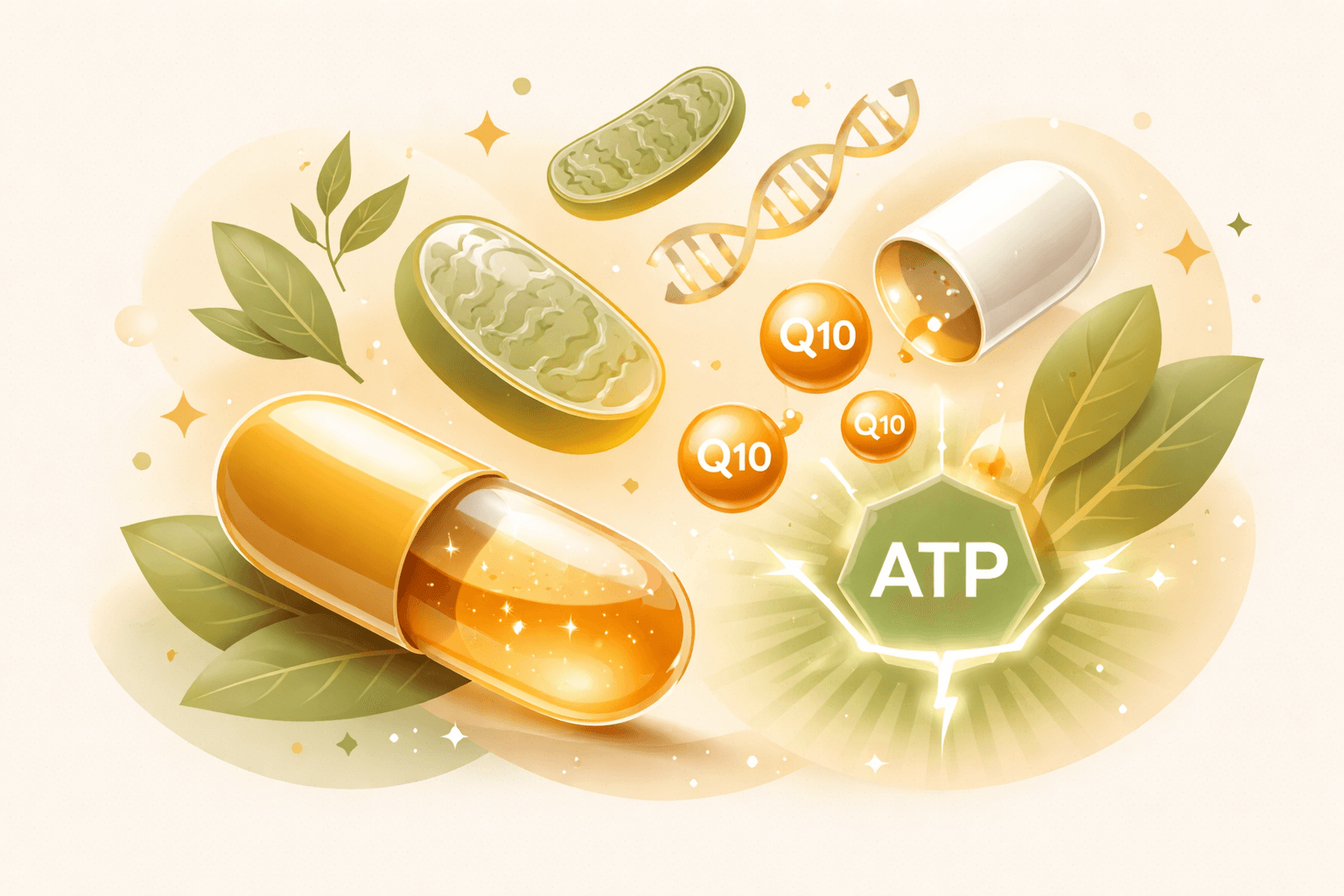
Coenzyme Q10 (CoQ10) sits at the heart of how cells make energy. Research suggests it shuttles electrons in mitochondria to help generate ATP, the chemical currency of cellular energy. Interest in CoQ10 has grown because levels appear to decline with age and may be reduced by statin therapy, potentially influencing energy-demanding tissues. This focused review explains how CoQ10 powers cellular energy, why status can fall, what clinical signals tell us about “energy” outcomes, how the two forms—ubiquinone and ubiquinol—compare for bioavailability, and where PQQ may complement CoQ10.
How CoQ10 Fuels Cellular Energy
- What it is: CoQ10 is a lipid-soluble molecule present in virtually all cell membranes; in mitochondria it cycles between an oxidized form (ubiquinone) and reduced form (ubiquinol).
- Role in the electron transport chain: CoQ10 transfers electrons from complexes I and II to complex III, supporting proton pumping and the mitochondrial membrane potential that drives ATP synthesis via ATP synthase (Evidence: strong; foundational biochemistry) (Lenaz & Genova, 2010; Nicholls, 2013).
- Antioxidant function: In its reduced state (ubiquinol), CoQ10 may help quench lipid peroxyl radicals and regenerate vitamin E within membranes, helping protect mitochondrial components from oxidative stress (Evidence: strong in vitro/biochemical; moderate in vivo) (Littarru & Tiano, 2007).
Why CoQ10 Status Can Drop: Aging and Statins
- Aging: Tissue CoQ10 concentrations appear to decline with age in several organs, including heart, kidney, and skeletal muscle, although magnitude varies by tissue and method (Evidence: moderate) (Kalén et al., 1989; Hernández‑Camacho et al., 2018). Mechanisms may include reduced biosynthesis and increased oxidative turnover.
- Statins: Because CoQ10 shares the mevalonate pathway with cholesterol, HMG‑CoA reductase inhibition can lower circulating CoQ10. Systematic reviews and meta-analyses report decreased plasma CoQ10 in statin users compared with nonusers or with baseline (Evidence: strong for lowering of circulating levels; moderate for clinical significance) (Qu et al., 2018, Medicine; Banach et al., 2015, review). Whether this translates to symptoms such as fatigue or myalgias is less consistent across randomized trials and meta-analyses (Evidence: mixed/modernate) (Skarlovnik et al., 2014; Qu et al., 2018, J Am Coll Nutr).
Does Raising CoQ10 Translate to “More Energy”? Clinical Signals
Direct measurement of “energy” is challenging in humans, but several clinical areas tied to high-energy demand or mitochondrial efficiency provide signals.
- Heart failure: In the Q‑SYMBIO randomized, double‑blind, multicenter trial, adjunctive CoQ10 was associated with fewer major adverse cardiovascular events and improvement in functional class over 2 years (Evidence: moderate; single sizable RCT) (Mortensen et al., 2014, JACC Heart Fail). Meta-analyses also report modest improvements in left ventricular ejection fraction and symptoms when CoQ10 is added to standard therapy (Evidence: moderate) (Fotino et al., 2013, Am J Clin Nutr; Madmani et al., 2014, BMC Cardiovasc Disord). These findings align with the concept that supporting mitochondrial electron transport may aid an energy‑hungry organ.
- Migraine prevention: Several randomized trials and meta-analyses suggest CoQ10 may reduce migraine attack frequency and days, consistent with a mitochondrial contribution to migraine pathophysiology (Evidence: moderate) (Parohan et al., 2019, Nutr Neurosci; Sanoobar et al., 2015, Nutr Neurosci). Benefits appear more evident for frequency than for acute pain intensity.
- Everyday fatigue and exercise: Small trials in healthy or fatigued adults show variable effects on perceived fatigue, time‑to‑exhaustion, or peak power, with heterogeneity in populations and outcomes (Evidence: emerging) (Lee et al., 2011, Int J Sport Nutr Exerc Metab; Zaffalon Júnior et al., 2017, Nutrition). Overall, research suggests potential benefits in some contexts but results are not uniform.
Ubiquinone vs Ubiquinol: What Matters for Cellular Energy
CoQ10 exists in two interconvertible forms: ubiquinone (oxidized) and ubiquinol (reduced). Inside the body, enzymes continually convert between these states as electrons move along the transport chain. The key practical questions are bioavailability and the ability to raise circulating and tissue levels.
- Absorption and transport: CoQ10 is fat‑soluble and transported in lipoproteins. Formulation and food matrix influence absorption (Evidence: strong for physicochemical principles) (Miles, 2007).
- Human pharmacokinetic comparisons: Several studies report that ubiquinol can raise plasma CoQ10 concentrations more efficiently than equal amounts of ubiquinone in some populations, including older adults, though not all trials agree (Evidence: moderate) (Evans et al., 2009; Langsjoen et al., 2014). Differences may narrow with improved ubiquinone formulations (e.g., oil suspensions, crystal dispersion) and over longer timeframes as interconversion occurs in vivo (Evidence: moderate) (Lopez‑Ledesma et al., 2016 review).
- Clinical implication: Research suggests either form can increase circulating CoQ10, but ubiquinol may provide higher or faster increases for individuals with impaired absorption, higher oxidative stress, or advanced age (Evidence: moderate). Whether higher plasma levels consistently translate to superior clinical outcomes remains to be demonstrated across conditions (Evidence: emerging).
Where PQQ May Complement CoQ10
Pyrroloquinoline quinone (PQQ) is a redox‑active compound that has drawn attention for mitochondrial biogenesis signaling.
- Mechanistic data: Preclinical work suggests PQQ can activate cell signaling pathways (e.g., CREB/PGC‑1α) associated with mitochondrial biogenesis and antioxidant defense (Evidence: emerging) (Chowanadisai et al., 2010, J Biol Chem).
- Human data: Early clinical studies report that PQQ may improve markers related to fatigue, stress, and sleep quality in adults, and may influence inflammatory and oxidative stress biomarkers (Evidence: emerging; small trials) (Nakano et al., 2009, J Nutr Sci Vitaminol; Harris et al., 2013, J Nutr Biochem). Combined with CoQ10, PQQ is hypothesized to pair “more mitochondria” signaling (biogenesis) with “better electron transport” function, though robust human trials on the combination are limited (Evidence: emerging).
Bridging Traditional and Modern Perspectives
- Traditional/Eastern views: In East Asian health systems, concepts roughly analogous to “vital energy” (Qi) have long emphasized supporting vitality and resilience. While not directly equivalent, modern research on mitochondrial efficiency and redox balance provides a biological narrative that may overlap with these traditional ideas (Evidence: traditional for concepts; emerging for direct linkage).
- Western biomedical lens: CoQ10’s role in electron transport and membrane antioxidant defense is well described biochemically, and clinical signals in heart failure and migraine suggest that, under stress, enhancing mitochondrial cofactor status may help some tissues perform their energy‑intensive jobs (Evidence: strong for mechanism; moderate for selected clinical outcomes).
Key Evidence Snapshots
- CoQ10 in electron transport and as membrane antioxidant: Evidence strong (Lenaz & Genova, 2010; Littarru & Tiano, 2007).
- Age‑related decline in tissue CoQ10: Evidence moderate (Kalén et al., 1989; Hernández‑Camacho et al., 2018).
- Statins lower circulating CoQ10: Evidence strong for level reductions; clinical symptom implications moderate/mixed (Qu et al., 2018; Skarlovnik et al., 2014).
- Heart failure (Q‑SYMBIO and meta‑analyses): Evidence moderate (Mortensen et al., 2014; Fotino et al., 2013; Madmani et al., 2014).
- Migraine prevention: Evidence moderate (Parohan et al., 2019; Sanoobar et al., 2015).
- Ubiquinol vs ubiquinone bioavailability: Evidence moderate for higher plasma increases with ubiquinol in some groups; outcomes data emerging (Evans et al., 2009; Langsjoen et al., 2014).
- PQQ as a complementary compound: Evidence emerging (Chowanadisai et al., 2010; Nakano et al., 2009).
Bottom Line
- CoQ10 is central to mitochondrial electron transport, and research suggests it may help sustain cellular energy and membrane antioxidant defenses, especially under conditions of higher demand.
- Levels appear to decline with age and can be lowered by statin therapy in the circulation; what that means for symptoms varies by individual and condition.
- In clinical research, adjunctive CoQ10 has shown benefits in heart failure and migraine prevention, lending indirect support to its role in energy‑intensive physiology.
- Both ubiquinone and ubiquinol can raise circulating CoQ10; ubiquinol may produce higher levels in some populations, though consistent superiority for clinical outcomes has not been established.
- PQQ may complement CoQ10 by supporting mitochondrial biogenesis signaling, but human evidence remains preliminary.
References (selected)
- Lenaz G, Genova ML. Structure and organization of mitochondrial respiratory complexes: a new understanding of an old subject. Antioxid Redox Signal. 2010.
- Nicholls DG. Mitochondrial bioenergetics: shuttles, motors and switches. Biochem Soc Trans. 2013.
- Littarru GP, Tiano L. Bioenergetic and antioxidant properties of coenzyme Q10: recent developments. Mol Biotechnol. 2007.
- Kalén A et al. Age-related changes in cortical and subcortical brain regions and in other tissues for coenzyme Q10 content. Lipids. 1989.
- Hernández‑Camacho JD et al. Coenzyme Q10 supplementation in aging and disease. Antioxidants (Basel). 2018.
- Qu H et al. Effects of statin therapy on plasma coenzyme Q10 concentrations: a meta-analysis. Medicine (Baltimore). 2018.
- Skarlovnik A et al. Coenzyme Q10 supplementation decreases statin-related mild-to-moderate muscle symptoms: a randomized clinical study. Med Sci Monit. 2014.
- Mortensen SA et al. The Q‑SYMBIO study: Coenzyme Q10 as adjunctive treatment of chronic heart failure. JACC Heart Fail. 2014.
- Fotino AD et al. Coenzyme Q10 in heart failure: a meta-analysis. Am J Clin Nutr. 2013.
- Madmani ME et al. Coenzyme Q10 for heart failure. BMC Cardiovasc Disord. 2014.
- Parohan M et al. Coenzyme Q10 supplementation for migraine prophylaxis: systematic review and meta-analysis. Nutr Neurosci. 2019.
- Sanoobar M et al. Coenzyme Q10 as a prophylactic treatment for migraine: RCT. Nutr Neurosci. 2015.
- Miles MV. The uptake and distribution of coenzyme Q10. Mitochondrion. 2007.
- Evans M et al. Bioavailability of ubiquinol vs ubiquinone in humans. Integr Med (Encinitas). 2009.
- Langsjoen PH et al. Comparison of ubiquinone and ubiquinol plasma levels. Clin Pharmacol. 2014.
- Lopez‑Ledesma R et al. Formulation effects on CoQ10 bioavailability: review. Nutr Hosp. 2016.
- Chowanadisai W et al. PQQ stimulates mitochondrial biogenesis. J Biol Chem. 2010.
- Nakano M et al. PQQ and measures of stress, fatigue, and sleep. J Nutr Sci Vitaminol. 2009.