Overview
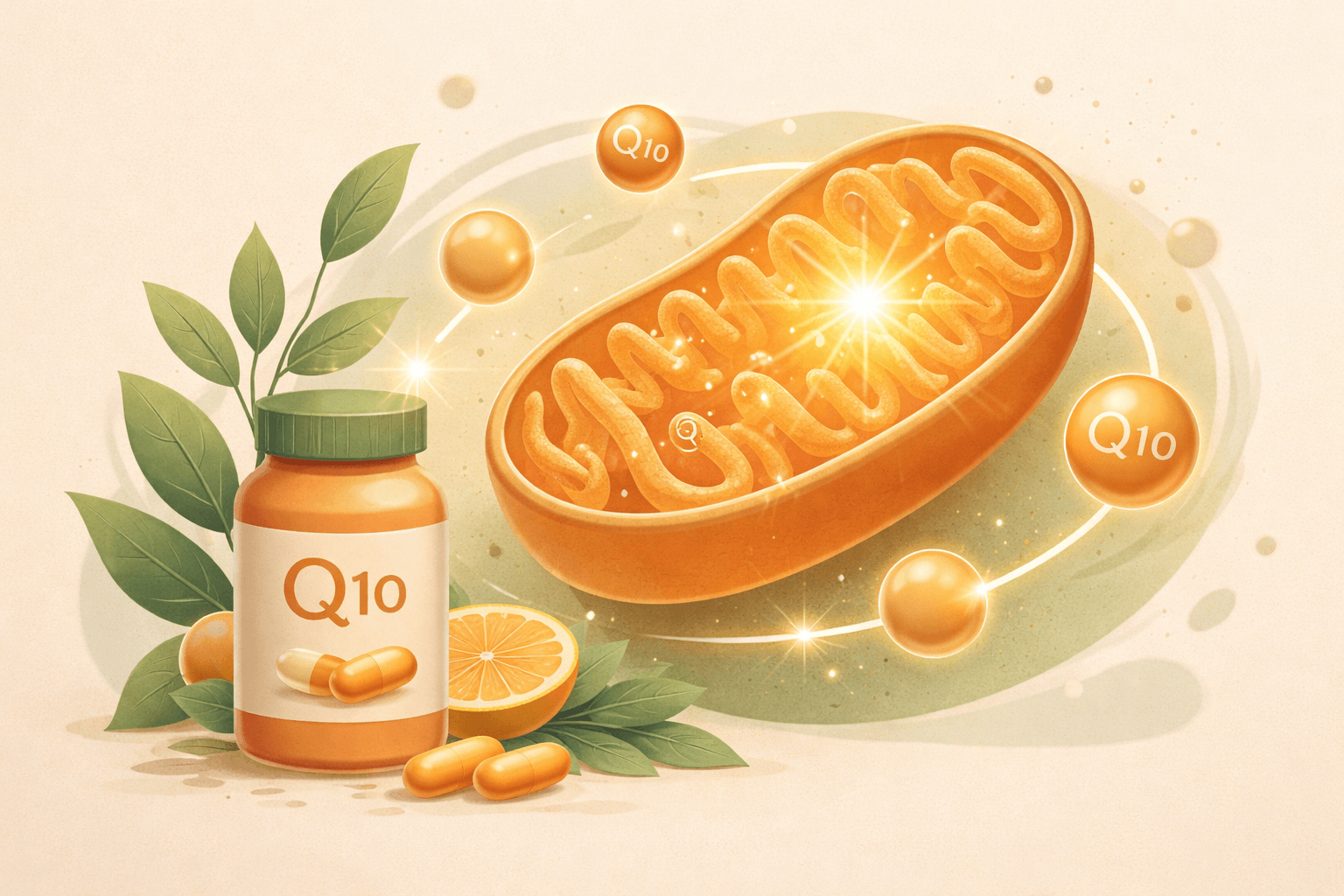
Coenzyme Q10 (CoQ10) sits at the heart of how our cells make energy. This lipid-soluble compound shuttles electrons inside mitochondria to help generate ATP—the cell’s energy currency—and also serves as an antioxidant. This supporting article focuses on CoQ10’s role in cellular energy and what research suggests about age-related changes, statin effects, key clinical signals (heart failure, migraine, fertility), forms (ubiquinone vs. ubiquinol), and a complementary compound, PQQ.
Key takeaways are labeled with evidence levels: strong, moderate, emerging, or traditional.
What is CoQ10?
CoQ10 exists in two interconvertible forms: oxidized ubiquinone and reduced ubiquinol. In healthy physiology, cells continuously cycle these forms to move electrons and neutralize reactive oxygen species. The body synthesizes CoQ10 via the mevalonate pathway, the same pathway targeted by statin medications. Dietary CoQ10 (found in oily fish and organ meats) contributes a smaller portion relative to endogenous synthesis. [Evidence: strong, established biochemistry]
How CoQ10 Powers ATP Production
- Mitochondrial electron transport: CoQ10 accepts electrons from Complex I (NADH dehydrogenase) and Complex II (succinate dehydrogenase) and donates them to Complex III (cytochrome bc1). This transfer helps establish the proton gradient that drives ATP synthase to create ATP. This role is core mitochondrial bioenergetics taught in standard texts and supported by decades of biochemical research. (Bioenergetics texts; mechanistic reviews) [Evidence: strong]
- Antioxidant and membrane stabilization: In its reduced form (ubiquinol), CoQ10 may help regenerate vitamin E and limit lipid peroxidation in mitochondrial membranes, potentially supporting efficient electron transport under stress. (Mechanistic and cell studies; human biomarker data) [Evidence: moderate]
Does CoQ10 Decline With Age?
Tissue and plasma studies suggest that CoQ10 levels tend to decrease with age, particularly in high-demand organs like the heart. Observational research reports lower myocardial and skeletal muscle CoQ10 content in older adults compared with younger counterparts. While the magnitude and clinical relevance vary across studies, age-related declines may help explain reduced mitochondrial efficiency seen in aging. (Observational tissue studies and reviews, 1980s–2010s) [Evidence: moderate]
Do Statins Lower CoQ10?
Because CoQ10 shares the mevalonate synthesis pathway with cholesterol, it is biologically plausible that statins reduce circulating CoQ10. Systematic reviews and meta-analyses of randomized trials report that statin therapy is associated with lower plasma CoQ10 compared with baseline or control, though not all studies align on the clinical significance of this change. Whether reduced circulating CoQ10 directly explains statin-associated muscle symptoms remains uncertain. (Systematic reviews/meta-analyses of RCTs, 2014–2019) [Evidence: strong for lowering blood levels; uncertain clinical implications]
Clinical Signals Relevant to Cellular Energy
While CoQ10’s bioenergetic role is clear mechanistically, clinical outcomes understandably vary by condition, dose, duration, and baseline status. Selected evidence:
Heart failure (Q-SYMBIO trial): In a multicenter, randomized, placebo-controlled trial of chronic heart failure patients, long-term CoQ10 co-supplementation was associated with fewer major adverse cardiovascular events and improved functional class compared with placebo. The investigators linked benefits to improved myocardial bioenergetics. Independent replication and contemporary trials have produced mixed results, but Q-SYMBIO remains a landmark study suggesting potential support where energetic demand is high. (Q-SYMBIO RCT, 2014; follow-up analyses) [Evidence: moderate]
Migraine prevention: Mitochondrial dysfunction is one proposed mechanism in migraine. Randomized controlled trials and meta-analyses suggest CoQ10 may reduce monthly migraine frequency and days compared with placebo, with a modest effect size and good tolerability. Evidence is more consistent in adults than in pediatric populations, and optimal regimens remain under study. (Systematic reviews/meta-analyses of RCTs, 2016–2021) [Evidence: moderate]
Fertility applications: Gametes are energy-intensive cells. In males, meta-analyses report improvements in sperm motility and some semen parameters with CoQ10 compared with placebo, though effects on live birth are less clear. In females undergoing assisted reproduction, small randomized studies and observational research suggest potential improvements in oocyte quality or ovarian response in selected groups, but larger confirmatory trials are needed. (Meta-analyses in male infertility; small RCTs/observational studies in women, 2013–2022) [Evidence: emerging]
Ubiquinone vs. Ubiquinol: Bioavailability Considerations
- Interconversion: The body readily interconverts ubiquinone and ubiquinol, and both reach systemic circulation. [Evidence: strong]
- Absorption differences: Several randomized crossover studies report that ubiquinol yields higher or faster increases in plasma CoQ10 than ubiquinone, particularly in older adults or individuals with certain absorption challenges. However, results are formulation-dependent; lipid-based delivery systems, taken with meals, and high-quality manufacturing can influence absorption regardless of form. Head-to-head trials show variability, and not all demonstrate a meaningful clinical difference. (Randomized pharmacokinetic studies, 2007–2020) [Evidence: moderate]
- Clinical relevance: Higher plasma levels do not always translate into superior clinical outcomes; comparative efficacy trials remain limited. (Clinical reviews) [Evidence: emerging]
PQQ: A Complementary Partner for Mitochondrial Health
Pyrroloquinoline quinone (PQQ) is a redox-active compound studied for its role in modulating mitochondrial biogenesis and cellular stress responses.
- Mechanistic and animal data: PQQ may influence pathways like PGC-1α and NRF1/2, supporting mitochondrial number and function in preclinical models. (Preclinical studies) [Evidence: emerging]
- Early human data: Small randomized or open-label human studies report improvements in subjective fatigue, sleep quality, and certain biomarkers of oxidative stress or inflammation with PQQ. Some exploratory work combining PQQ with CoQ10 suggests additive benefits on perceived energy or cognitive performance, but studies are small and heterogenous. Larger, well-controlled trials are needed. (Small human trials, 2010s) [Evidence: emerging]
Traditional and Eastern Perspectives
Traditional East Asian frameworks describe energy as Qi—vitality that powers organs and movement. While CoQ10 is a modern nutrient concept, its mitochondrial role parallels the idea of supporting fundamental vitality. From a traditional lens, bolstering core energy—through nutrition, breathing practices, and restorative sleep—aligns with supporting mitochondrial efficiency. Modern research suggests that nutrients like CoQ10 and PQQ may complement these foundational practices by aiding cellular redox balance and energy transfer. [Evidence: traditional perspective integrated with modern mechanisms]
Safety Snapshot
CoQ10 is generally well tolerated in clinical trials, with adverse effects typically mild (e.g., gastrointestinal discomfort). Because it participates in redox and metabolic pathways, individuals with complex medical conditions or on medications (for example, therapies affecting coagulation or lipid metabolism) should consult a qualified clinician before use. This article does not provide medical advice or dosage recommendations.
How to Interpret the Evidence for Energy
- Strong: Fundamental mitochondrial role (electron transport, interconversion in vivo)
- Moderate: Age-related decline; statin-associated reductions in circulating CoQ10; potential benefits in heart failure and migraine prophylaxis; ubiquinol’s higher plasma levels in some studies
- Emerging: Fertility effects on clinical endpoints; ubiquinone vs. ubiquinol clinical outcome differences; PQQ synergy and human efficacy
Bottom Line
- CoQ10 is central to how cells convert nutrients into ATP, and its redox cycling helps protect mitochondrial membranes. [Evidence: strong]
- Levels may decrease with age and with statin therapy, which could influence cellular energy, though clinical implications vary by person and condition. [Evidence: moderate]
- Clinical research signals potential benefits where mitochondrial demand or dysfunction is high—such as heart failure and migraine prevention—and emerging roles in fertility. Results are promising but not universal. [Evidence: moderate to emerging]
- Ubiquinone and ubiquinol both support CoQ10 status. Ubiquinol may raise plasma levels more efficiently in some contexts, but real-world performance depends on formulation and individual factors. [Evidence: moderate]
- PQQ may complement CoQ10 by supporting mitochondrial biogenesis and redox balance, with early human data suggesting possible benefits for perceived energy. Larger trials are needed. [Evidence: emerging]
References (selected)
- Biochemical and mechanistic overviews of CoQ10 in electron transport and antioxidant cycling: Reviews of mitochondrial bioenergetics and CoQ10 (e.g., Ernster & Dallner 1995; later narrative reviews).
- Age-related changes: Observational tissue and plasma studies across 1980s–2010s documenting lower CoQ10 content with age.
- Statins and CoQ10: Systematic reviews/meta-analyses (e.g., 2014–2019) showing reduced circulating CoQ10 with statin therapy.
- Heart failure: Q-SYMBIO randomized, placebo-controlled trial (2014) with long-term clinical endpoints.
- Migraine: Systematic reviews and meta-analyses of RCTs (2016–2021) showing modest reductions in attack frequency/days.
- Fertility: Meta-analyses in male infertility (2013–2018) and small RCTs/observational studies in assisted reproduction for women.
- Ubiquinone vs. ubiquinol: Randomized pharmacokinetic comparisons (2007–2020) with formulation-dependent findings.
- PQQ: Preclinical studies on mitochondrial biogenesis and small human trials on fatigue/sleep and biomarkers (2010s).