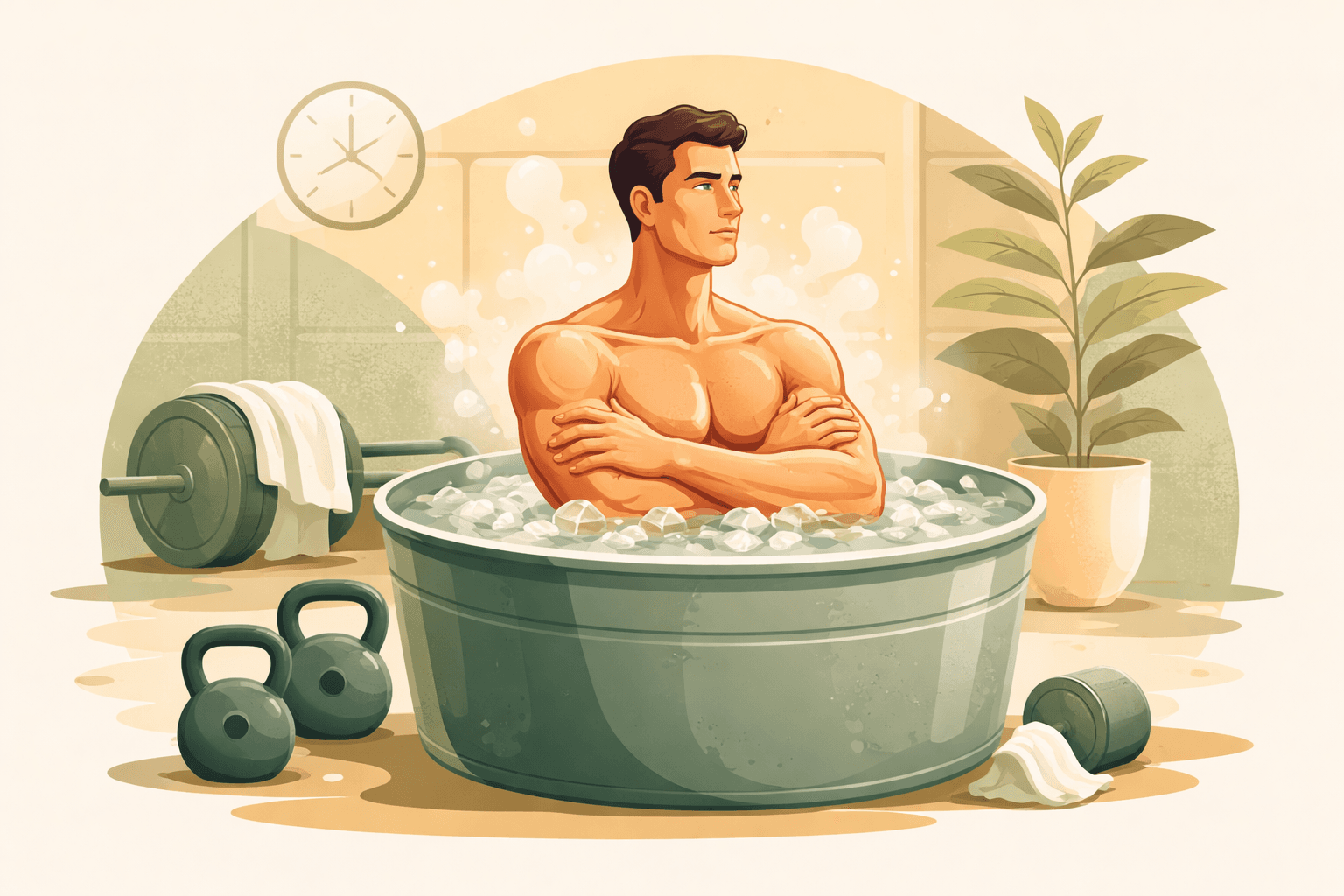
Cold plunges, ice baths, and cryotherapy have exploded in popularity—thanks in part to high-profile advocates and podcasts elevating the practice to mainstream recovery culture. But for people lifting weights to build muscle, an important question keeps surfacing: does cold exposure right after strength training blunt hypertrophy? Here’s what research suggests.
Key takeaways at a glance
- Immediate post-lift cold water immersion may attenuate muscle growth and some strength gains when used chronically after training blocks [Evidence: moderate to strong].
- Cold exposure may reduce soreness and perceived fatigue in the short term, which can help athletes tolerate dense competition schedules [Evidence: moderate].
- Mechanistically, cold can dampen anabolic signaling and inflammatory processes thought to drive adaptation after resistance exercise [Evidence: moderate].
- For endurance-focused adaptations, cold may acutely enhance some mitochondrial signals, though long-term outcomes are mixed [Evidence: emerging to moderate].
- Traditional Nordic hot–cold practices and breath–cold methods (e.g., Wim Hof) emphasize resilience and alertness rather than hypertrophy; these aims may align better with cold exposure’s strengths [Evidence: traditional].
Why recovery benefits don’t always mean better gains
Cold water immersion (CWI) and similar modalities reliably make athletes feel better after hard sessions. Multiple systematic reviews and meta-analyses report small-to-moderate improvements in delayed-onset muscle soreness (DOMS) and perceived recovery within 24–72 hours of exercise compared with passive rest (e.g., Hohenauer 2015; Leeder 2012; Bleakley 2012 Cochrane). These effects may be meaningful in tournament play or congested schedules [Evidence: moderate].
However, the processes that make muscles feel sore—transient inflammation, cell signaling, and fluid shifts—also appear to be part of how muscles remodel and grow. When these processes are repeatedly blunted right after lifting, training adaptations can be dampened [Evidence: moderate].
What the hypertrophy studies show
- Resistance training adaptations: A landmark randomized trial in The Journal of Physiology reported that men who used CWI immediately after lower-body resistance sessions for 12 weeks experienced smaller increases in muscle mass and strength compared with an active recovery control. Biopsy data suggested reduced activation of anabolic signaling pathways and satellite cell activity (Roberts et al., 2015) [Evidence: strong for the specific protocol studied].
- Broader evidence base: Narrative and systematic reviews have echoed this concern, noting that repeated post-exercise cooling can attenuate gains in muscle size and, in some cases, strength, particularly when CWI is applied immediately after each session over weeks (Fyfe et al., 2019; Peake et al., 2017) [Evidence: moderate].
- Not all outcomes, intensities, or populations respond the same way. Some studies show smaller or no meaningful decrements in performance outcomes, especially when strength rather than hypertrophy is the primary endpoint, or when cold exposure is not used after every session [Evidence: moderate/emerging].
Mechanisms: how cold could interfere with growth
- Anabolic signaling: Post-exercise cold has been shown to reduce phosphorylation of mTOR pathway components and blunt satellite cell responses—signals crucial for muscle protein accretion (Roberts et al., 2015) [Evidence: moderate].
- Inflammation and perfusion: Cooling reduces tissue temperature, blood flow, and inflammatory mediator activity. While this may lower soreness, it may also limit the local “danger signals” that cue repair and growth [Evidence: moderate].
- Edema and cell swelling: The “pump” and associated fluid shifts after lifting are proposed anabolic cues. Rapidly reversing these through cold and vasoconstriction may reduce that signal [Evidence: emerging].
When cold may still make sense
- Between-competition recovery: For athletes who need to repeat high outputs within 24–72 hours (e.g., tournaments, congested fixtures), reducing soreness and perceived fatigue may outweigh small potential trade-offs in adaptation. Meta-analyses suggest CWI improves perceptual recovery and may modestly affect markers of muscle damage (Hohenauer 2015; Leeder 2012) [Evidence: moderate].
- Endurance-biased signaling: Acute studies report that cooling after endurance exercise can increase mRNA expression of PGC-1α and related mitochondrial biogenesis signals (Ihsan et al., 2014/2015), though long-term training outcomes are mixed and context-dependent [Evidence: emerging to moderate].
- Heat-sensitive conditions and heat stress: In hot environments, post-exercise cooling can help reduce core temperature and perceived strain, which may support subsequent performance independent of hypertrophy goals [Evidence: moderate].
Cold shock proteins and brown fat: interesting, but not the main lever for muscle size
- Cold shock proteins (RBM3, CIRP): Experimental models link these proteins to cellular stress tolerance and neuroprotection. Their role in resistance training recovery or hypertrophy in humans is not well established [Evidence: emerging].
- Brown adipose tissue (BAT) activation: Cold exposure can activate BAT and increase thermogenesis. While potentially relevant for metabolic health and energy expenditure, these effects do not directly translate to enhanced muscle growth after lifting [Evidence: moderate for BAT activation; emerging for implications in resistance training].
Contrast therapy vs. cold alone
Alternating hot and cold (contrast water therapy) is a traditional and sporting practice meant to cycle vasodilation and vasoconstriction. Some studies suggest similar short-term reductions in soreness compared with cold alone, but head-to-head evidence on long-term strength or hypertrophy outcomes is limited. It remains unclear whether contrast therapy avoids the potential blunting seen with immediate CWI after resistance training [Evidence: emerging].
Practical implications without prescriptive advice
- Goal clarity matters. If maximizing muscle size and strength is the priority, research suggests caution with routine, immediate post-lift cold exposure across a training block [Evidence: moderate to strong].
- Timing may be a lever. Some athletes aiming for hypertrophy choose to separate intense cold exposure from strength sessions, reserving it for rest days or different training phases. This approach is based on the mechanistic and training-block evidence rather than dosage specifics [Evidence: moderate].
- Context rules. Team-sport or endurance athletes who need to feel and perform ready in the short term may accept a small risk of blunted adaptation in favor of acute recovery benefits [Evidence: moderate].
Traditional perspectives: hot–cold for resilience, not hypertrophy
Nordic cultures have long used cold water immersion, sea dips, and winter bathing, often paired with sauna, for alertness, mood, and resilience. The Wim Hof method blends breathwork with cold exposure to cultivate stress tolerance. These practices emphasize mental and systemic resilience rather than muscle growth per se, aligning with research that cold may help perceived recovery, stress modulation, and arousal but is not a dedicated hypertrophy tool [Evidence: traditional for practices; moderate for perceived recovery effects].
Limitations and open questions
- Individual variability is high. Genetics, training age, sex, and environmental factors likely affect how cold influences adaptation [Evidence: emerging].
- Protocol heterogeneity complicates interpretation. Studies vary in timing, frequency, temperature, and body coverage, making direct comparisons difficult [Evidence: moderate].
- Long-term endurance outcomes with routine post-exercise cold remain unsettled, with some signals of benefit and others of neutral or negative impact depending on the training type and measurement [Evidence: emerging].
Bottom line
- If your primary goal is muscle hypertrophy or maximal strength from resistance training, routinely jumping into intense cold immediately after lifting may blunt some of the gains over time [Evidence: moderate to strong].
- If your priority is rapid turnarounds between efforts—feeling less sore and more ready within 1–3 days—cold exposure may help with perceived recovery, at a possible small cost to long-term adaptation [Evidence: moderate].
- Traditional hot–cold practices and breath–cold approaches appear well-suited for resilience and alertness; they are not validated strategies to enhance muscle growth after lifting [Evidence: traditional].
- As with most recovery tools, align cold exposure with your phase goals: performance tomorrow vs. adaptation over months. Research suggests these aims sometimes trade off.
References (representative)
- Roberts et al. The Journal of Physiology, 2015: Post-exercise cold water immersion attenuates skeletal muscle hypertrophy and strength gains vs. active recovery.
- Fyfe et al. Frontiers in Physiology, 2019: Review on post-exercise cooling and training adaptations.
- Peake et al. The Journal of Physiology, 2017: Perspective on recovery modalities and adaptation trade-offs.
- Hohenauer et al. Sports Medicine/Int J Sports Physiol Perform, 2015: Systematic review/meta-analysis on CWI and recovery from exercise.
- Leeder et al. British Journal of Sports Medicine, 2012: Meta-analysis on CWI effects on recovery markers.
- Bleakley et al. Cochrane Review, 2012: Cold water immersion for preventing and treating muscle soreness after exercise.
- Ihsan et al. The Journal of Physiology/Sports Medicine, 2014–2015: Acute increases in mitochondrial biogenesis signals with post-endurance exercise cooling.