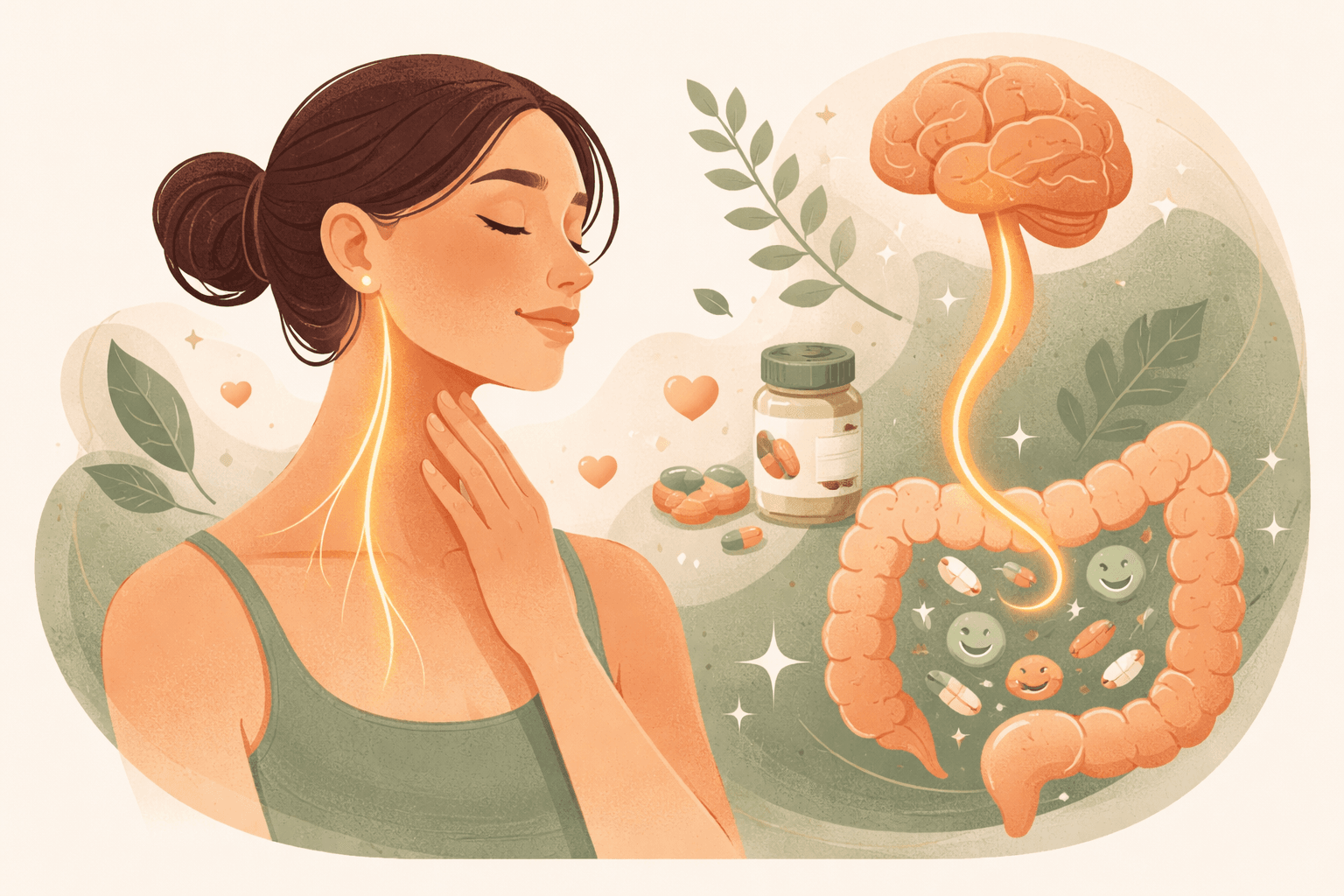
Psychobiotics—specific probiotic strains that influence the brain via the gut-brain axis—have moved from niche research to mainstream curiosity. Among the most compelling angles in this field is the vagus nerve, the bidirectional “information highway” connecting the gut and brain. This article focuses on how select Lactobacillus and Bifidobacterium strains may modulate anxiety through vagal signaling, what human trials have found so far, and how fermented foods and traditional practices fit into the picture.
What are psychobiotics?
Psychobiotics are live microorganisms that, when ingested in adequate amounts, may confer mental health benefits such as reduced anxiety or depressive symptoms. Mechanisms proposed include modulation of neurotransmitters (for example, GABA and serotonin precursors), anti-inflammatory effects, stress-hormone regulation, and neural signaling via the vagus nerve. [Evidence: emerging-to-moderate]
The vagus nerve: a gut-brain highway
The vagus nerve carries sensory information from the gut to the brain and motor signals back to the gut, regulating digestion, inflammation, and stress responses. Preclinical work provides a proof-of-concept that gut microbes can influence behavior via this route. In a landmark mouse study, Lactobacillus rhamnosus (JB-1) reduced anxiety- and depression-like behavior and stress hormones; these effects disappeared when the vagus nerve was surgically severed (Bravo et al., 2011, PNAS). While animal data cannot be extrapolated directly to people, it supports the plausibility that some psychobiotics may act, at least partly, through vagal signaling. [Evidence: strong in animals; emerging in humans]
Clinical evidence: key strains and anxiety outcomes
Human studies are heterogeneous—differing strains, populations, and endpoints—yet several randomized controlled trials (RCTs) point to anxiety-relevant benefits.
Lactobacillus helveticus R0052 + Bifidobacterium longum R0175 (combination)
A double-blind RCT in healthy adults found reduced psychological distress and anxiety scores after four weeks versus placebo (Messaoudi et al., 2011, Psychiatry Research). The same formula has been associated with cortisol attenuation in other small trials. [Evidence: moderate]
Lactobacillus rhamnosus HN001
In a perinatal RCT, participants receiving L. rhamnosus HN001 reported lower postpartum anxiety and depression scores compared with placebo (Slykerman et al., 2017, EBioMedicine/PLoS One). Although postpartum populations are unique, the finding suggests stress- and mood-modulating potential. [Evidence: moderate]
Bifidobacterium longum NCC3001
In individuals with irritable bowel syndrome (IBS), B. longum NCC3001 reduced depression scores and altered brain activity on fMRI versus placebo (Pinto-Sanchez et al., 2017, Gastroenterology). IBS often coexists with anxiety; brain changes imply central effects consistent with gut-brain signaling. [Evidence: moderate]
Bifidobacterium longum 1714
In healthy volunteers, this strain has been associated with reduced perceived stress and altered neural activity in small RCTs (Allen et al., 2016, Translational Psychiatry). Findings point toward stress resilience rather than treatment of clinical anxiety per se. [Evidence: emerging-to-moderate]
Bifidobacterium breve CCFM1025
A recent RCT in adults with depressive symptoms reported improvements in depression scales; anxiety-related outcomes varied (Tian et al., 2022, Nutrients). This supports a broader mood-modulating role for certain Bifidobacterium strains. [Evidence: emerging]
What do reviews say?
Systematic reviews and meta-analyses generally report small but statistically significant benefits for depressive symptoms, with more mixed results for anxiety. For instance, Firth et al. (2019, Journal of Affective Disorders) noted modest improvements in depression with probiotics; anxiety outcomes were less consistent. Other reviews (Huang et al., 2017; Wallace & Milev, 2017) also suggest benefit is strain-specific and more evident in people with higher baseline symptoms. Overall, research suggests that certain strains may help some individuals, though effects are not universal. [Evidence: moderate]
How the vagus connection may work in humans
Direct human proof that a psychobiotic’s effects are vagus-mediated is limited, but converging data points in that direction:
- Preclinical vagotomy studies show necessity of the vagus in some microbial effects (Bravo et al., 2011). [Evidence: strong in animals]
- Human neuroimaging demonstrates central changes after probiotic ingestion, including altered brain connectivity (Tillisch et al., 2013, Gastroenterology) and amygdala-related changes in IBS (Pinto-Sanchez et al., 2017). [Evidence: emerging]
- Clinically, implanted vagus nerve stimulation reduces depressive symptoms in treatment-resistant cases, illustrating the pathway’s relevance to mood regulation even though it is not a probiotic intervention. [Evidence: strong for VNS; indirect for psychobiotics]
Fermented foods and mood: where they fit
Fermented foods can deliver live microbes and microbial metabolites, though content varies by product and preparation.
- A randomized dietary trial found that a high–fermented-food diet increased microbiome diversity and reduced inflammatory cytokines versus a high-fiber diet (Wastyk et al., 2021, Cell). Since inflammation is tied to stress and mood, this may indirectly support mental well-being. Mood was not the primary endpoint. [Evidence: moderate for immune effects; emerging for mood]
- Observational research has linked greater fermented food intake with lower social anxiety in certain subgroups (Hilimire et al., 2015, Psychiatry Research), though observational designs cannot prove causation. [Evidence: emerging]
Traditional fermentation as proto-psychobiotics
Many traditional ferments harbor Lactobacillus and Bifidobacterium species or related lactic acid bacteria that may influence neurotransmitters.
- Kimchi often contains Lactobacillus brevis strains capable of producing GABA in vitro and in animal models, a neurotransmitter implicated in anxiety regulation (Kim et al., 2014; Park & Oh, 2005). [Evidence: emerging/traditional]
- Kefir delivers diverse lactic acid bacteria and yeasts; small human studies suggest potential mood benefits, but results are preliminary. [Evidence: emerging/traditional]
- Miso, a soybean ferment, provides microbial metabolites and peptides; Japanese cohort studies associate regular miso soup consumption with lower psychological distress, though confounding is likely (Nanri et al., 2016). [Evidence: emerging/traditional]
Bridging perspectives
- Western research emphasizes strain-specific RCTs, biomarkers (cortisol, cytokines), and imaging to infer mechanisms like vagal signaling. [Evidence: moderate]
- Eastern and traditional lenses emphasize whole-food ferments, seasonal eating, and balance, which may deliver diverse microbes and metabolites that collectively nudge the gut-brain axis. [Evidence: traditional]
Practical considerations (non-prescriptive)
- Strain specificity matters. Benefits observed with L. helveticus R0052 + B. longum R0175, L. rhamnosus HN001, B. longum NCC3001, and B. longum 1714 do not generalize to all probiotics. [Evidence: strong]
- Context counts. Effects may be more noticeable in people with higher baseline stress or coexisting gut symptoms (e.g., IBS). [Evidence: moderate]
- Fermented foods vary. Homemade and commercial products differ in live microbe content and strains; heat treatment can inactivate microbes. [Evidence: strong]
- Safety and interactions. Probiotics and ferments are generally well tolerated in healthy individuals, but those with compromised immunity or serious illness should consult a clinician. This article does not provide medical advice. [Evidence: strong]
Bottom line
- Research suggests certain psychobiotic strains—particularly combinations like L. helveticus R0052 + B. longum R0175, and single strains such as L. rhamnosus HN001 and B. longum NCC3001—may help reduce anxiety-related distress in some people. [Evidence: moderate]
- The vagus nerve is a plausible pathway connecting gut microbial signals to the brain, supported by animal studies and suggestive human neuroimaging data. [Evidence: strong in animals; emerging in humans]
- Fermented foods may complement this approach by enriching microbial diversity and reducing inflammation, with early evidence linking them to better mood or lower social anxiety in certain groups. [Evidence: emerging]
- Effects are strain-specific and modest on average. Individual responses vary, and psychobiotics are not a stand-alone treatment for clinical anxiety. [Evidence: moderate]
Selected references
- Messaoudi M et al. Psychiatry Res. 2011.
- Slykerman RF et al. PLoS One/EBioMedicine. 2017.
- Pinto-Sanchez MI et al. Gastroenterology. 2017.
- Allen AP et al. Transl Psychiatry. 2016.
- Firth J et al. J Affect Disord. 2019.
- Huang R et al. Nutrients. 2017.
- Bravo JA et al. PNAS. 2011.
- Tillisch K et al. Gastroenterology. 2013.
- Wastyk HC et al. Cell. 2021.
- Hilimire MR et al. Psychiatry Res. 2015.
- Kim et al. J Microbiol Biotechnol. 2014; Park & Oh. 2005.
- Nanri A et al. Psychiatry Res. 2016.