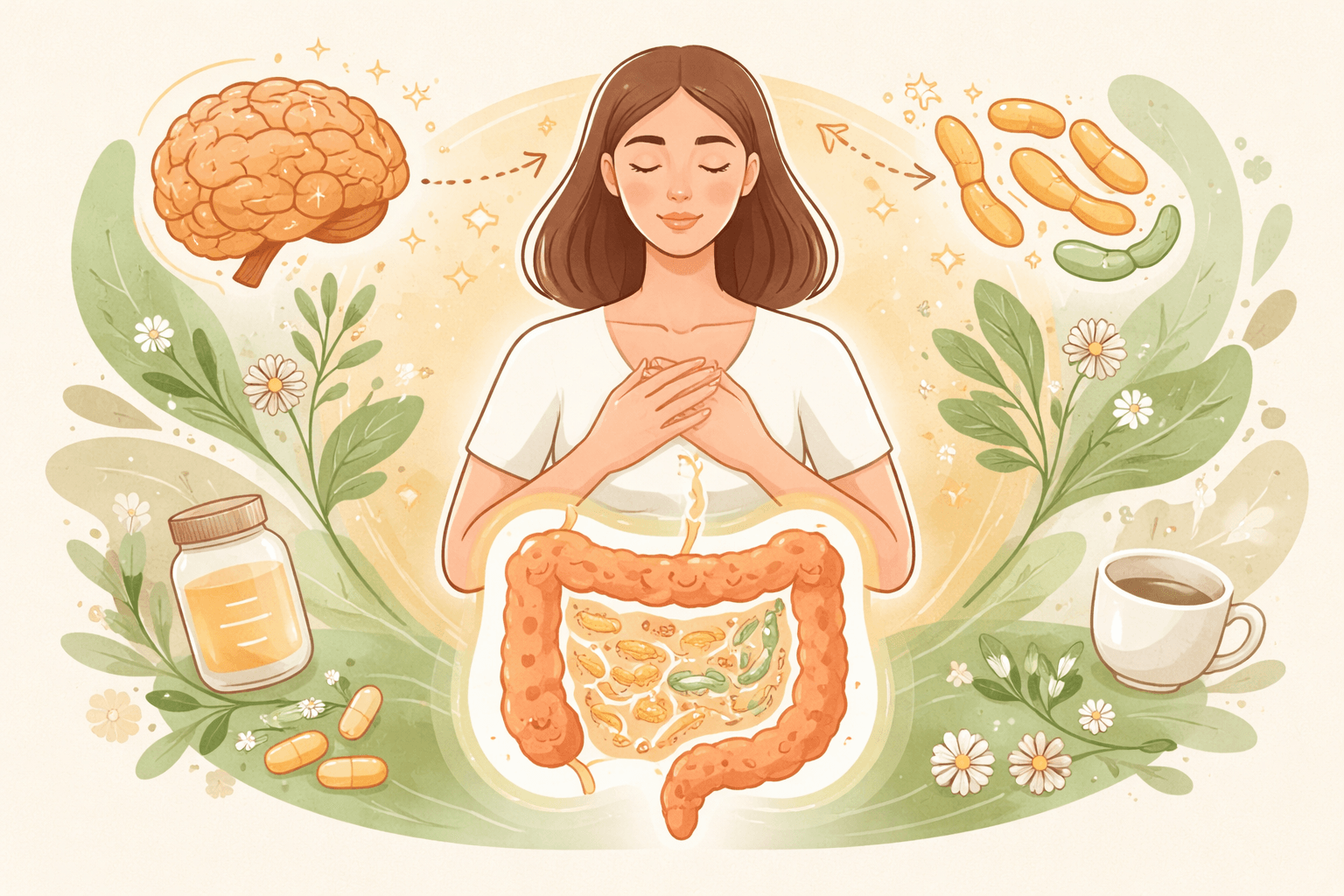
Why focus on this psychobiotic pair?
Psychobiotics are probiotic strains that may influence mental health through the gut–brain axis. Among the most studied combinations is Lactobacillus helveticus R0052 with Bifidobacterium longum R0175. Research suggests this duo may help reduce psychological distress and support mood, possibly via signaling through the vagus nerve, modulation of stress hormones, and immune pathways. While the overall evidence is still developing, this pair is one of the few with human randomized controlled trial (RCT) data linking specific strains to mood outcomes.
- Key point: Strain identity matters. Results seen with R0052 and R0175 cannot be generalized to other Lactobacillus or Bifidobacterium strains. (Evidence: consensus principle in probiotic research, strong)
How might these strains influence the gut–brain axis?
Several interconnected mechanisms are under investigation:
- Vagus nerve signaling
- Animal studies show certain Lactobacillus strains can affect anxiety-like behavior via the vagus nerve; when the nerve is severed, benefits disappear (e.g., L. rhamnosus JB-1 in mice; Bravo et al., PNAS 2011). Although this work is not on R0052/R0175 specifically, it supports a plausible pathway for psychobiotics more broadly. (Evidence: animal models, emerging)
- Stress hormone modulation (HPA axis)
- In a human RCT of R0052+R0175, participants showed reduced urinary free cortisol alongside improved mood scores, suggesting a stress-axis link (Messaoudi et al., Br J Nutr 2011). (Evidence: RCT, moderate)
- Neuroactive metabolites and neurotransmitters
- Lactobacilli and bifidobacteria can produce or modulate metabolites (e.g., GABA precursors, short-chain fatty acids) that may influence brain function indirectly. Human confirmation for these specific strains is limited but mechanistically plausible. (Evidence: mechanistic and in vitro/animal data, emerging)
- Immune and inflammatory signaling
- Psychobiotics may help rebalance immune tone and gut barrier function, potentially reducing signals that exacerbate stress and low mood. Human trials with fermented foods (not specific to these strains) show decreased inflammatory markers, aligning with this mechanism (Wastyk et al., Cell 2021). (Evidence: RCT for fermented foods broadly, moderate; strain-specific for R0052/R0175, emerging)
What does the clinical evidence say?
The most frequently cited human RCT for this pair is:
- Messaoudi et al., British Journal of Nutrition (2011): In a double-blind, placebo-controlled trial of healthy volunteers over 30 days, the R0052+R0175 combination was associated with reduced global psychological distress, anxiety, and depressive symptoms (measured by validated scales, including HADS and HSCL-90), and with lower urinary cortisol compared with placebo. (Evidence: RCT, moderate)
Additional context from broader syntheses:
- Systematic reviews and meta-analyses on probiotics for mood disorders report small but statistically significant improvements in depressive symptoms, with more variability in anxiety outcomes. Effects are generally more consistent in people with subclinical or mild-to-moderate symptoms and in multi-strain formulations. Specific attribution to R0052/R0175 is limited by the small number of trials, but this combination is often highlighted as among the better-studied psychobiotics. Examples include Ng et al., Nutrients 2018; Nikolova et al., Psychol Med 2021. (Evidence: systematic reviews/meta-analyses, moderate)
What this means in practice:
- Research suggests R0052+R0175 may help with psychological distress in otherwise healthy or mildly stressed adults. The magnitude of benefit tends to be modest and may depend on baseline stress levels and individual microbiome context. (Evidence: RCT plus meta-analytic context, moderate)
Anxiety, IBS, and related overlaps
The gut–brain axis is especially relevant in conditions that straddle gastrointestinal and psychological domains. While the R0052/R0175 pair has not been as extensively tested in clinical anxiety or major depressive disorder, it has been studied in the context of stress-related symptoms. Other Bifidobacterium strains (e.g., B. longum NCC3001/1714 in separate trials) have shown benefits for stress, IBS-related quality of life, and brain activity patterns during emotional tasks, reinforcing the plausibility that targeted psychobiotics can influence mood-related pathways. These are different strains, but they provide convergent evidence for the gut–brain concept (Pinto-Sanchez et al., Gastroenterology 2017; Allen et al., Transl Psychiatry 2016). (Evidence: RCTs on related strains, moderate)
Where do fermented foods fit in?
Traditional fermented foods—kefir, kimchi, miso, tempeh, and yogurt—deliver live microbes and metabolites that may shape the gut ecosystem. While they do not necessarily contain R0052 or R0175, they embody a “proto-psychobiotic” approach long practiced in Eastern and traditional cuisines.
- In a Stanford RCT, a diet high in fermented foods increased microbiome diversity and reduced inflammatory markers over 10 weeks, factors relevant to mood regulation even if mood was not a primary endpoint (Wastyk et al., Cell 2021). (Evidence: RCT, moderate)
- Observational research links higher fermented food intake with lower social anxiety in certain subgroups, though causality cannot be established (Hilimire et al., Psychiatry Res 2015). (Evidence: observational, emerging)
- Fermented milk beverages containing specific Lactobacillus strains (e.g., L. casei Shirota; not the R0052/R0175 pair) have reduced stress-related symptoms in students during exam periods (e.g., Kato-Kataoka et al., Beneficial Microbes 2016). (Evidence: RCT, moderate)
Together, these findings suggest fermented foods may support a gut environment conducive to mental well-being, even as strain-specific psychobiotics provide a more targeted approach. (Evidence: mixed human evidence, moderate)
Eastern and traditional perspectives
Many traditional medical systems emphasize digestive balance for emotional harmony. Fermented staples—such as kimchi in Korea, natto and miso in Japan, and kefir across the Caucasus—have long been valued for sustaining resilience during stress. Modern psychobiotic research echoes this view, proposing that microbial communities and their metabolites may influence calmness, clarity, and vitality. While contemporary trials isolate strains like R0052 and R0175, traditional diets likely delivered diverse consortia that shaped host stress responses over time. (Evidence: historical/traditional use, traditional; mechanistic plausibility, emerging)
Quality and expectations: what to know
- Strain specificity: Benefits observed with R0052 and R0175 cannot be assumed for other Lactobacillus helveticus or Bifidobacterium longum strains. Look for clear strain labels when evaluating products. (Evidence: probiotic taxonomy principle, strong)
- Modest effect sizes: Meta-analyses of probiotics for mood generally report small improvements; effects may be most noticeable for subclinical distress and when combined with lifestyle approaches such as sleep hygiene, movement, and a fiber- and fermented-food–rich diet. (Evidence: systematic reviews/meta-analyses, moderate)
- Individual variability: Baseline microbiome composition, diet, and stress exposure may influence response to psychobiotics. (Evidence: emerging human stratification data, emerging)
This article does not provide medical advice or dosage recommendations. Individuals with medical conditions or on psychotropic medications should consult a qualified clinician before making changes to their care plan.
Bottom line
- The Lactobacillus helveticus R0052 and Bifidobacterium longum R0175 combination is one of the better-studied psychobiotic pairs for anxiety and psychological distress. A human RCT reported improvements in validated mood scales and reduced cortisol over 30 days. (Evidence: RCT, moderate)
- Mechanisms likely involve the gut–brain axis, including vagus nerve signaling, stress-hormone modulation, microbial metabolites, and immune pathways. (Evidence: animal-to-human translational mix, emerging to moderate)
- Fermented foods from traditional cuisines may complement targeted psychobiotics by enhancing microbial diversity and reducing inflammation, though they typically do not supply these exact strains. (Evidence: RCTs for fermented diets and related strains, moderate)
- Overall, research suggests R0052+R0175 may help support mood in some individuals, with modest effects best understood as part of a broader, holistic approach to stress and mental well-being. (Evidence: RCT plus meta-analytic context, moderate)