Introduction
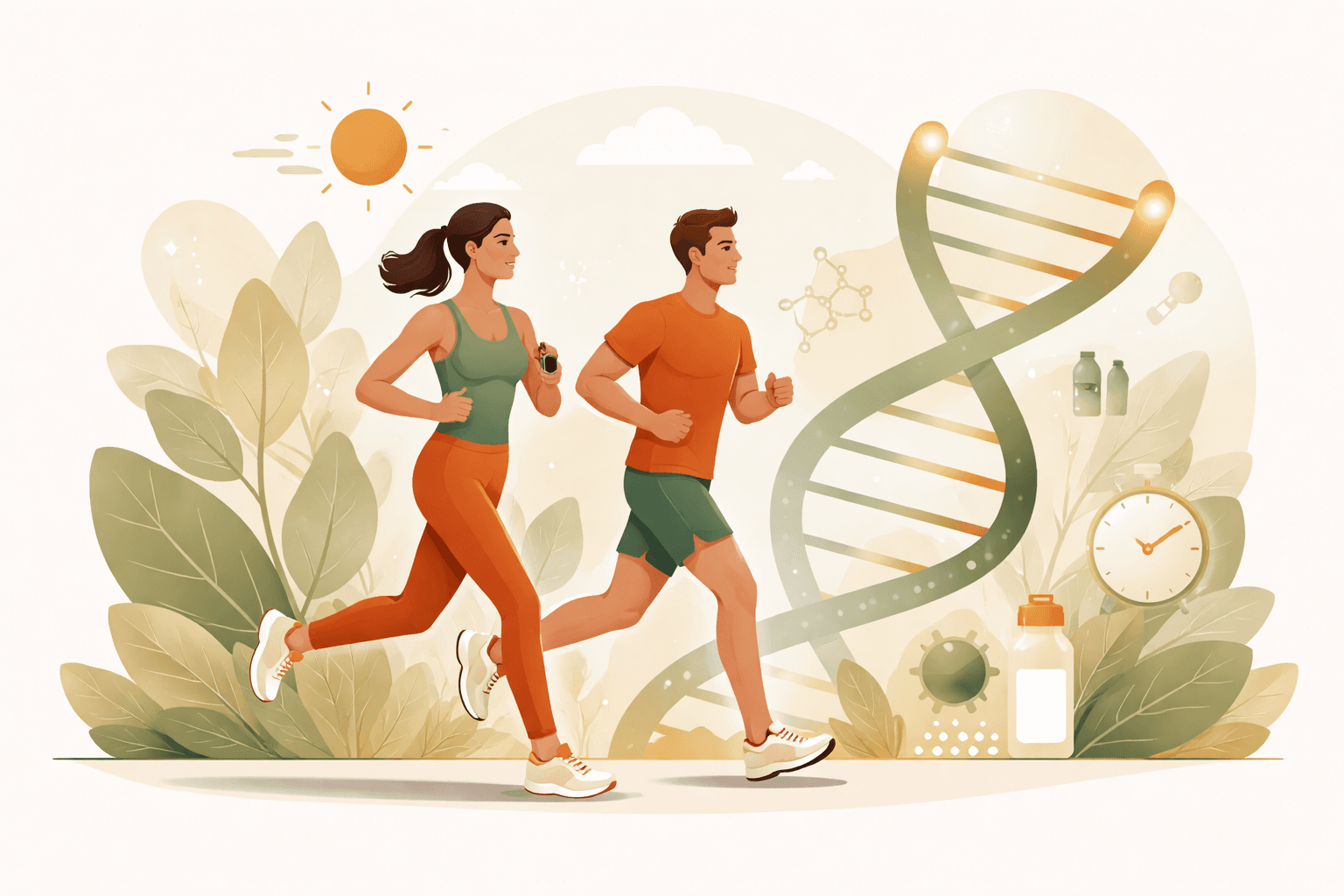
Telomeres—the protective DNA caps at chromosome ends—shorten as cells divide, a process linked with cellular aging. Elizabeth Blackburn, Carol Greider, and Jack Szostak received the 2009 Nobel Prize in Physiology or Medicine for discovering telomerase and the role of telomeres in chromosome stability. Against this backdrop, a common question is whether exercise can help preserve telomere length and support healthy aging. This focused review looks at what research suggests about endurance-style exercise (including continuous aerobic training and high-intensity intervals) and telomere biology.
What telomeres are—and why exercise might matter
- Telomeres act like protective caps that help maintain genomic integrity. As they shorten, cells may enter senescence or apoptosis more readily. [Evidence: strong]
- Exercise may influence telomeres through several pathways: lower oxidative stress and inflammation, improved mitochondrial function, and shifts in signaling molecules (for example, boosting telomerase activity and supporting telomere-protective proteins). [Evidence: moderate]
Key observational findings
- Active people often show longer leukocyte telomere length (LTL) than less active peers. A large twin study found leisure-time physical activity was positively associated with LTL, even after accounting for age and lifestyle factors (Cherkas et al., 2008, Archives of Internal Medicine). [Evidence: moderate]
- A systematic review and meta-analysis reported that physical activity is associated with longer telomeres across multiple studies (Mundstock et al., 2015, Ageing Research Reviews). Effect sizes were modest and heterogeneous, reflecting differences in populations and measurement methods. [Evidence: moderate]
- Caution is warranted: observational designs cannot prove causality, and healthier people may both exercise more and have longer telomeres (reverse causation). [Evidence: strong]
Randomized trials: endurance and interval training stand out
The most informative studies come from interventions that directly compare training modalities.
- Endurance and HIIT vs. resistance training: In a randomized controlled trial, adults assigned to either endurance training (continuous aerobic) or high-intensity interval training (HIIT) for several months showed increased telomerase activity and longer leukocyte telomere length compared with resistance training or control groups (Werner et al., 2019, European Heart Journal). The endurance-type groups demonstrated the most robust changes in telomerase activity in blood cells. [Evidence: moderate]
- Multi-component lifestyle programs: In men with low-risk prostate cancer, a comprehensive program including plant-forward diet, moderate aerobic activity, and stress management increased telomerase activity over 3 months (Ornish et al., 2008, PNAS) and was linked to longer telomeres at 5-year follow-up relative to controls (Ornish et al., 2013, PNAS). Because the intervention combined several behaviors, the specific contribution of exercise cannot be isolated. [Evidence: moderate]
- Not all RCTs show changes: Some trials of aerobic exercise—particularly when short in duration or conducted in metabolically healthy participants—report no significant telomere length changes, highlighting that baseline health, training dose, and study length may influence detectability (e.g., mixed findings in weight-loss and breast cancer survivorship trials). [Evidence: moderate]
How might endurance exercise affect telomeres?
- Oxidative stress and inflammation: Regular aerobic training may reduce chronic oxidative and inflammatory burden—key drivers of telomere attrition in leukocytes. Systematic reviews link endurance exercise with lower C-reactive protein and improved redox balance. [Evidence: moderate]
- Telomerase and shelterin proteins: Human trials have shown increased telomerase activity in peripheral blood mononuclear cells after endurance-style training (Werner et al., 2019) and after comprehensive lifestyle programs (Ornish et al., 2008). Animal and cell models suggest exercise may support proteins that guard telomeres (shelterin complex). [Evidence: moderate]
- Mitochondrial fitness: Aerobic training enhances mitochondrial biogenesis and efficiency (via PGC-1α and related pathways), potentially reducing the cellular stress that accelerates telomere loss. [Evidence: moderate]
What about intensity and modality?
- Endurance and HIIT: Research suggests continuous aerobic training and HIIT may be particularly effective at stimulating telomerase activity and preserving LTL over months (Werner et al., 2019). [Evidence: moderate]
- Resistance training: Strength training provides important health benefits, but the above RCT found it did not increase telomerase activity to the same extent as endurance modalities over the study period. Other studies show mixed results. [Evidence: moderate]
- A balanced approach: Because different exercise modes target complementary systems (cardiometabolic, musculoskeletal, neuromotor), a combination may best support overall healthy aging—even if telomere outcomes vary by modality. [Evidence: strong]
Eastern/traditional perspectives on movement
Traditional Chinese Medicine (TCM) emphasizes cultivating vital energy (qi) through regular movement, breathing, and mind–body practices such as Tai Chi (Taiji) and Qigong. These gentle forms of endurance-like activity may reduce perceived stress and improve autonomic balance.
- Small randomized trials in stress-related or cancer populations suggest mindfulness-based programs and supportive-expressive therapies can help maintain telomere length relative to usual care (Carlson et al., 2015, Cancer). While not strictly “exercise,” these practices share features with low-to-moderate intensity movement and breath regulation. [Evidence: emerging]
- Preliminary studies report increases in telomerase activity following yoga or meditation in stressed adults, but results are inconsistent and samples are small. More rigorous trials are needed to clarify whether mind–body movement specifically influences telomere dynamics. [Evidence: emerging]
Important caveats and criticisms
- Telomeres are one biomarker, not a biological destiny: Telomere length varies by cell type and changes slowly. Short-term changes reported in human trials are typically small and measured in leukocytes, which may not reflect other tissues. [Evidence: strong]
- Measurement limitations: Common lab methods (e.g., qPCR) estimate average LTL with variability across runs and labs, which can blur small effects over months. [Evidence: strong]
- Mixed human data: While meta-analyses and some RCTs support a link between endurance exercise and telomere biology, other trials find no change—particularly when participants are already healthy, when training periods are brief, or when weight loss and diet changes confound interpretation. [Evidence: moderate]
- U-curve? Some reviews hypothesize a hormetic relationship where very low and very high training loads could be less favorable for telomere maintenance than moderate-to-high but sustainable loads. Direct evidence in humans is limited and mixed. [Evidence: emerging]
What this means in practice
- For healthy aging, broad lifestyle patterns matter: Regular movement, stress management, nutritious eating, and adequate sleep likely work together to support telomere maintenance. Exercise may be a meaningful contributor within this matrix. [Evidence: strong]
- Endurance-style activity shows promise for telomerase activity and LTL in randomized studies, but individual responses vary, and benefits extend beyond telomeres (cardiorespiratory fitness, metabolic health, mood). [Evidence: strong]
- Telomere tests provide population-level insights but may not precisely gauge an individual’s “biological age” or short-term training effects. [Evidence: strong]
Bottom line
- Research suggests endurance and interval training may help maintain or modestly lengthen leukocyte telomeres and increase telomerase activity over months, with mixed but encouraging findings from randomized trials. [Evidence: moderate]
- Observational studies generally find that more physically active people have longer telomeres, though causality cannot be assumed. [Evidence: moderate]
- Mechanisms may include reduced oxidative stress and inflammation, improved mitochondrial function, and upregulation of telomerase. [Evidence: moderate]
- Traditional movement and mind–body practices align with the stress-reduction pathways linked to telomere maintenance, but current evidence remains preliminary. [Evidence: emerging]
- Telomeres are one piece of a complex aging puzzle; exercise supports longevity through many pathways beyond telomere biology. [Evidence: strong]
References
- Blackburn EH. Telomeres and telomerase: the means to the end. Nobel Prize in Physiology or Medicine, 2009 (Prize background and scientific publications).
- Cherkas LF et al. The association between physical activity in leisure time and leukocyte telomere length. Archives of Internal Medicine. 2008.
- Mundstock E et al. Effect of physical activity in telomere length: systematic review and meta-analysis. Ageing Research Reviews. 2015.
- Werner CM et al. Exercise training and telomere biology: differential effects of endurance, interval, and resistance training in a randomized trial. European Heart Journal. 2019.
- Ornish D et al. Increased telomerase activity and comprehensive lifestyle changes: a pilot study. Proceedings of the National Academy of Sciences (PNAS). 2008.
- Ornish D et al. Changes in telomere length after comprehensive lifestyle changes: 5-year follow-up of a pilot study. PNAS. 2013.
- Carlson LE et al. Mindfulness-based cancer recovery and supportive-expressive therapy maintain telomere length relative to controls in breast cancer survivors: a randomized trial. Cancer. 2015.
- Denham J, Marques FZ, O’Brien BJ, Charchar FJ. Exercise: putting the telomere story into context. Sports Medicine. 2016 (narrative review).