Why this question matters
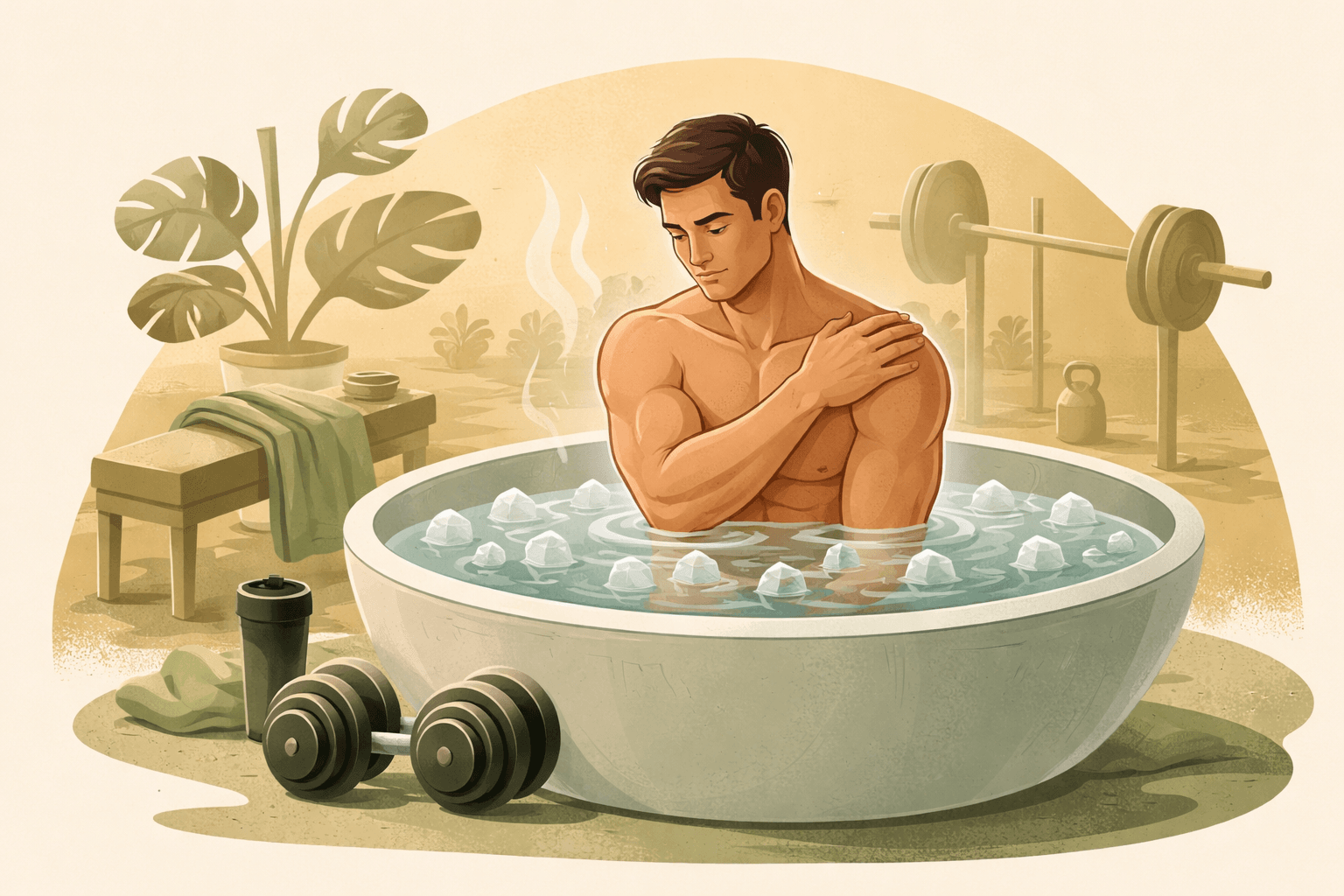
Cold plunges and ice baths have exploded in popularity, boosted by high-profile voices like the Huberman Lab podcast and social media challenges. Many athletes report less soreness and faster “readiness” after cold exposure. But if your priority is building muscle and strength, research suggests timing matters: jumping into the cold right after lifting may dampen the very signals your body uses to grow. (emerging-to-moderate evidence)
This article focuses on the narrow question: does post-resistance-training cold exposure interfere with hypertrophy and strength gains?
The adaptation puzzle: inflammation, blood flow, and signaling
Resistance training creates microdamage and metabolic stress. Those stressors trigger inflammatory signaling, satellite cell activity, and anabolic pathways like mTOR/p70S6K—core steps toward bigger, stronger muscle. Cold exposure, by design, reduces tissue temperature, blood flow, and some inflammatory mediators. That may feel good, but blunting the acute stress response right after lifting could reduce the downstream adaptations you train for. (moderate evidence)
- Research suggests cold water immersion (CWI) immediately post-lift reduces markers of anabolic signaling (e.g., mTOR/p70S6K phosphorylation) and satellite cell activity compared with active recovery. (moderate evidence; Peake JM et al., Journal of Physiology, 2017; Roberts LA et al., Journal of Physiology, 2015)
What long-term studies show
A 12-week randomized trial found that men who performed resistance training followed by CWI achieved smaller increases in muscle mass and strength than those who did the same training with active recovery. Molecular analyses indicated suppressed satellite cell activity and reduced activation of anabolic signaling pathways in the CWI group. (moderate evidence; Roberts LA et al., Journal of Physiology, 2015)
Narrative and systematic reviews converge: while CWI may reduce soreness and perceived fatigue, it may also interfere with muscle hypertrophy when used immediately after resistance training across weeks to months. (moderate evidence; Ihsan M et al., Sports Medicine, 2016; Fyfe JJ et al., Sports Medicine, 2019)
These effects appear most relevant to hypertrophy-focused programs. They do not necessarily generalize to endurance adaptations or mixed-sport schedules, although some data also suggest local cooling can blunt angiogenesis and endurance-related muscle remodeling when applied right after training. (emerging-to-moderate evidence; Yamane M et al., Journal of Applied Physiology, 2015)
What about soreness and short-term performance?
If your goal is to feel less sore for a quick turnaround between sessions, cold exposure may help with perceived recovery.
- Meta-analyses report small-to-moderate reductions in delayed-onset muscle soreness (DOMS) and perceived fatigue in the 24–96 hours after fatiguing exercise with CWI versus passive recovery. Effects on actual performance measures (e.g., strength, jump height) are inconsistent or small. (moderate evidence; Leeder JD et al., British Journal of Sports Medicine, 2012; Hohenauer E et al., Sports Medicine, 2015)
In practical terms, for athletes facing dense competition schedules or back-to-back practices, the acute perceptual benefits may outweigh any small risk to longer-term adaptations. For lifters prioritizing size and strength, the trade-off may not be desirable. (moderate evidence)
Mechanistic notes: cold shock proteins and brown fat
Cold shock proteins: Proteins such as RBM3 and CIRP rise with cooling and have been linked to cellular protection and neuroplasticity. Whether these proteins meaningfully support—or hinder—skeletal muscle growth in humans is not established. (emerging evidence; Peretti D et al., Nature, 2015; Cai Z et al., International Journal of Molecular Sciences, 2020)
Brown adipose tissue (BAT): Cold can activate BAT and non-shivering thermogenesis, modestly increasing energy expenditure and insulin sensitivity. This is interesting for metabolism but not directly tied to hypertrophy outcomes after lifting. (moderate evidence for BAT activation; Cypess AM et al., New England Journal of Medicine, 2009; Hanssen MJW et al., Diabetes, 2015)
Contrast therapy vs. ice baths alone
Alternating hot and cold (contrast water therapy) is a popular alternative. Reviews suggest contrast therapy may provide similar or slightly better short-term relief of soreness and perceived fatigue than cold alone, with limited evidence for changes in objective performance. Long-term effects on hypertrophy remain unclear. (moderate evidence for short-term recovery; Bieuzen F et al., Scandinavian Journal of Medicine & Science in Sports, 2013; Hohenauer E et al., Sports Medicine, 2015)
When cold may blunt training adaptations most
Immediately after resistance training: The bulk of blunting data comes from studies applying CWI within a short window after lifting, where reduced muscle temperature and blood flow coincide with peak anabolic signaling. (moderate evidence; Roberts LA et al., 2015; Peake JM et al., 2017)
High-frequency use during hypertrophy blocks: Repeated post-lift cooling across weeks is the context where smaller gains in size/strength have been observed. (moderate evidence)
Local cooling of the trained limb: Limb-specific cooling appears particularly likely to affect local vascular and remodeling responses. (emerging-to-moderate evidence; Yamane M et al., 2015)
Research has not firmly established whether separating cold exposure from training by many hours—or using it on rest days—avoids these effects, but experts hypothesize that greater separation reduces interference with anabolic signaling. (emerging evidence)
Eastern and traditional perspectives
Nordic cultures have long cycled between hot saunas and cold dips as a resilience ritual, emphasizing mood, alertness, and social wellbeing rather than hypertrophy. In parallel, breathwork-focused approaches such as the Wim Hof Method draw from meditative traditions; controlled studies show practitioners can voluntarily activate the sympathetic nervous system and attenuate inflammatory responses during experimental immune challenges. These effects may influence perceived recovery and stress resilience but do not directly translate to greater muscle growth after lifting. (emerging-to-moderate evidence; Kox M et al., Proceedings of the National Academy of Sciences, 2014)
Practical takeaways for lifters
If maximizing muscle size and strength is your top priority, research suggests avoiding immediate post-lift cold exposure may help preserve anabolic signaling and long-term gains. (moderate evidence)
If you need to feel better fast for the next session—tournaments, congested fixtures, or heavy training camps—cold exposure may reduce soreness and perceived fatigue, with mixed effects on objective performance. (moderate evidence)
Contrast therapy may offer similar short-term perceptual benefits to ice baths, with no clear long-term advantage for hypertrophy. (moderate evidence)
Whole-body metabolic effects of cold (e.g., BAT activation) and cold shock proteins are scientifically interesting but not proven levers for building more muscle after lifting. (emerging evidence)
This article is informational and not a substitute for medical guidance. It does not include protocol specifics.
Bottom line
Cold exposure has real, measurable effects on recovery sensations—especially soreness—and it is a useful tool for athletes who must perform again soon. However, when used immediately after strength training and repeated across a hypertrophy block, research suggests it may blunt muscle-building signals and reduce long-term gains. If muscle growth is your primary goal, consider preserving the post-workout window for warmth, fueling, and rest; reserve cold exposure for other times when rapid turnaround or perceived recovery is paramount. (overall: moderate evidence)