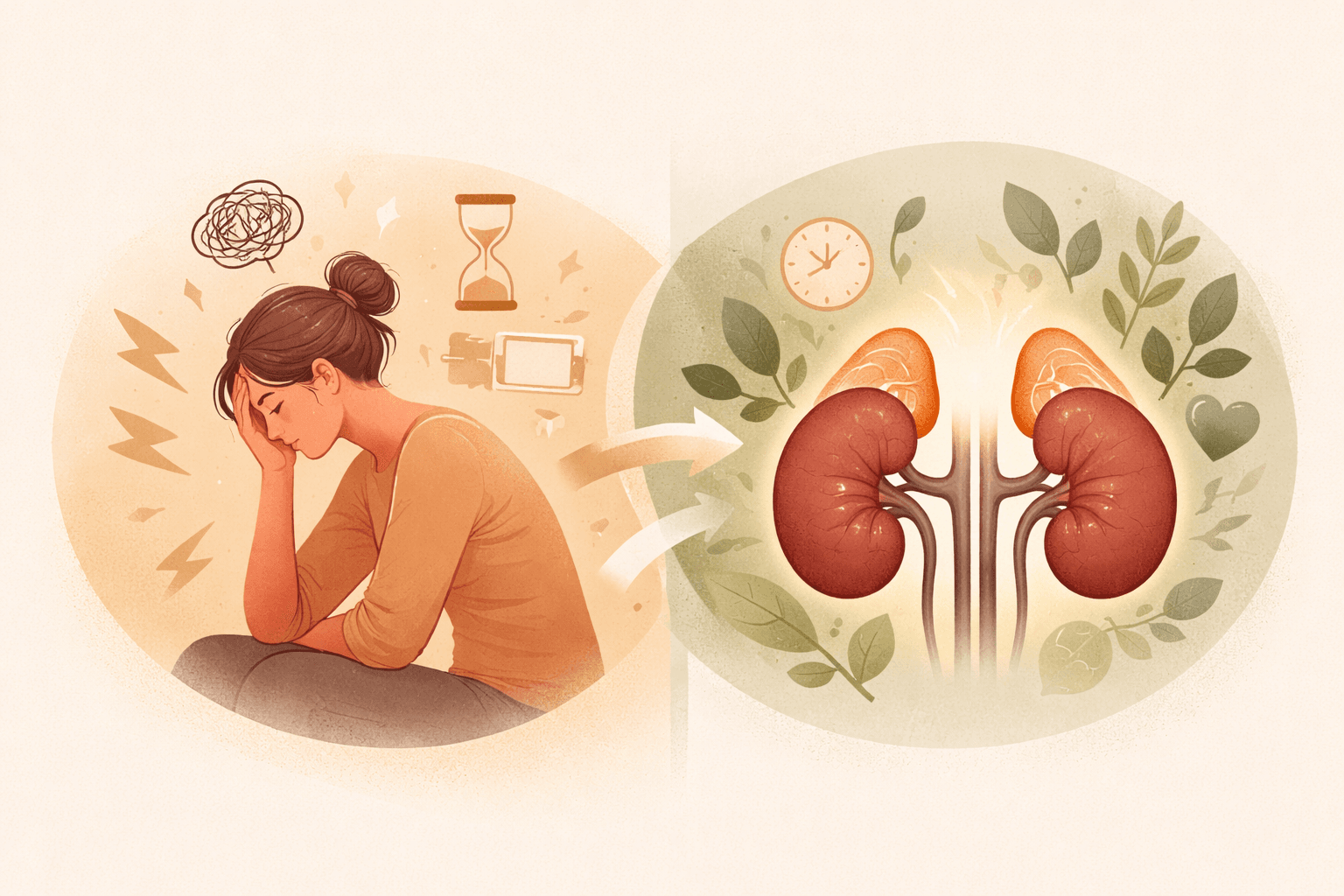
Burnout vs “Adrenal Fatigue”: What Cortisol Patterns Really Show
Burnout is often described as feeling “fried,” “flat,” or running on fumes. Online, that experience is frequently labeled “adrenal fatigue.” Endocrinology societies do not recognize adrenal fatigue as a diagnosis, yet the symptoms people describe are real. Research suggests many cases reflect changes in the brain–body stress system—the hypothalamic–pituitary–adrenal (HPA) axis—rather than the adrenal glands wearing out. This article focuses on what cortisol patterns reveal in burnout, the controversy around “adrenal fatigue,” and what evidence says about adaptogens like ashwagandha and rhodiola.
HPA Axis 101: Why Cortisol Matters
- The HPA axis links the brain and adrenal glands to regulate the stress response. Cortisol is its key hormone, helping mobilize energy, modulate inflammation, and shape attention and mood. (Evidence: strong; endocrine physiology texts and consensus)
- Cortisol follows a diurnal rhythm: a sharp rise 30–45 minutes after waking (the cortisol awakening response, CAR) and a gradual decline toward midnight. A healthy pattern shows a high morning peak and low evening levels. (Evidence: strong; numerous population studies and endocrine guidelines)
- Under chronic stress, the HPA axis may adapt by changing sensitivity and feedback signaling. This can manifest as either elevated or blunted cortisol output depending on the person, stress duration, and context. (Evidence: strong to moderate; meta-analyses across stress-related conditions)
What Studies Show in Burnout: Blunted, Flattened, Not “Empty”
Research in occupational health and psychoneuroendocrinology has examined cortisol in people meeting burnout criteria.
- Flattened daily slope: Compared with controls, individuals with burnout often show a flatter diurnal cortisol curve—lower-than-expected morning levels and/or relatively higher evening levels. (Evidence: moderate; systematic reviews and cohort studies report small-to-moderate effects with heterogeneity)
- Reduced CAR in some, elevated in others: Several studies report a reduced cortisol awakening response in burnout, consistent with a “blunted” HPA profile; a minority show an exaggerated CAR, possibly reflecting earlier stages or distinct subtypes. (Evidence: moderate; mixed findings but overall trend toward blunting with chronicity)
- Hypocortisolism as an adaptation: Meta-analytic work on chronic stress suggests long-term exposure may shift the axis toward lower basal cortisol—an allostatic “downregulation” rather than gland failure. (Evidence: moderate; influential reviews describe hypocortisolism across PTSD, chronic fatigue, and some burnout samples)
Importantly, these patterns differ from adrenal insufficiency (Addison’s disease), a serious condition with low cortisol due to glandular failure that requires urgent medical care. In burnout, adrenal glands still produce cortisol; the issue is dysregulation of timing and feedback rather than exhaustion of the organ. (Evidence: strong; endocrine diagnostic criteria)
The “Adrenal Fatigue” Controversy
- Not a recognized diagnosis: A 2016 systematic review in BMC Endocrine Disorders concluded that “adrenal fatigue” lacks scientific basis—studies do not consistently show adrenal underperformance in people labeled with the term. (Evidence: strong; systematic review conclusion)
- Symptoms are real, labels matter: Fatigue, brain fog, sleep disruption, and mood changes are well-documented in burnout and chronic stress. The mismatch lies in the mechanism: research points to HPA axis signaling changes and broader allostatic load (cardiometabolic, immune, and neural adaptations), not worn-out adrenals. (Evidence: strong for symptom burden; moderate for mechanistic specificity)
Adaptogens and Burnout: What the Evidence Says
Traditional “adaptogens” are herbs historically used to improve stress resilience. Modern research tests whether they may modulate HPA activity and subjective stress. Evidence is growing but still limited by small trials and variable quality.
Ashwagandha (Withania somnifera)
- Cortisol and perceived stress: Randomized, placebo-controlled trials in adults with chronic stress report that standardized ashwagandha extracts reduce perceived stress scores and are associated with modest reductions in morning or serum cortisol compared with placebo. (Evidence: moderate; multiple small RCTs with consistent direction of effect)
- Sleep and well-being: Some trials note improvements in self-reported sleep quality and well-being, outcomes relevant to burnout recovery. (Evidence: moderate; secondary outcomes in RCTs)
- Safety and limitations: Studies are typically short (6–12 weeks), involve otherwise healthy adults with stress, and vary in extract standardization. While generally well-tolerated in trials, individual responses vary, and long-term data remain limited. (Evidence: moderate for short-term tolerability; emerging for long-term outcomes)
Rhodiola (Rhodiola rosea)
- Fatigue and stress symptoms: RCTs in individuals with stress-related fatigue or mild burnout symptoms suggest that rhodiola may improve fatigue, energy, and mental performance relative to placebo. (Evidence: moderate; several small RCTs show benefit but with heterogeneity)
- Mechanisms: Preclinical and human data propose effects on monoaminergic signaling and HPA modulation, potentially supporting attention and perceived energy under stress. (Evidence: emerging; mechanistic data from lab and small human studies)
- Evidence caveats: Many trials have small samples, short durations, and variable preparations, which complicates dose–response conclusions and generalizability. (Evidence: moderate for symptom improvement; emerging for definitive clinical endpoints)
Bridging Traditional Perspectives: Qi, Ojas, and Allostasis
Traditional Chinese Medicine (TCM) and Ayurveda describe states akin to burnout using different frameworks.
- TCM: “Qi deficiency” and especially “Kidney qi/yang deficiency” are traditional patterns associated with low vitality, weakness, and impaired stress tolerance. (Evidence: traditional; based on classical texts and clinical pattern diagnosis)
- Ayurveda: “Vata aggravation” and depletion of “ojas” (vital essence) are thought to underlie fatigue, sleep disturbance, and mental restlessness after prolonged stress. (Evidence: traditional)
These models emphasize restoring balance, building foundational energy, and pacing activity—concepts that parallel modern notions of allostasis, or the body’s adaptive recalibration under persistent demand. In contemporary research terms, the goal is supporting healthier HPA timing, reducing overall allostatic load, and improving sleep and autonomic balance. (Evidence: conceptual bridge; traditional plus emerging biomedical frameworks)
What Cortisol Testing Can—and Can’t—Tell You
- Diurnal profiles vs single snapshots: Because timing matters, multiple measurements across the day (e.g., waking, 30–45 minutes after waking, afternoon, evening) are more informative than a single cortisol value. (Evidence: strong; standard in psychoneuroendocrine research)
- Interpretation needs context: Stress history, sleep, shift work, medications, and inflammatory states all influence cortisol. Research-grade protocols are rigorous; consumer tests vary in quality and clinical relevance. (Evidence: strong for confounders; moderate regarding consumer testing validity)
Bottom Line
- Burnout is linked to HPA axis dysregulation—often a flatter daily cortisol curve and, in some, a reduced cortisol awakening response—rather than literal “adrenal exhaustion.” (Evidence: moderate)
- “Adrenal fatigue” is not a recognized medical diagnosis; a 2016 systematic review found no consistent evidence of adrenal underperformance in such cases. (Evidence: strong)
- Adaptogens like ashwagandha and rhodiola may help with perceived stress and fatigue, and ashwagandha has been associated with modest cortisol reductions in small RCTs. Findings are promising but not definitive. (Evidence: moderate)
- Traditional TCM and Ayurvedic concepts (qi deficiency, Kidney deficiency; vata aggravation, ojas depletion) echo the modern idea of allostatic overload and the need to restore balance. (Evidence: traditional)
- Because many factors influence cortisol, research emphasizes patterns over single numbers and careful interpretation within the broader picture of sleep, mood, and lifestyle. (Evidence: strong)
References (selected)
- Cadegiani FA, Kater CE. Adrenal fatigue does not exist: a systematic review. BMC Endocrine Disorders, 2016. (Systematic review)
- Fries E, Hesse J, Hellhammer J, Hellhammer DH. A new view on hypocortisolism in stress-related disorders. Psychoneuroendocrinology, 2005. (Narrative review proposing hypocortisolism model)
- Miller GE, Chen E, Zhou ES. If it goes up, must it come down? Chronic stress and the hypothalamic–pituitary–adrenocortical axis in humans. Psychological Bulletin, 2007. (Meta-analytic review)
- Randomized, placebo-controlled trials of ashwagandha for stress and cortisol reduction (e.g., Indian Journal of Psychological Medicine, 2012) and subsequent systematic reviews report modest benefits with short-term use. (RCTs and systematic reviews)
- Trials and reviews of Rhodiola rosea for stress-related fatigue and performance indicate potential benefit with methodological limitations. (RCTs; narrative and systematic reviews)