Overview
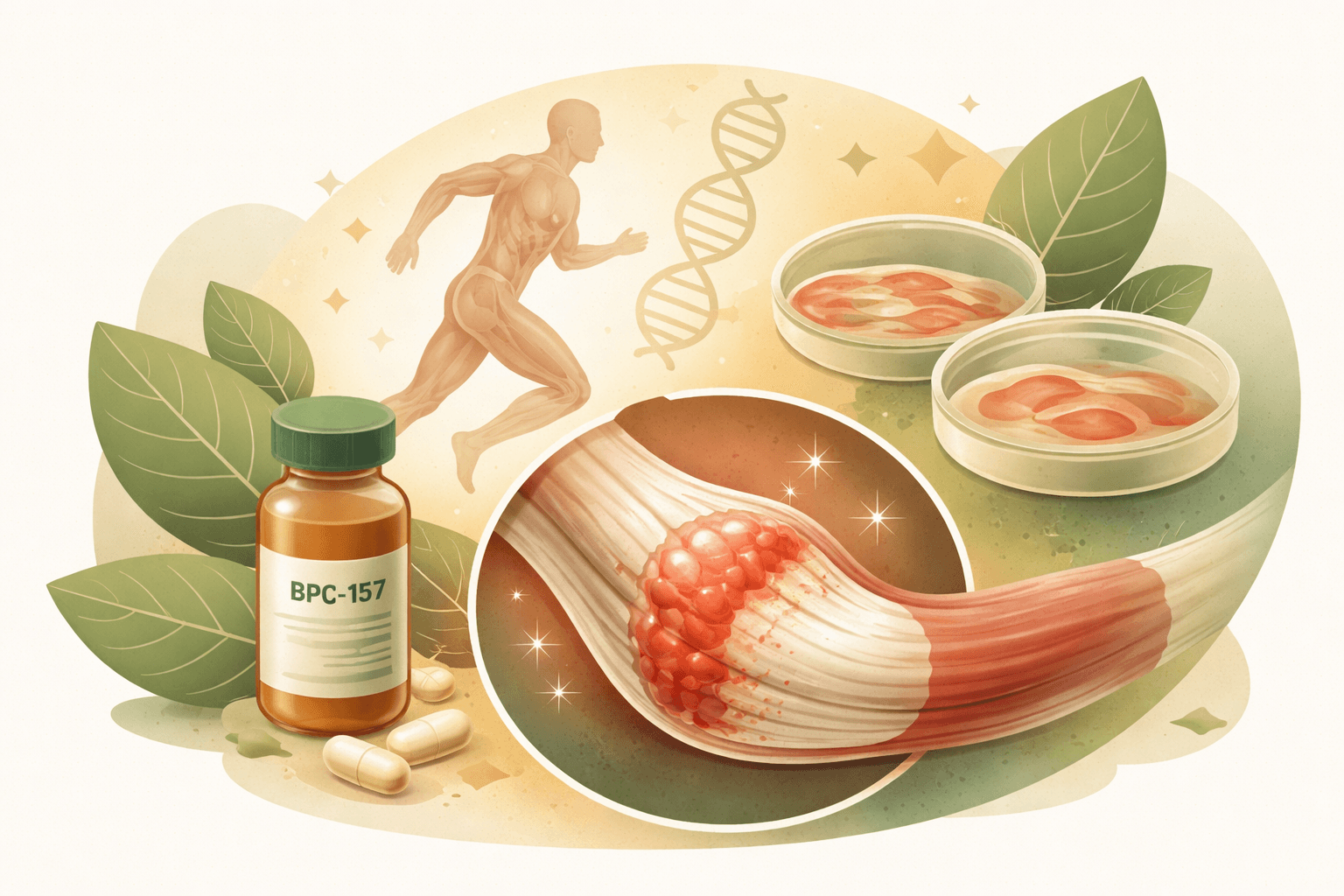
BPC-157 (Body Protection Compound-157) is a synthetic 15–amino acid peptide originally isolated from research into protective factors found in gastric juice. Interest in BPC-157 surged because animal experiments suggest it may support tissue repair across tendons, ligaments, and muscle, potentially by promoting angiogenesis (new blood vessel formation), modulating inflammation, and encouraging collagen organization. However, well-controlled human trials for sports-related injuries are lacking, and regulatory agencies have not approved BPC-157 for medical use. [Evidence level: Emerging]
What Is BPC-157?
• Origin: BPC-157 was derived during studies investigating cytoprotective components of gastric juice and their role in maintaining gut lining integrity. [Evidence level: Emerging]
• Structure and stability: It is a pentadecapeptide designed to be stable in gastric environments, a property often cited to explain oral bioactivity observed in animals. [Evidence level: Emerging]
How Might It Work? Proposed Mechanisms in Repair
Research suggests several overlapping mechanisms may contribute to the repair effects observed in animal models:
• Angiogenesis and blood flow: BPC-157 appears to upregulate pathways involved in angiogenesis (e.g., VEGF/VEGFR2 signaling) and nitric oxide (NO) activity, which may improve local blood supply to injured tissues. Increased perfusion is a known prerequisite for tendon and ligament healing. [Evidence level: Emerging]
• Fibroblast migration and collagen remodeling: Preclinical studies report enhanced fibroblast outgrowth and improved collagen fiber organization at injury sites, which may translate to stronger repair tissue in animals. [Evidence level: Emerging]
• Anti-inflammatory modulation: Animal data indicate downregulation of pro-inflammatory signals (e.g., NF-κB–related pathways) and reduction in edema at injury sites, potentially shortening the inflammatory phase of healing. [Evidence level: Emerging]
• Cytoprotective and GI-linked effects: Because it originated from gastric cytoprotective research, BPC-157 has been studied extensively for mucosal protection and counteracting NSAID-induced GI injury in animals—properties that may indirectly support recovery when inflammation and analgesics are part of the injury context. [Evidence level: Emerging]
What Animal Studies Show for Tendon, Ligament, and Muscle
Across numerous rodent and some rabbit models, randomized preclinical experiments have explored BPC-157’s effects on musculoskeletal repair:
• Tendon healing: Studies in rat Achilles or quadriceps tendon injuries report accelerated functional recovery, earlier granulation tissue formation, and stronger biomechanical properties (e.g., load-to-failure) compared with controls. Some experiments also describe improved tendon-to-bone integration. [Evidence level: Emerging]
• Ligament repair: In rodent medial collateral ligament (MCL) or anterior cruciate ligament (ACL) injury models, research suggests faster restoration of ligament continuity and mechanical strength, with histological signs of more organized collagen bundles. [Evidence level: Emerging]
• Muscle injury: Crush or transection models in rats have shown reduced necrosis, less edema, and enhanced muscle regeneration markers in BPC-157–treated groups, alongside earlier return of contractile function. [Evidence level: Emerging]
• Nerve and bone adjunct findings: While outside the tendon/ligament focus, several animal studies report ancillary benefits to peripheral nerve or bone healing, often attributed to improved microcirculation and cellular signaling—mechanisms that could also be relevant to soft-tissue repair. [Evidence level: Emerging]
Importantly, these findings derive from controlled animal experiments conducted largely by a handful of academic groups. While the consistency across models is noteworthy, translation to human clinical outcomes remains unproven. No large, peer-reviewed human randomized controlled trials (RCTs) have established efficacy for tendon, ligament, or muscle injury as of this writing. [Evidence level: Emerging]
Clinical Trial Status and Regulatory Context
• Human trials: Human evidence is sparse. Historical reports and small early-phase investigations linked a BPC-157–related candidate with gastrointestinal indications, but robust, peer-reviewed human RCTs for musculoskeletal repair are not available. Registries show limited or no active late-phase trials for sports injuries as of 2026. [Evidence level: Emerging]
• Approval status: BPC-157 is not approved by the U.S. FDA or most regulatory agencies for any medical indication. It is often marketed online as a “research chemical,” raising quality and purity concerns. [Evidence level: Strong for regulatory status]
• Sport and anti-doping: The World Anti-Doping Agency (WADA) lists BPC-157 as prohibited under the category of non-approved substances. Athletes subject to anti-doping rules risk sanctions for its use. [Evidence level: Strong]
Safety Profile: What We Know—and Don’t
• Preclinical safety: Animal studies commonly report low acute toxicity and a broad margin of safety across tested doses, with no clear organ toxicity in standard models. [Evidence level: Emerging]
• Theoretical risks: Because BPC-157 appears pro-angiogenic in some settings, theoretical concerns include unwanted vessel growth in pathological contexts. The net effect on tumor biology in humans is unknown; some preclinical data are conflicting and not definitive. [Evidence level: Emerging]
• Anecdotal adverse events: Human case reports outside controlled research have described headaches, dizziness, palpitations, flushing, and injection-site reactions. Without controlled trials, incidence, causality, and long-term effects are unclear. [Evidence level: Emerging]
• Product quality: Unregulated sourcing creates risks of contamination, mislabeling, and variable peptide integrity. This is a practical safety concern independent of the compound’s intrinsic toxicology. [Evidence level: Strong]
Why Athletes Are Interested
• Potential for faster return-to-play: The animal literature suggests earlier restoration of mechanical strength and tissue organization after tendon, ligament, or muscle injury. For competitive athletes, even small time savings are meaningful. [Evidence level: Emerging]
• Multi-pathway action: By potentially promoting angiogenesis, modulating inflammation, and supporting collagen remodeling, BPC-157 touches several bottlenecks in musculoskeletal healing. [Evidence level: Emerging]
• Oral stability claims: Preclinical work indicates oral activity in animals, which is unusual among peptides and increases practical interest. [Evidence level: Emerging]
Bridging Western Research and Traditional Perspectives
The origins of BPC-157 in gastric cytoprotection echo traditional healing systems that emphasize gut integrity as foundational for whole-body resilience. In Traditional Chinese Medicine, for example, the spleen–stomach axis is considered central to recovery and tissue nourishment; in various folk traditions, broths and mucosa-soothing preparations are used to “strengthen from within.” While these frameworks differ from molecular biology, both point to the gut as a regulator of systemic repair capacity. Modern peptide research into gastric-derived compounds like BPC-157 reflects a scientific exploration of that intuition. [Evidence level: Traditional for the perspective; Emerging for mechanistic links]
Key Gaps in the Evidence
• Lack of human RCTs for musculoskeletal injury: No high-quality trials definitively show benefit for tendon or ligament healing in people. [Evidence level: Strong]
• Dosing, duration, and formulation unknowns: Optimal protocols for humans remain speculative without clinical data. [Evidence level: Strong]
• Long-term safety: Data beyond short-term animal studies are lacking; effects on angiogenesis in chronic conditions remain uncertain. [Evidence level: Strong]
Practical Considerations and Cautions
• Regulatory and anti-doping: BPC-157 is a prohibited, non-approved substance. Athletes in tested sports face disqualification and sanctions for use. [Evidence level: Strong]
• Quality control: Products sold online may not contain the labeled compound or concentration, posing safety and efficacy risks. [Evidence level: Strong]
• Medical guidance: Given the absence of approved indications and limited human data, professional medical supervision and adherence to local regulations are essential for any discussion about experimental therapies. This article does not provide medical advice or dosing guidance.
Bottom Line
• What the science suggests: In animals, BPC-157 consistently accelerates healing markers in tendon, ligament, and muscle models and appears to act through pro-angiogenic, anti-inflammatory, and collagen-organizing pathways. [Evidence level: Emerging]
• What we still need: Well-designed human RCTs to confirm whether these effects translate to meaningful clinical benefits, determine appropriate regimens, and clarify long-term safety. [Evidence level: Strong]
• For athletes: Interest is high due to promising animal data and practical considerations, but BPC-157 is prohibited by WADA and not approved for medical use. Quality, legality, and unknown risks are major barriers. [Evidence level: Strong]
• Traditional lens: The peptide’s gastric origin aligns with long-standing healing traditions that prioritize gut integrity as a foundation for recovery, even as modern research works to validate specific mechanisms. [Evidence level: Traditional/Emerging]