Overview
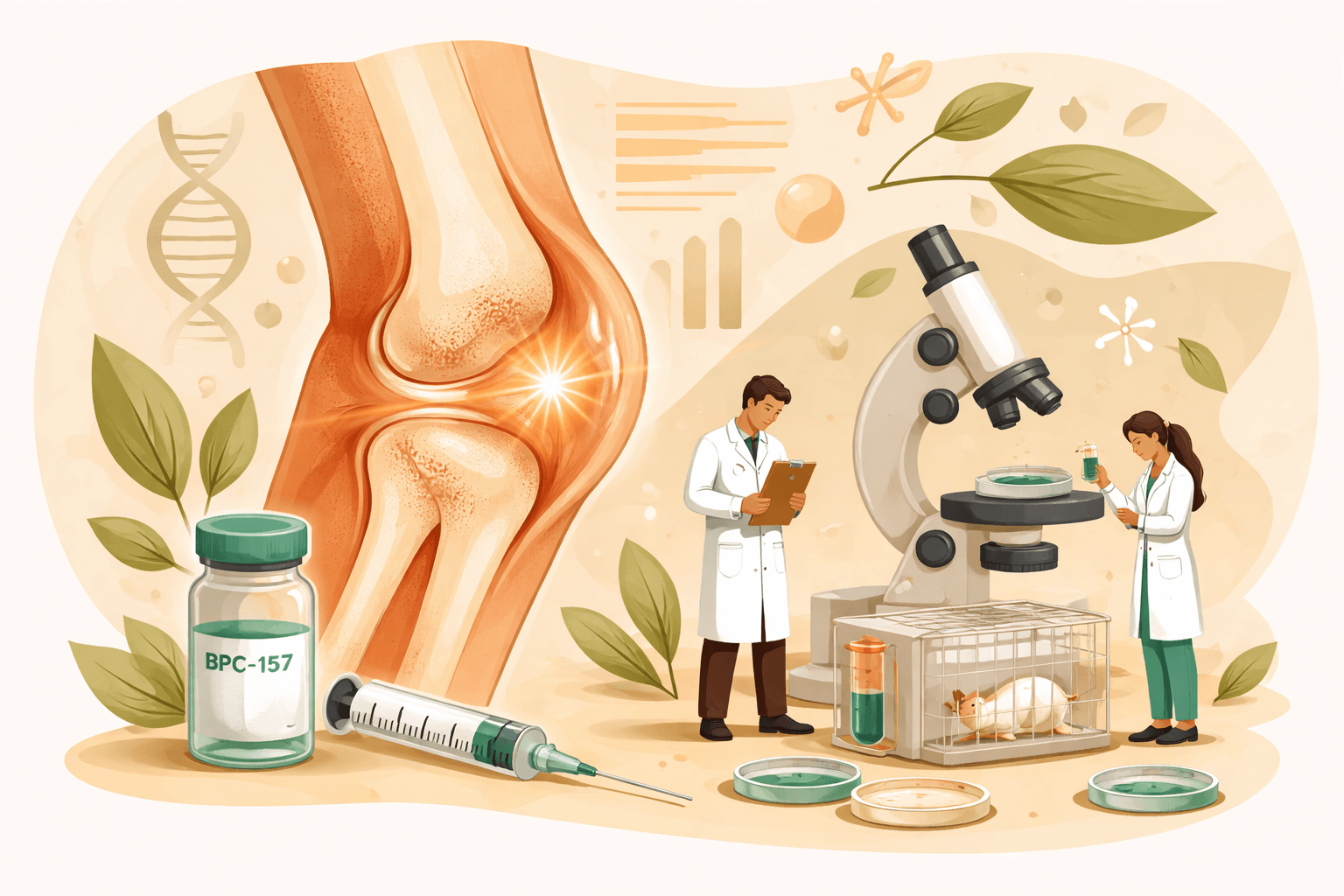
BPC-157 (Body Protection Compound-157) is a synthetic 15–amino acid peptide originally derived from a larger protein found in gastric juice. Interest in the peptide surged because preclinical studies suggest it may accelerate healing in soft tissues, including tendons and ligaments—areas notoriously slow to recover after injury. Yet despite wide discussion in athletic and rehabilitation circles, human clinical data remain sparse, and major regulators have not approved it for medical use.
This focused review examines what animal research suggests about BPC-157 for tendon and ligament repair, outlines proposed mechanisms (such as angiogenesis and extracellular matrix remodeling), summarizes current clinical-trial and regulatory status, and highlights safety considerations. The goal is to clarify where the evidence stands—and where the gaps remain.
What Is BPC-157 and Why the Tendon/Ligament Focus?
- Origin: BPC-157 was developed after researchers studied protective factors in gastric juice that help the stomach lining tolerate constant chemical and mechanical stress. BPC-157 is a stable fragment synthesized from that larger protein and has been investigated for tissue-protective effects in multiple organ systems. (Evidence level: emerging)
- Tendon/ligament relevance: Tendons and ligaments heal slowly due to limited blood supply and complex extracellular matrix (ECM) architecture. Any intervention that may improve angiogenesis (new blood vessel formation), reduce excessive inflammation, and support collagen organization attracts attention for potential recovery benefits. (Evidence level: strong, general tendon biology)
How Might BPC-157 Influence Repair?
Preclinical mechanistic studies propose several pathways by which BPC-157 may aid tendon and ligament healing. These findings are primarily in cell culture and animal models and should be viewed as hypothesis-generating for human research.
- Angiogenesis and microcirculation: Research suggests BPC-157 may upregulate pro-angiogenic signaling and improve blood flow to injured tissues, potentially supporting nutrient delivery and waste removal during repair. Some rodent studies report increased vessel density and faster granulation tissue formation around injured tendons or ligaments when BPC-157 is administered. (Evidence level: emerging)
- Fibroblast migration and ECM remodeling: Tendon healing requires fibroblasts to migrate, proliferate, and lay down organized collagen. In vitro and animal models indicate BPC-157 may enhance tendon fibroblast outgrowth and influence focal adhesion/ECM pathways (e.g., FAK–paxillin signaling), which could translate into improved collagen alignment and mechanical strength. (Evidence level: emerging)
- Nitric oxide (NO) system modulation: The NO pathway is implicated in vascular tone, inflammation, and tissue repair. Some preclinical work suggests BPC-157 interacts with NO signaling, which could help balance inflammation and perfusion in the healing milieu. (Evidence level: emerging)
What Do Animal Studies Show for Tendon and Ligament Healing?
A body of preclinical research—largely in rodents—reports beneficial effects of BPC-157 on tendon and ligament injury models. Typical findings include faster histological repair, improved biomechanical properties, and reduced swelling or pain-like behaviors. Examples include:
- Achilles tendon transection or detachment models: Studies commonly report more rapid collagen organization, increased angiogenesis at the repair site, and better ultimate load-to-failure compared with control animals. (Evidence level: emerging)
- Medial collateral ligament (MCL) injury: Some rodent models show quicker structural remodeling and earlier return of tensile strength. (Evidence level: emerging)
- Tendon–bone interface healing: In models where tendon is reattached to bone, BPC-157 has been associated with improved fibrocartilage formation and interface integrity. (Evidence level: emerging)
Important caveats:
- Species and model limitations: Rodent healing kinetics differ from humans, and controlled surgical injuries may not fully mirror real-world sports injuries. (Evidence level: strong)
- Research concentration: Many papers originate from a limited number of research groups, which increases the importance of independent replication. (Evidence level: moderate)
- Variable administration: Routes (e.g., local vs. systemic), timing, and formulations vary widely across studies, complicating translation to clinical protocols. (Evidence level: strong)
Clinical Trials and Regulatory Status
- Human evidence: As of this writing, no randomized controlled trials evaluating BPC-157 for tendon or ligament injuries have been published in peer-reviewed journals. Some clinical trial registrations exist in other indications, but musculoskeletal outcomes lack robust, publicly available human data. (Evidence level: strong regarding the evidence gap)
- Regulatory approval: BPC-157 is not an FDA- or EMA-approved drug, and it is not approved for human use by most national regulatory authorities. It is considered an unapproved substance in many jurisdictions. (Evidence level: strong)
- Anti-doping considerations: The World Anti-Doping Agency (WADA) lists BPC-157 as a prohibited substance. Athletes subject to doping control who use BPC-157 risk anti-doping violations. (Evidence level: strong)
Safety Profile: What’s Known and Unknown
- Preclinical safety: Animal studies generally report favorable tolerability at experimental doses; however, toxicology programs designed for human drug approval (covering genotoxicity, reproductive toxicity, long-term carcinogenicity, etc.) have not been comprehensively published. (Evidence level: emerging)
- Human safety: Without controlled clinical trials, human safety signals—both short- and long-term—remain largely unknown. Potential issues include product quality (contamination, incorrect identity or purity), immunogenic reactions, and unanticipated off-target effects. Several national regulators have issued warnings about unapproved peptides sold online. (Evidence level: strong regarding regulatory warnings; emerging for specific human risk profiles)
- Practical risk: In many markets, BPC-157 products are sourced outside regulated pharmaceutical channels, increasing variability in potency and purity. For athletes, in addition to anti-doping risks, product adulteration may add safety concerns. (Evidence level: strong)
Why Are Athletes Interested?
- Recovery bottlenecks: Tendon and ligament injuries can sideline training for months. Preclinical data suggesting faster collagen organization and angiogenesis are appealing because they address rate-limiting steps in recovery. (Evidence level: emerging)
- Broader tissue effects: Beyond tendons, animal models describe benefits in muscle, nerve, and bone interfaces, reinforcing a perception of “global” tissue support. However, these findings need rigorous human testing. (Evidence level: emerging)
- Performance-recovery context: If recovery windows shorten, athletes can theoretically return to sport sooner. Without human RCTs, though, these remain promising hypotheses rather than established outcomes. (Evidence level: strong regarding the evidence gap)
Bridging Western Research and Traditional Perspectives
- Western viewpoint: The core rationale centers on angiogenesis, modulation of inflammation, and ECM remodeling—processes well-characterized in tendon biology and wound healing. (Evidence level: strong for biological plausibility)
- Eastern/traditional lens: Traditional medicine systems often emphasize restoring circulation and “nourishing” connective tissues to facilitate healing. While BPC-157 is not part of traditional pharmacopeias, its proposed actions—supporting blood flow and tissue integrity—align conceptually with these goals. Such parallels can inspire integrative hypotheses but still require modern clinical trials for validation. (Evidence level: traditional for conceptual alignment; emerging for empirical support)
How to Interpret the Current Evidence
- What looks promising: Consistent signals across multiple animal models—faster histological healing, stronger biomechanical properties, and pro-angiogenic effects—suggest BPC-157 may help tendon and ligament repair. (Evidence level: emerging)
- What holds us back: A lack of independent replication, absence of human RCTs, and unclear dosing/regimen parameters leave major translation gaps. (Evidence level: strong)
- What to watch next: High-quality, placebo-controlled human trials evaluating functional outcomes (pain, strength, time to return-to-play), imaging (ultrasound/MRI), and safety endpoints will be crucial. (Evidence level: strong)
Bottom Line
- BPC-157 is a lab-synthesized peptide derived from gastric-juice research that may promote tendon and ligament healing in animal models, potentially via angiogenesis, ECM remodeling, and NO pathway modulation. (Evidence level: emerging)
- Despite growing interest from athletes and clinicians, there are currently no robust human trials demonstrating efficacy for tendon or ligament injuries. (Evidence level: strong)
- Safety in humans remains uncertain, and BPC-157 is not approved by major regulators; it is prohibited by WADA. (Evidence level: strong)
- Until well-designed human studies are published, BPC-157 should be considered an experimental approach with promising preclinical biology but unproven clinical benefit for tendon/ligament repair. (Evidence level: strong)
References and Resources