Ashwagandha, Cortisol, and Burnout: An Evidence Brief
A focused evidence brief on ashwagandha, cortisol, and burnout—what research suggests about HPA axis dysregulation and how traditional and modern views align.
·7 min read
This content is for informational purposes only and does not constitute medical advice. Always consult a qualified healthcare provider before starting, stopping, or changing any supplement or medication regimen.
Introduction
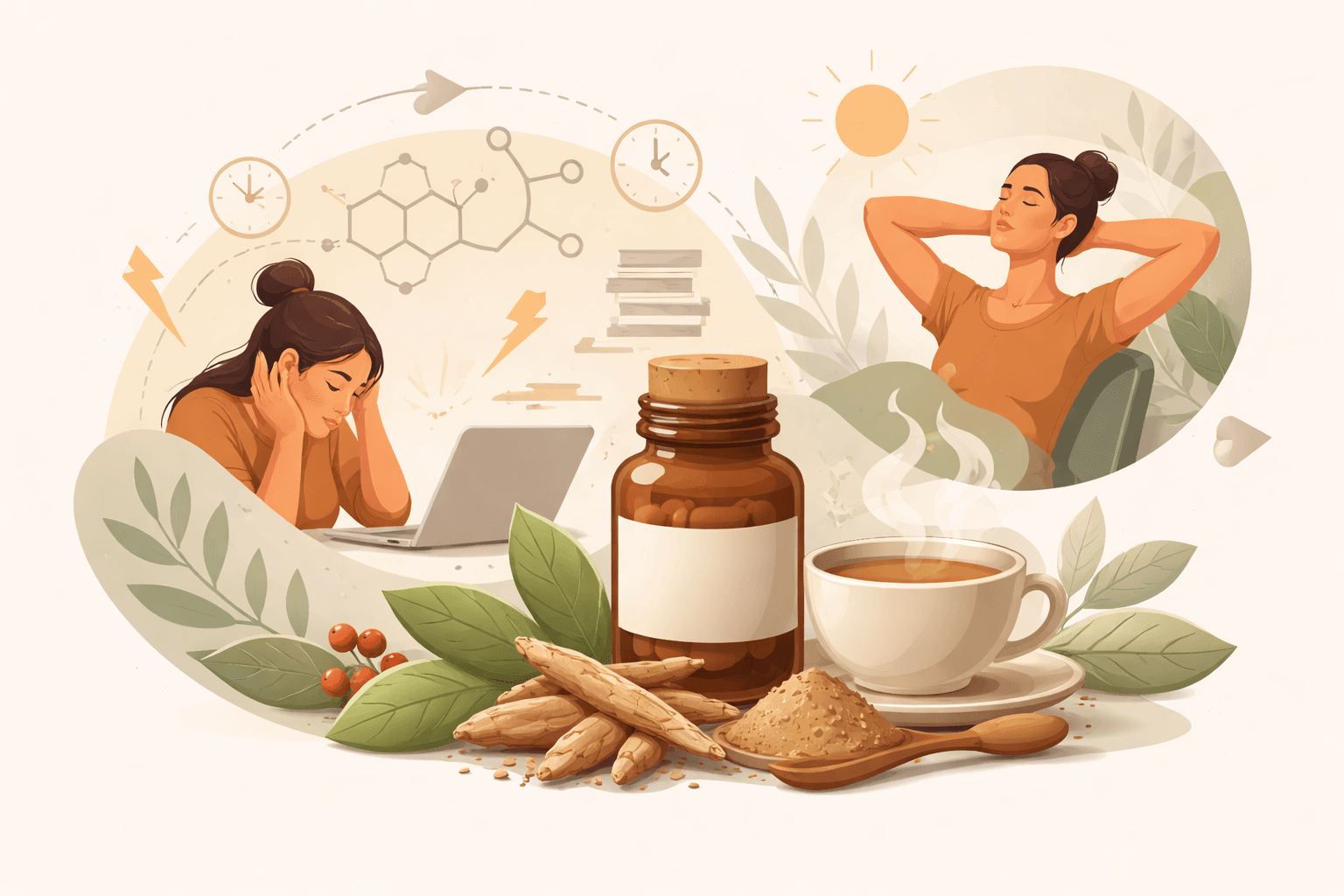
Burnout is more than feeling tired—it reflects a chronic stress load that may alter how the brain and body regulate stress hormones. Research suggests that burnout is associated with changes in the hypothalamic–pituitary–adrenal (HPA) axis and with atypical daily cortisol patterns, such as a flattened morning-to-evening curve. At the same time, the popular term “adrenal fatigue” is not recognized by mainstream endocrinology; the adrenal glands typically remain structurally normal. Instead, scientists focus on HPA axis dysregulation—how signaling along the brain–pituitary–adrenal pathway may become maladaptive under prolonged stress. Within this context, interest has grown in adaptogens like ashwagandha (Withania somnifera), which traditional systems have used to support resilience and which modern trials have begun to study for stress and cortisol.
This article summarizes what research suggests about ashwagandha, cortisol, and burnout-related stress. It does not provide medical advice or dosage guidance.
Why Cortisol Patterns Matter in Burnout
What the HPA axis does: The HPA axis helps orchestrate the stress response. Cortisol normally rises rapidly after waking (the cortisol awakening response, or CAR) and tapers across the day. Healthy variation supports energy, focus, and metabolism. (Evidence level: strong for basic physiology.)
What changes in burnout: Systematic reviews of observational studies report that people with burnout may show a blunted CAR, a flatter diurnal slope, or altered overall cortisol output; findings are not uniform, likely reflecting differences in measurement timing, chronicity, and coexisting depression or anxiety. Taken together, research supports an association between burnout and HPA axis dysregulation rather than adrenal gland failure. (Evidence level: moderate, due to heterogeneous findings.)
The “Adrenal Fatigue” Debate in Brief
The controversy: Endocrine societies do not recognize “adrenal fatigue” as a medical diagnosis; standard adrenal insufficiency involves objectively low cortisol and specific testing, which is typically normal in burnout. Yet the symptoms people describe—fatigue, sleep difficulties, brain fog, low motivation—are real and may stem from central (brain-level) stress regulation changes and behavioral factors like sleep loss. (Evidence level: strong regarding non-recognition by endocrinology; moderate regarding symptom origins.)
Ashwagandha at a Glance
What it is: Ashwagandha (Withania somnifera) is an Ayurvedic rasayana herb traditionally used to promote vitality and calm. Preclinical research indicates it may influence GABAergic signaling, reduce markers of oxidative stress, and modulate HPA axis activity—all mechanisms relevant to stress resilience. (Evidence level: emerging for mechanisms; traditional for historical use.)
Why it’s discussed for burnout: Because burnout relates to chronic stress and potential HPA axis dysregulation, researchers have explored whether ashwagandha may help normalize stress perceptions and cortisol dynamics. (Evidence level: emerging-to-moderate.)
What Human Studies Show About Ashwagandha, Stress, and Cortisol
Human trials have primarily enrolled adults under chronic stress rather than patients with formally diagnosed burnout. Still, outcomes are relevant:
Randomized controlled trials report reductions in perceived stress and serum or salivary cortisol in adults taking ashwagandha compared to placebo over several weeks. Several trials in working adults observed improvements in stress scores and modest cortisol decreases. (Evidence level: moderate; multiple small-to-midsize RCTs.)
Systematic reviews and meta-analyses pooling these RCTs conclude that ashwagandha may reduce stress and anxiety symptoms compared to placebo, with small-to-moderate effect sizes. Pooled data also suggest a reduction in cortisol; however, heterogeneity in study design and extract composition limits precision. (Evidence level: moderate.)
Sleep and mood secondary outcomes: Some trials note improvements in sleep quality and self-rated well-being alongside stress reductions—domains often affected in burnout. These findings are supportive but not definitive for burnout itself. (Evidence level: moderate for sleep/mood improvements in stressed adults; emerging for direct burnout relevance.)
Safety profile: Across controlled trials in healthy or stressed adults, ashwagandha has generally been well-tolerated, with mild gastrointestinal or drowsiness-type effects most commonly reported. Rare case reports of liver injury exist, underscoring the importance of product quality and clinical oversight for those with underlying conditions. (Evidence level: moderate—supported by RCTs and pharmacovigilance reports.)
How This Maps to Burnout Specifically
Direct evidence in burnout is limited: Few studies enroll participants using standardized burnout criteria. Most evidence applies to “chronically stressed” populations, which overlap with—but are not identical to—burnout. Therefore, while ashwagandha may help reduce stress perception and cortisol in relevant groups, translating this to formal burnout requires caution. (Evidence level: emerging-to-moderate.)
HPA axis plausibility: If burnout involves a blunted or dysregulated daily cortisol rhythm, agents that modestly normalize HPA signaling could, in theory, support better stress handling. Yet studies rarely measure full diurnal cortisol profiles; many report single morning serum values. More research using standardized sampling (e.g., awakening response and slope) is needed. (Evidence level: emerging.)
Multimodal context: In trials, benefits often co-occur with improvements in sleep and perceived stress—factors central to burnout recovery when combined with workload changes, psychological support, and restorative behaviors. Botanicals, if used, function best as adjuncts rather than stand-alone solutions. (Evidence level: strong for multimodal burnout care in general; moderate for adjunctive botanical role.)
Traditional Perspectives: Ojas and Qi in the Language of Exhaustion
Ayurveda: Burnout-like exhaustion maps to depletion of ojas (vital essence) and aggravation of vata (the dosha governing movement and the nervous system). Ashwagandha is classified as a rasayana, traditionally used to replenish ojas and calm vata, aligning conceptually with modern goals of restoring resilience and steadier energy. (Evidence level: traditional.)
Traditional Chinese Medicine (TCM): Chronic overexertion may be framed as qi and yin deficiency, with symptoms like fatigue, poor sleep, and reduced stress tolerance. While ashwagandha is not a classical TCM herb, the pattern parallels the idea of nourishing depleted reserves to rebalance the stress response. (Evidence level: traditional.)
Quality and Practical Considerations (No Dosage Advice)
Extract variability: Clinical studies have used root extracts with differing withanolide profiles and quality controls. Product-to-product differences may influence outcomes. Selecting products with third-party testing and transparent standardization may help align real-world use with trial conditions. (Evidence level: strong for variability; moderate for impact on outcomes.)
Interactions and precautions: Because ashwagandha may influence stress pathways, thyroid labs, or sedation in some contexts, individuals with medical conditions, those who are pregnant, or those taking medications should consult a qualified clinician before use. This article does not provide medical advice or dosage recommendations. (Evidence level: moderate—supported by clinical reports and expert consensus.)
What to Watch in Future Research
Burnout-specific trials: Studies that enroll participants with validated burnout scales and track diurnal cortisol (awakening response, slope, area under the curve) could clarify relevance. (Evidence level: emerging need.)
Comparative adaptogen research: Head-to-head trials of ashwagandha versus other adaptogens like rhodiola for fatigue and stress endpoints may refine botanical choices. Rhodiola trials suggest benefits for fatigue and stress-related performance, but cortisol findings are less consistent. (Evidence level: moderate for rhodiola on fatigue; emerging for cortisol effects.)
Mechanistic biomarkers: Adding sleep actigraphy, heart-rate variability, and inflammatory markers to cortisol readouts may show whether improvements reflect broader stress-system recalibration. (Evidence level: emerging.)
Bottom Line
Burnout is linked to HPA axis dysregulation and atypical cortisol rhythms rather than structural adrenal failure; “adrenal fatigue” is not a recognized medical diagnosis. (Evidence level: strong for non-recognition; moderate for HPA-cortisol associations.)
In adults under chronic stress, ashwagandha may reduce perceived stress and modestly lower cortisol compared with placebo, based on multiple randomized trials and meta-analyses. (Evidence level: moderate.)
Direct evidence in clinically defined burnout is limited, so findings should be viewed as suggestive rather than definitive. Benefits, when present, likely complement—not replace—restorative sleep, workload adjustments, and psychological support. (Evidence level: strong for multimodal approach; emerging-to-moderate for ashwagandha in burnout.)
Traditional frameworks from Ayurveda and TCM conceptualize burnout-like states as depletion of vital energy; ashwagandha’s historical use as a rasayana aligns with modern aims of resilience-building, while formal clinical validation continues. (Evidence level: traditional.)
This article is for informational purposes only and does not include medical advice or dosage recommendations.
This content is for informational purposes only and does not constitute medical advice. Always consult a qualified healthcare provider before starting, stopping, or changing any supplement or medication regimen.
## Overview
Burnout is more than feeling tired after a long week. The World Health Organization classifies burnout as an occupational phenomenon resulting from chronic workplace stress that has not be
Adrenal Burnout. Burnout, Stress Burnout, Adrenal Burn Out. ## Overview
**"Adrenal burnout"** is a popular lay term used to describe a cluster of symptoms such as **persistent fatigue, feeling overwhelmed, low stress tolerance, sleep disruption, brain fog, cravings, and reduced resilience after prolonged stress**. It is often used interchangeably with **"ad
Burnout vs. “Adrenal Fatigue”: What HPA Axis Research Actually Shows
Summary: Many people describe burnout as “adrenal fatigue,” but endocrinology does not recognize that diagnosis. Research suggests
If you’re curious about ashwagandha benefits—especially for stress, sleep, and focus—you’re not alone. This adaptogenic herb from Ayurveda has surged in popularity, and research suggests it may help t
Holistic Approaches to Stress Relief: Evidence‑Based Mind‑Body Practices, Herbs, and Lifestyle Strategies. If you’re feeling wired, tired, and overwhelmed, you’re not alone. Many people look for holistic approaches to stress relief that work with the whole person—mind, body, and daily environment. Research suggests integrated strategies can calm the stress response, improve mood and sleep, and support lo
Adrenal Fatigue. . ## Adrenal Fatigue: Overview
**“Adrenal fatigue”** is a popular term in alternative and integrative health circles used to describe a pattern of **persistent tiredness, low stress tolerance, sleep disruption, brain fog, cravings, and reduced resilience** that is thought to arise after prolonged phy