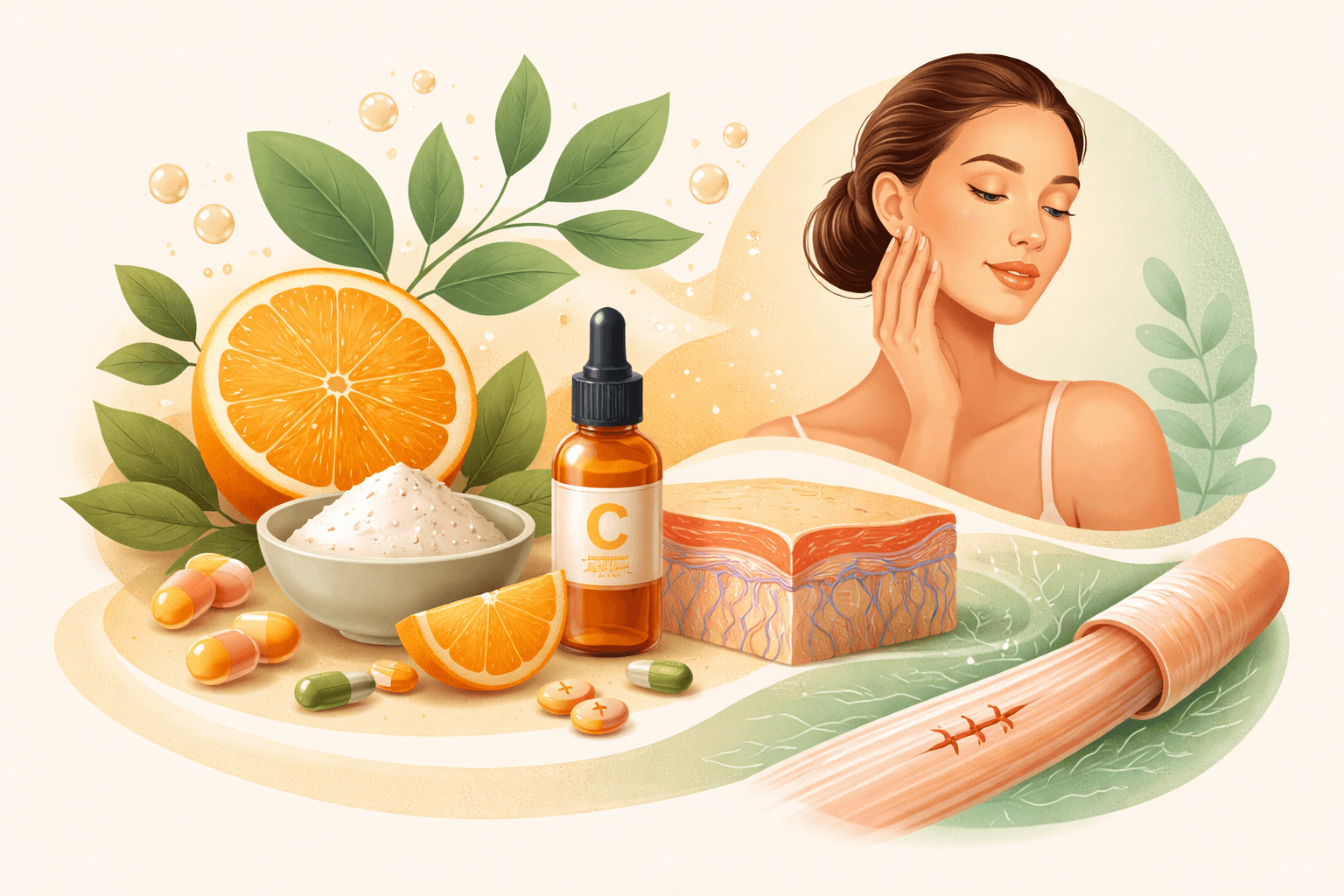
Vitamin C Beyond Colds: Collagen, Skin, and Tissue Repair
Vitamin C is best known for immune health, but its most fundamental job may be keeping the body’s structural proteins intact. Research suggests vitamin C is an essential cofactor for enzymes that build and stabilize collagen—the protein scaffolding in skin, tendons, ligaments, bone, blood vessels, and gums. This focused review looks at how vitamin C contributes to collagen-dependent tissues, what clinical studies show for skin aging and wound repair, what’s known about exercise and tendon support, and how traditional vitamin C–rich foods have long been used to nourish connective tissue.
How Vitamin C Builds Collagen
What it does: Vitamin C donates electrons to prolyl and lysyl hydroxylases—enzymes that hydroxylate specific amino acids in procollagen. This step stabilizes the collagen triple helix and enables cross-linking that gives tissues tensile strength. Without adequate vitamin C, newly formed collagen is under-hydroxylated and weak. Evidence level: strong (established biochemistry; classic enzymology and human deficiency studies).
Why it matters: Impaired collagen explains why scurvy presents with easy bruising, bleeding gums, fragile capillaries, corkscrew hairs, and poor wound healing—features of weak connective tissue. Evidence level: strong (clinical observations and controlled depletion–repletion studies in humans).
What the research says: Decades of biochemical work (e.g., Kivirikko and colleagues’ enzyme studies) established vitamin C’s cofactor role, and controlled human depletion experiments historically demonstrated rapid onset of impaired wound healing and gingival bleeding when vitamin C status falls.
Vitamin C and Wound Healing
Wound healing depends on orderly phases—hemostasis, inflammation, proliferation (including collagen deposition), and remodeling. Vitamin C is involved in collagen maturation and may help modulate oxidative stress around the wound microenvironment.
Pressure ulcers and complex wounds: Systematic reviews of nutrition in pressure ulcer care report that multi-nutrient formulas containing protein, arginine, zinc, and vitamin C may accelerate healing compared with standard diets, though results are heterogeneous and not solely attributable to vitamin C. Evidence level: moderate (systematic reviews and RCTs of multi-nutrient support; certainty limited by study variation).
Surgical and traumatic wounds: Observational data link low vitamin C status with delayed wound closure and higher complication rates. Some small clinical trials suggest improved healing markers when vitamin C status is optimized as part of comprehensive nutrition, but isolated vitamin C effects remain difficult to parse. Evidence level: emerging (mixed clinical data; need larger, well-controlled studies focused on vitamin C alone).
Key studies: Cochrane-style and other systematic reviews (2014–2021) of nutritional support in pressure ulcer management note benefits from enriched formulas that include vitamin C, while emphasizing risk of bias and co-interventions. These findings support the idea that sufficient vitamin C is relevant to healing, especially when combined with adequate protein and other co-factors, but they stop short of proving a standalone effect.
Skin Health and Photodamage
Collagen supports skin firmness and elasticity. Research suggests vitamin C contributes through two routes: (1) collagen hydroxylation and (2) antioxidant recycling, notably regeneration of vitamin E in lipophilic compartments, which may help buffer UV-induced oxidative stress.
Topical vitamin C: Randomized clinical trials and systematic reviews report that stabilized topical L‑ascorbic acid formulations may improve fine wrinkling, tactile roughness, and mottled pigmentation in photodamaged skin over several weeks to months. Evidence level: moderate (multiple RCTs and systematic reviews in dermatology; effects depend on formulation and stability).
Oral vitamin C with antioxidants: RCTs show that oral vitamin C combined with vitamin E may reduce UV-induced erythema (a proxy for sunburn) and oxidative markers, consistent with antioxidant synergy. Whether this translates to long-term photoaging changes requires further research. Evidence level: moderate (human trials for acute UV responses; limited long-term outcomes).
Key sources: Narrative and systematic reviews in dermatology (e.g., 2017–2021) synthesize RCTs demonstrating improvements in photodamage with topical vitamin C and acute photoprotection with oral vitamin C plus vitamin E. Outcomes vary with product stability and study duration.
Tendons, Ligaments, and Exercise Recovery
Tendons and ligaments are rich in type I collagen and remodel slowly. Strategies that pair mechanical loading with collagen substrates and vitamin C have gained interest.
Pre-exercise nutrition: A small crossover RCT found that consuming a vitamin C–containing gelatin supplement prior to intermittent activity increased circulating markers related to collagen synthesis and improved engineered ligament strength ex vivo compared with placebo. Evidence level: emerging (small human RCT showing biomarker changes; clinical injury outcomes not established).
Injury and rehabilitation: Animal studies suggest vitamin C may enhance collagen cross-linking and tensile strength in healing tendons and ligaments, but human clinical trials demonstrating faster return to sport or reduced re-injury are limited. Evidence level: emerging (preclinical support; insufficient human outcomes).
Key study: The 2017 trial led by sports physiology researchers reported greater procollagen peptide levels when vitamin C and gelatin preceded exercise, supporting a timing-plus-substrate hypothesis for connective tissue anabolism.
Traditional Vitamin C–Rich Foods for Tissue Vitality
Long before vitamin C was isolated, cultures relied on fruits and botanicals now recognized as vitamin C–dense.
Amla (Emblica officinalis): In Ayurveda, amla is a Rasayana (rejuvenative) traditionally used for skin luster and tissue resilience. Modern analyses show high vitamin C content and polyphenols that may complement antioxidant defenses. Evidence level: traditional for use; emerging for modern clinical endpoints.
Acerola (Malpighia emarginata) and Camu Camu (Myrciaria dubia): Indigenous to the Americas, these fruits are among the richest natural sources of vitamin C. Traditional uses include supporting vigor and resistance to stressors. Contemporary studies highlight potent antioxidant capacity, though clinical trials specific to skin or tendon outcomes are sparse. Evidence level: traditional for use; emerging for targeted outcomes.
These whole-food sources provide a matrix of phytonutrients that may act synergistically with vitamin C, though disentangling vitamin C’s specific contribution from other compounds is challenging.
What About Liposomal Vitamin C?
Liposomal encapsulation is marketed to improve vitamin C bioavailability. Small human pharmacokinetic studies suggest liposomal vitamin C can achieve higher circulating concentrations than some conventional oral forms at matched amounts. However, no trials have directly tied liposomal delivery to superior outcomes in collagen-dependent endpoints (e.g., faster wound closure, better tendon recovery, or improved skin elasticity) compared with standard vitamin C. Evidence level: emerging (limited human PK data; minimal head-to-head clinical outcomes for collagen).
Practical Ways to Support Collagen—Without Dosage Advice
Emphasize dietary patterns rich in vitamin C: Citrus, kiwifruit, berries, bell peppers, broccoli, leafy greens, and traditional sources such as amla, acerola, and camu camu may help maintain vitamin C status. Evidence level: strong for food content; moderate for direct collagen outcomes.
Pair with protein and smart loading: Research suggests connective tissue may respond when vitamin C–containing foods are consumed alongside quality protein and followed by mechanical loading (e.g., tendon-focused rehab). Evidence level: emerging (biomarker and mechanistic data; limited clinical endpoints).
Consider skin care context: Stabilized topical vitamin C formulations have clinical support for photodamage; formulation and packaging influence results. Evidence level: moderate.
Think whole-system: Adequate total nutrition (energy and protein), micronutrients (including vitamin C), and sleep/recovery likely matter more for tissue repair than any single component. Evidence level: moderate (integrative wound-care literature).
Bottom Line
Vitamin C’s role in collagen synthesis places it at the center of skin integrity, wound repair, and connective tissue resilience—well beyond its reputation in the common cold. Strong biochemical and clinical deficiency data show that inadequate vitamin C compromises collagen and healing. For real-world outcomes, research suggests:
- Wound healing may improve when vitamin C is optimized within comprehensive nutrition, though isolated effects are hard to separate (moderate evidence).
- Topical vitamin C can benefit photodamaged skin, and oral vitamin C with vitamin E can blunt acute UV responses (moderate evidence).
- Pairing vitamin C–containing foods with protein and exercise may support collagen synthesis in tendons, but human outcomes data are still building (emerging evidence).
- Traditional vitamin C–rich fruits like amla, acerola, and camu camu offer culturally rooted, nutrient-dense options that align with modern redox and collagen biology (traditional/emerging evidence).
As always, nutrition works as a team sport: vitamin C is essential for collagen maturation, but its best outcomes likely occur alongside sufficient protein, targeted loading, and overall recovery practices.