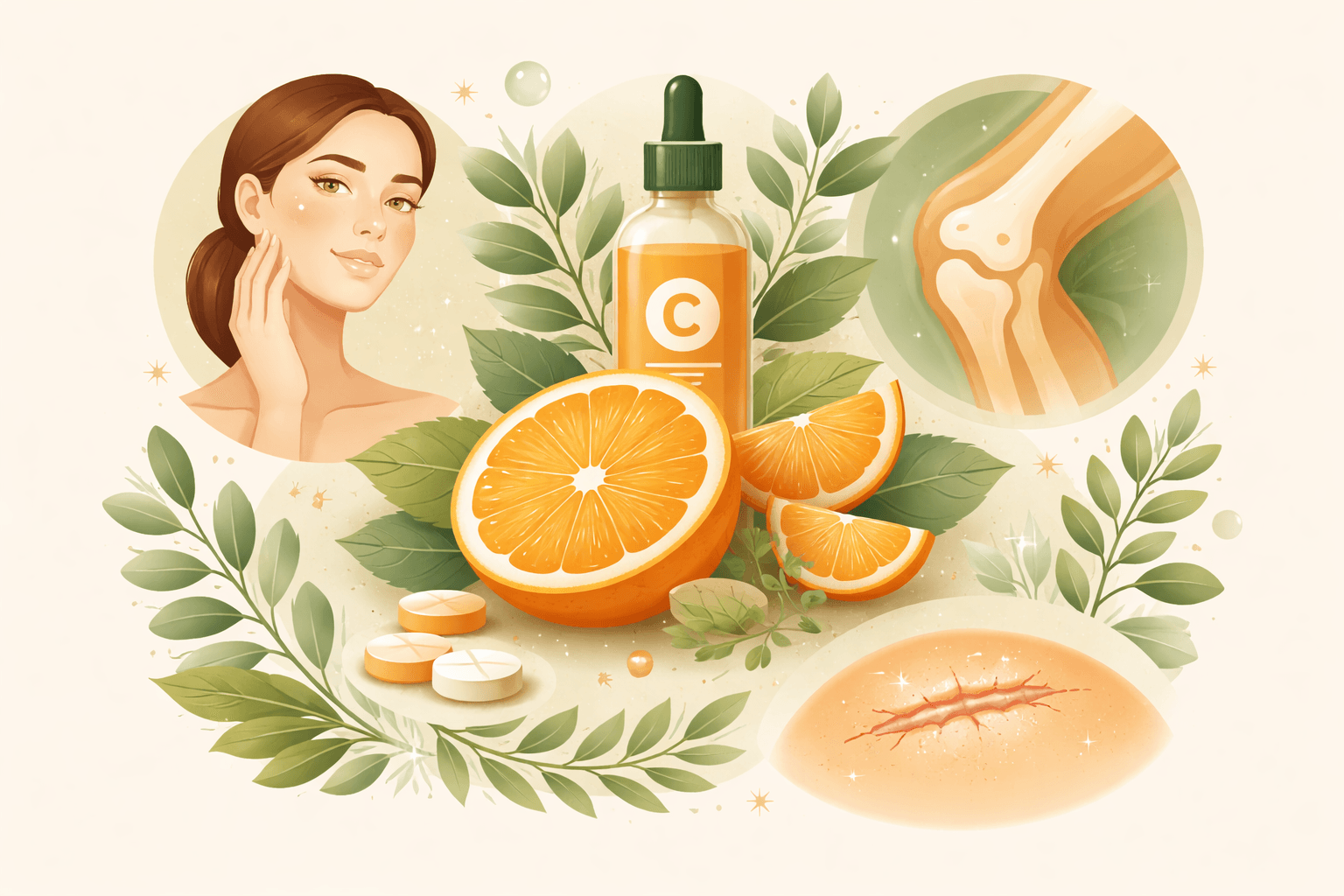
Vitamin C Beyond Colds: Collagen, Skin, and Tissue Repair
Vitamin C’s reputation for immune support often overshadows a foundational role: it is an essential cofactor for enzymes that build and stabilize collagen—the body’s primary structural protein. Collagen gives skin its firmness, supports tendons and ligaments, and forms the scaffolding of bones, cartilage, blood vessels, and gums. This focused review looks at how vitamin C influences collagen-rich tissues, what human studies show for skin and musculoskeletal health, and how traditional vitamin C–rich foods fit alongside modern research.
Key takeaways in this article are evidence-rated for strength (strong, moderate, emerging, traditional).
How Vitamin C Builds Collagen
- The cofactor role: Vitamin C maintains iron in the active Fe2+ state within prolyl and lysyl hydroxylase enzymes, enabling hydroxylation of proline and lysine residues on procollagen. These modifications allow collagen’s triple helix to fold, stabilize, and cross-link properly. Without sufficient vitamin C, collagen is weak and disorganized. (Evidence: strong; biochemical consensus and deficiency syndromes) [Myllyharju & Kivirikko 2004; Peterkofsky 1991]
- Clinical relevance of deficiency: Scurvy—severe vitamin C deficiency—presents with impaired wound healing, gum bleeding, bruising, joint pain, and skin fragility due to defective collagen. Restoration of vitamin C reverses these findings. (Evidence: strong; historical/clinical) [Hirschmann & Raugi 1999]
Skin Health and Photoaging
- Dermal matrix support: The dermis is rich in type I collagen produced by fibroblasts. Vitamin C supports procollagen gene expression and stabilizes newly formed fibers, and participates in antioxidant recycling that helps protect dermal lipids and proteins from oxidation. (Evidence: moderate; mechanistic and human topical studies) [Nusgens 2001; Carr & Frei 1999]
- Topical vitamin C: Controlled trials of topical L-ascorbic acid formulations report improvements in fine wrinkles, elasticity, and dermal density over 8–24 weeks, consistent with increased collagen production in skin. Results depend on formulation stability and penetration. (Evidence: moderate; RCTs and systematic reviews) [Humbert et al. 2003; Farris 2017 review]
- Oral vitamin C and photoaging: Observational studies link higher vitamin C–rich diets with fewer wrinkles and better skin appearance. Trials of oral vitamin C alone are limited; multi-ingredient supplements (often combining vitamin C with vitamin E, carotenoids, or collagen peptides) show modest improvements in some skin parameters, but isolate effects of vitamin C are difficult to confirm. (Evidence: emerging; observational and combination RCTs) [Cosgrove et al. 2007; Choi et al. 2016]
Tendons, Ligaments, and Exercise Recovery
- Collagen synthesis signaling: In a controlled human experiment, consuming gelatin with vitamin C prior to exercise increased circulating markers of collagen synthesis and improved collagen content in engineered ligament models, suggesting a priming effect on tendon/ligament repair pathways. (Evidence: emerging; mechanistic human study) [Shaw et al. 2017]
- Musculoskeletal injuries: Animal models routinely show that restoring vitamin C improves tendon and ligament healing quality. Human clinical trials isolating vitamin C’s effect on soft-tissue injury outcomes remain limited, and many use multi-nutrient protocols. (Evidence: emerging; preclinical and small human studies) [Paxton et al. 2010; Close et al. 2005]
Bone, Cartilage, and Joint Health
- Structural roles: Collagen forms the organic matrix of bone and the framework of cartilage. Vitamin C supports osteoblast collagen production and may influence chondrocyte function via antioxidant mechanisms. (Evidence: moderate; mechanistic and epidemiology) [Aghajanian et al. 2015]
- Human data: Prospective cohort studies have associated higher vitamin C intake with slower progression of knee osteoarthritis and higher bone mineral density in some populations, while randomized trials of supplementation alone show mixed results. Benefits may be most apparent in individuals with low baseline vitamin C status. (Evidence: emerging to moderate; observational > interventional) [McAlindon et al. 1996; Sahni et al. 2008]
Wound and Ulcer Healing
- Deficiency impairs healing: Poor collagen deposition is a hallmark of delayed wound closure in scurvy. (Evidence: strong; clinical) [Hirschmann & Raugi 1999]
- Supplementation in wounds: Older RCTs reported faster pressure ulcer healing with vitamin C, but studies were small and used varying regimens. Contemporary reviews judge the evidence as limited and confounded by multi-nutrient formulas that also include protein, zinc, and arginine. (Evidence: emerging; small RCTs, mixed systematic reviews) [Ter Riet et al. 1995; Liu et al. 2018 Cochrane]
Gums and Oral Tissues
- Periodontal support: Collagen-rich gingival tissues rely on vitamin C for structural integrity. Low vitamin C status is associated with increased gingival bleeding and periodontitis risk. Supplementation appears to reduce bleeding in people with low baseline status or higher oxidative stress (such as smokers), though periodontal treatment still requires professional care. (Evidence: moderate; observational and small RCTs) [Nishida et al. 2000; Leggott et al. 1986]
Iron Absorption and Why It Matters for Collagen
- Iron–ascorbate partnership: The same redox chemistry that drives collagen hydroxylases also explains vitamin C’s support of non-heme iron absorption in the gut. By keeping iron in the ferrous state and forming soluble complexes, vitamin C enhances dietary iron uptake. Adequate iron, in turn, supports iron-dependent collagen enzymes. (Evidence: strong; human absorption studies) [Hallberg et al. 1989; Teucher et al. 2004]
Antioxidant Recycling: Protecting the Collagen Environment
- Vitamin E regeneration: Vitamin C can regenerate oxidized vitamin E, helping maintain membrane integrity in skin and connective tissues exposed to oxidative stress (UV light, pollution, exercise). This redox network may indirectly preserve collagen by limiting oxidative damage to fibroblasts and extracellular matrix. (Evidence: moderate; human and mechanistic) [Carr & Frei 1999; Niki 1991]
Traditional Vitamin C–Rich Foods and “Food Matrix” Synergy
- Amla (Emblica officinalis): In Ayurveda, amla is a classic rasayana (rejuvenative) used for skin, hair, and vitality. Modern studies suggest antioxidant and matrix metalloproteinase–modulating effects that could favor collagen balance; small human studies report improvements in skin parameters with amla-containing preparations, though formulations vary. (Evidence: traditional to emerging; preclinical and small human studies) [Horie et al. 2017]
- Acerola (Malpighia emarginata): Acerola is among the densest natural vitamin C sources and also supplies polyphenols. Early human work shows rises in plasma antioxidant capacity with acerola intake; specific collagen outcomes are not well established. (Evidence: emerging; small human studies) [Assis et al. 2018]
- Camu camu (Myrciaria dubia): In a small trial, camu camu juice reduced oxidative and inflammatory markers more than isolated vitamin C matched for dose in smokers, hinting that polyphenols may confer added benefits beyond ascorbate alone. Collagen-specific outcomes were not measured. (Evidence: emerging; small RCT) [Inoue et al. 2008]
Practical Takeaways (No Medical Advice)
- Diet-first approach: Research suggests that regularly eating vitamin C–rich fruits and vegetables—citrus, kiwifruit, berries, peppers, crucifers, and traditional sources like amla, acerola, and camu camu—may help maintain the vitamin C status needed for normal collagen synthesis and tissue repair. (Evidence: strong for status; emerging for targeted outcomes)
- Context matters: Effects of additional vitamin C on collagen-related outcomes appear most notable when baseline status is low, oxidative stress is high, or tissues are actively repairing (e.g., after injury), but high-quality trials isolating vitamin C are limited. (Evidence: moderate)
- Synergy is likely: Patterns that pair vitamin C–rich foods with protein (for amino acids), adequate iron, copper, and overall energy availability support the collagen-building milieu. Topical vitamin C has more consistent evidence for photoaged skin than oral vitamin C alone. (Evidence: moderate)
Bottom Line
Vitamin C is indispensable for collagen synthesis, stabilizing the very scaffold that supports skin, joints, blood vessels, bone, and gums. Strong biochemical and clinical evidence show that deficiency impairs wound healing and connective-tissue integrity. For people with adequate intake, research suggests potential—though not guaranteed—benefits for skin aging, soft-tissue recovery, and periodontal health, especially when vitamin C is part of a broader dietary and topical strategy. Traditional vitamin C–rich foods like amla, acerola, and camu camu may offer additional polyphenol-driven support, but human trials targeting collagen outcomes remain limited. Maintaining sufficient vitamin C through whole foods, and considering formulation and context, may help the body do what it is wired to do: build and repair resilient collagen-rich tissues.
References (selected)
- Myllyharju J, Kivirikko KI. Collagens, modifying enzymes and their mutations in humans, flies and worms. Ann Med. 2004.
- Peterkofsky B. Ascorbate requirement for hydroxylation and secretion of procollagen. Am J Clin Nutr. 1991.
- Hirschmann JV, Raugi GJ. Adult scurvy. J Am Acad Dermatol. 1999.
- Carr AC, Frei B. Toward a new recommended dietary allowance for vitamin C based on antioxidant and health effects. Crit Rev Food Sci Nutr. 1999.
- Humbert PG et al. Topical vitamin C on photoaged skin: a clinical study. Dermatology. 2003.
- Farris PK. Topical vitamin C in aging. Dermatol Surg. 2017.
- Cosgrove MC et al. Diet and skin-aging appearance. Am J Clin Nutr. 2007.
- Choi SY et al. Dietary supplementation on skin aging: meta-analysis. J Cosmet Dermatol. 2016.
- Shaw G et al. Vitamin C–enriched gelatin and exercise increase collagen synthesis. Am J Clin Nutr. 2017.
- McAlindon TE et al. Antioxidant micronutrients and osteoarthritis progression. Arthritis Rheum. 1996.
- Sahni S et al. Vitamin C and bone mineral density. J Bone Miner Res. 2008.
- Ter Riet G et al. High-dose vitamin C and pressure sores. J Clin Epidemiol. 1995.
- Liu P et al. Nutritional interventions for treating pressure ulcers. Cochrane Database Syst Rev. 2018.
- Nishida M et al. Vitamin C and periodontal disease. J Periodontol. 2000.
- Leggott PJ et al. Ascorbic acid deficiency and gingival health in smokers. J Periodontol. 1986.
- Hallberg L et al. Ascorbic acid and nonheme iron absorption. Am J Clin Nutr. 1989.
- Teucher B et al. Factors affecting nonheme iron absorption. Int J Vitam Nutr Res. 2004.
- Niki E. Interaction of ascorbate and alpha-tocopherol. Free Radic Biol Med. 1991.
- Horie K et al. Emblica officinalis and skin parameters. J Tradit Complement Med. 2017.
- Assis S et al. Acerola intake and antioxidant status. Food Res Int. 2018.
- Inoue T et al. Camu camu vs vitamin C tablets in smokers. J Clin Biochem Nutr. 2008.