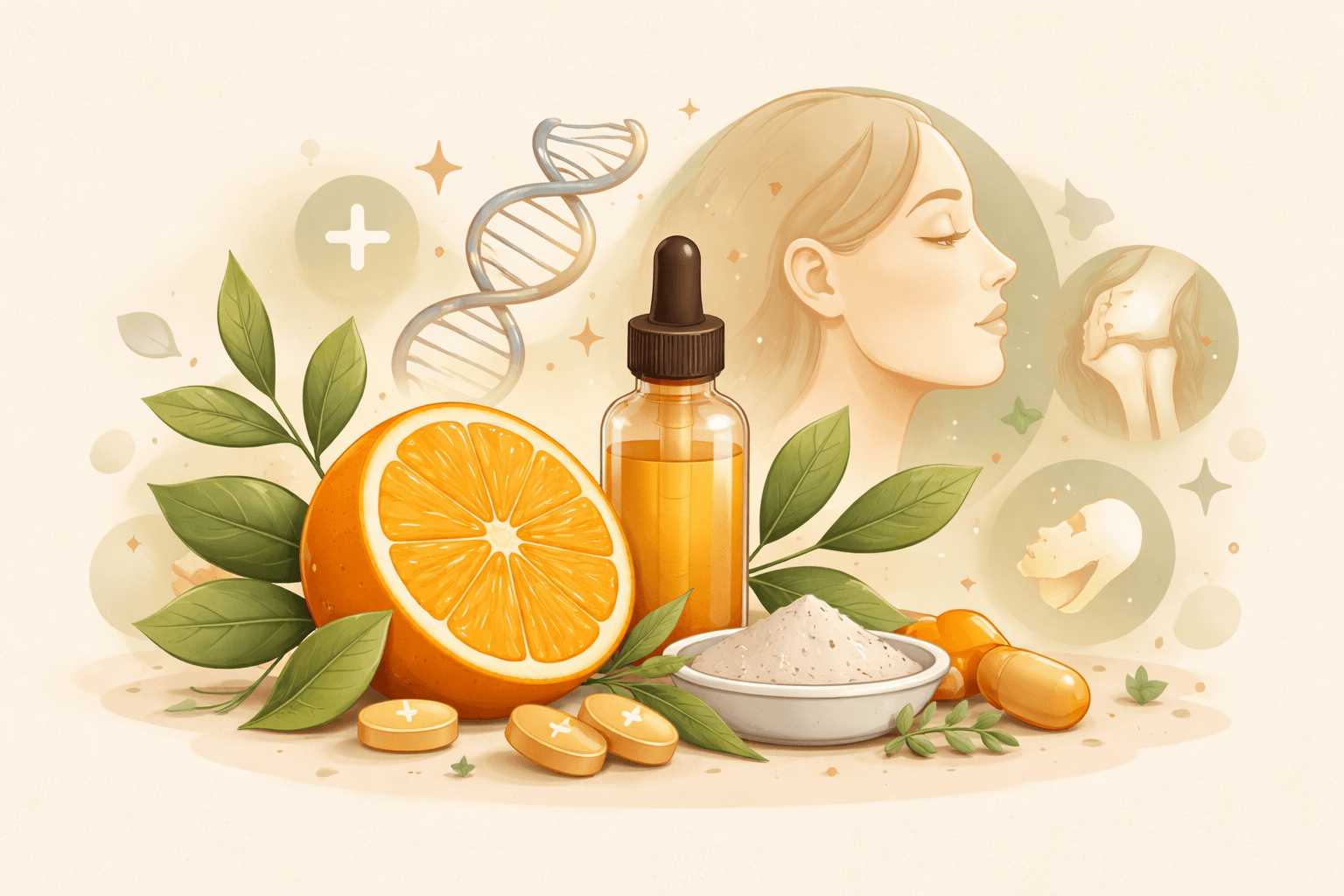
Vitamin C Beyond Colds (Supporting Topic)
Focus: Vitamin C as a cofactor for collagen synthesis—and why that matters for skin integrity, joints, and wound healing.
Key points at a glance
- Vitamin C is a required cofactor for enzymes that stabilize and crosslink collagen, the body’s main structural protein. [Evidence: strong]
- Adequate vitamin C status is associated with better skin appearance and may aid normal wound healing; supplementation appears most impactful when deficiency is present. [Evidence: moderate]
- Early human studies suggest vitamin C given with collagen-building amino acids around exercise may boost tendon collagen synthesis markers, but outcome data are limited. [Evidence: emerging]
- Traditional vitamin C–rich botanicals (amla, acerola, camu camu) have long histories in skin and connective tissue care; human data remain preliminary. [Evidence: traditional/emerging]
Why collagen depends on vitamin C
Collagen is the most abundant protein in the human body, forming the scaffold of skin, tendons, ligaments, bone, blood vessels, and gums. Its strength and stability depend on a series of post‑translational modifications to the collagen chains made inside cells. Two key steps—hydroxylation of proline and lysine residues—require vitamin C (ascorbate) as a cofactor for the enzymes prolyl and lysyl hydroxylases. Ascorbate maintains iron in the enzyme active site in its reduced state so these enzymes can function effectively (Prockop & Kivirikko, 1995; Gorres & Raines, 2010; Myllyharju & Kivirikko, 2004). [Evidence: strong]
If vitamin C is lacking, these hydroxylation reactions falter. Collagen triple helices are less stable and form weaker crosslinks, translating to fragile capillaries, bleeding gums, poor wound healing, and musculoskeletal pain—hallmarks of scurvy, the classic vitamin C deficiency syndrome (Pullar et al., 2017). [Evidence: strong]
Skin structure and visible aging
- Observational data link higher vitamin C intakes with better skin appearance. In a large U.S. cohort of middle‑aged women, greater dietary vitamin C was associated with fewer wrinkles and less dryness after adjusting for confounders (Cosgrove et al., 2007). While observational designs can’t prove causality, the findings support a role for vitamin C in maintaining dermal matrix quality. [Evidence: moderate]
- Clinical trials with topical vitamin C show improvements in fine wrinkling and dermal collagen. Randomized, vehicle‑controlled studies of topical L‑ascorbic acid reported increased dermal collagen and reduced photoaging signs over 3–6 months (Traikovich, 1999; Humbert et al., 2003). Topical delivery bypasses intestinal transport saturation and achieves high local concentrations relevant to collagen synthesis and antioxidant activity in skin. [Evidence: strong for topical; does not establish effects of oral intake]
- Oral supplementation evidence for anti‑aging skin outcomes is mixed. Narrative and systematic reviews conclude that oral vitamin C supports normal collagen formation and may aid skin health, particularly when status is low or when provided as part of multi‑nutrient formulas, but isolated effects are difficult to separate (Pullar et al., 2017). [Evidence: moderate]
Tendons, ligaments, and training adaptations
Tendons and ligaments are collagen‑dense tissues that remodel slowly. Research suggests vitamin C may support normal collagen turnover in response to loading:
- In a randomized crossover study, healthy adults ingested gelatin (a source of collagen peptides) with vitamin C prior to intermittent exercise; biomarkers of collagen synthesis increased compared with placebo, and engineered ligaments showed enhanced collagen content ex vivo (Shaw et al., 2017, Am J Clin Nutr). These findings point to a permissive role for vitamin C when amino acid substrates and mechanical stimulus are present. [Evidence: emerging]
- Clinical outcome trials (e.g., faster tendon healing, reduced injury rates) remain limited, so it is premature to draw firm conclusions about performance or rehabilitation benefits. [Evidence: emerging]
Wound healing and surgery
Vitamin C supports normal wound healing through collagen maturation, angiogenesis, and modulation of redox signaling. What does the clinical literature say?
- Deficiency impairs healing: Low plasma vitamin C is associated with delayed wound closure and increased complications, and correction of deficiency generally improves healing trajectories (Pullar et al., 2017). [Evidence: strong for deficiency states]
- Pressure ulcers and complex wounds: Systematic reviews of nutritional support for pressure ulcers report that formulas enriched with protein, arginine, zinc, and vitamin C may improve healing rates compared with standard care, though isolating the effect of vitamin C alone is challenging (Cochrane Review: Langer et al., 2015; Stratton et al., 2005). [Evidence: moderate for multi‑nutrient formulas; uncertain for vitamin C monotherapy]
- Burns and critical care: In severe burns, small randomized and controlled studies suggest high‑dose intravenous vitamin C early in resuscitation may reduce fluid requirements and edema, likely via endothelial stabilization and antioxidant effects (Tanaka et al., 2000). These trials focus on acute physiology rather than collagen endpoints, but they underscore vitamin C’s roles beyond immunity. [Evidence: emerging to moderate; specific to critical care settings]
How vitamin C gets where collagen is made
Vitamin C is water‑soluble and transported into cells by sodium‑dependent vitamin C transporters (SVCT1/2). Intestinal absorption is saturable, which is why increases in oral dose yield diminishing plasma returns (Carr & Vissers, 2013). This matters for collagen because local, intracellular ascorbate levels within fibroblasts and chondrocytes determine enzyme activity.
- Delivery innovations: Small randomized crossover pharmacokinetic studies report that liposomal‑encapsulated vitamin C can produce higher plasma concentrations than non‑liposomal oral forms, though still well below intravenous delivery (Davis et al., 2016). Whether such differences translate to superior collagen‑related outcomes has not been established. [Evidence: emerging]
Traditional perspectives and whole‑food sources
Long before vitamin C was identified, many medical systems emphasized fruits and botanicals now known to be vitamin C–rich for skin and tissue vitality:
- Amla (Emblica officinalis; Ayurveda): Used as a rasayana (rejuvenative), amla features in classical texts for supporting skin, hair, and connective tissues. Modern in vitro and small clinical studies suggest antioxidant and anti‑glycation effects that may protect dermal matrix, but robust trials are limited (Dhale et al., 2016; Zaid et al., 2010). [Evidence: traditional/emerging]
- Acerola (Malpighia emarginata) and camu camu (Myrciaria dubia): Used traditionally in the Caribbean and Amazon, these fruits provide exceptionally high vitamin C alongside polyphenols. Early human studies hint that whole‑fruit matrices may influence oxidative stress markers differently than isolated ascorbate (Inoue et al., 2008), but collagen‑specific outcomes remain to be shown. [Evidence: emerging]
These traditions align with the modern view that vitamin C works within a network of dietary compounds, and that baseline status influences responsiveness.
What this means in everyday health
- Skin: Maintaining adequate vitamin C status supports the enzymes that build strong, well‑crosslinked collagen, which may translate to better skin elasticity and resilience with age, particularly when combined with sun protection and a nutrient‑dense diet. [Evidence: moderate]
- Joints and tendons: For active individuals, vitamin C appears to play a permissive role in collagen remodeling when paired with mechanical loading and amino acid substrates, though outcome data are still developing. [Evidence: emerging]
- Wounds: Ensuring sufficient vitamin C is especially relevant around tissue repair, where deficiency impairs healing. Multi‑nutrient approaches used clinically often include vitamin C as one pillar. [Evidence: strong for deficiency correction; moderate within multi‑nutrient protocols]
Limitations and nuances
- More is not necessarily better: Collagen enzymes require vitamin C, but once those enzymes are saturated, additional intake may not further enhance collagen production in healthy, replete individuals (Carr & Vissers, 2013). [Evidence: strong]
- Context matters: Effects appear greatest when status is low, when there is active tissue remodeling (e.g., after injury), or when combined with other supportive nutrients and appropriate loading. [Evidence: moderate]
- Route of delivery: Topical vitamin C has strong evidence for localized skin effects; oral and liposomal forms affect systemic status but have less direct evidence for collagen‑specific clinical outcomes. [Evidence: strong for topical; moderate/emerging for oral]
Bottom line
Vitamin C is fundamental to collagen biology: it activates the enzymes that stabilize and crosslink collagen, shaping the integrity of skin, joints, blood vessels, and healing tissues. Research suggests maintaining adequate vitamin C status may help support normal skin appearance, tendon remodeling in response to training, and wound healing—especially when combined with other nutrients and appropriate mechanical stimuli. Topical vitamin C shows clear benefits for photoaged skin, while oral and liposomal forms primarily sustain systemic status; their specific advantages for collagen outcomes require more clinical trials. Traditional vitamin C–rich botanicals like amla, acerola, and camu camu echo this connective‑tissue focus, though modern evidence is still emerging. As with most nutrients, context, baseline status, and overall dietary patterns shape the real‑world impact.
References (selected)
- Prockop & Kivirikko. Collagens: Molecular biology, diseases, and potentials for therapy. Annu Rev Biochem (1995).
- Myllyharju & Kivirikko. Collagens, modifying enzymes and their mutations in humans, flies and worms. Trends Genet (2004).
- Gorres & Raines. Prolyl 4‑hydroxylase. Crit Rev Biochem Mol Biol (2010).
- Cosgrove et al. Dietary nutrient intakes and skin‑aging appearance. Am J Clin Nutr (2007).
- Traikovich. Use of topical ascorbic acid and its effects on photodamaged skin. Dermatol Surg (1999).
- Humbert et al. Topical vitamin C and improvement of the dermal‑epidermal junction in photoaged skin. Exp Dermatol (2003).
- Pullar, Carr, Vissers. The roles of vitamin C in skin health. Nutrients (2017).
- Shaw et al. Vitamin C–enriched gelatin and exercise increase collagen synthesis markers. Am J Clin Nutr (2017).
- Langer et al. Nutritional interventions for treating pressure ulcers. Cochrane Database Syst Rev (2015).
- Tanaka et al. High‑dose vitamin C in burn resuscitation reduces fluid requirements. Surgery (2000).
- Davis et al. Bioavailability of liposomal vitamin C in humans. Nutr Metab Insights (2016).
- Inoue et al. Acute effects of camu camu vs vitamin C tablets on oxidative stress markers. J Cardiol (2008).
- Dhale et al.; Zaid et al. Emblica officinalis (amla) dermatologic and antioxidant effects. Various journals (2010–2016).