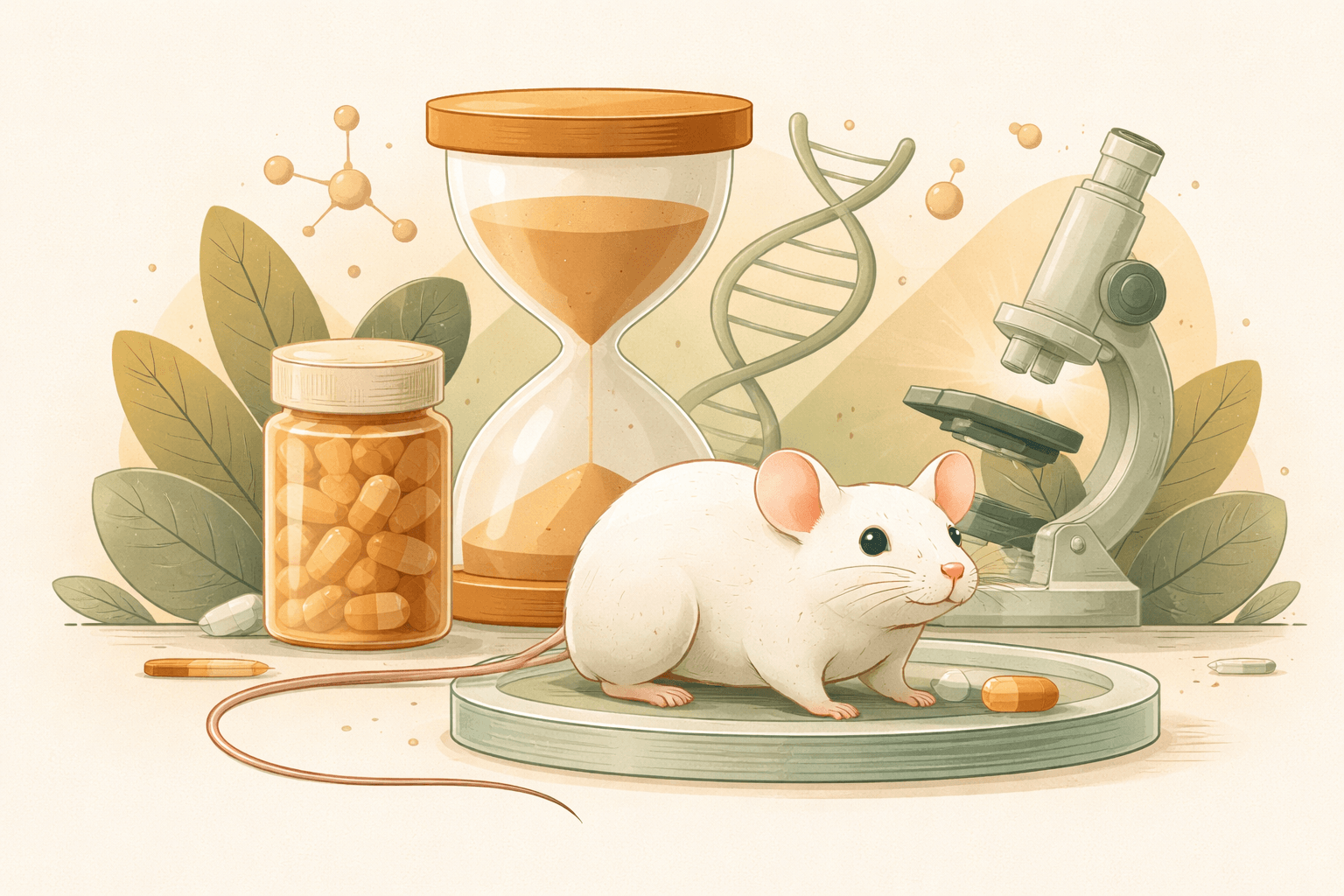
What the ITP Mouse Studies Reveal About Rapamycin and Longevity
The ITP’s rapamycin results show strong lifespan extension in mice via mTORC1 inhibition. Here’s how that connects to caloric restriction, ongoing human and dog trials, risks, and natural mTOR modulators—and why excitement is tempered by caution.
·9 min read
This content is for informational purposes only and does not constitute medical advice. Always consult a qualified healthcare provider before starting, stopping, or changing any supplement or medication regimen.
Overview
The NIH/NIA Interventions Testing Program (ITP) has become a proving ground for longevity science in mammals. Among dozens of compounds tested, rapamycin—an inhibitor of the nutrient-sensing mTOR pathway—stands out for consistently extending lifespan in mice, even when started late in life. This focused review explains what the ITP mouse studies found, how those findings connect to mTOR and caloric restriction, and what they may mean for people—alongside risks, ongoing trials, and natural mTOR modulators.
Why the ITP Matters
The ITP is a multi-site, rigorously controlled program that evaluates candidate longevity interventions in genetically diverse (UM-HET3) mice. By testing at three independent sites and using both sexes, the ITP aims to weed out false positives and lab-specific effects, increasing confidence in reproducibility and generalizability to mammals [Nadon 2017].
What the ITP Found for Rapamycin
The landmark ITP paper in 2009 reported that rapamycin extended both median and maximal lifespan in mice, including when treatment began at 600 days of age—roughly equivalent to late middle age in mice [Harrison 2009]. Subsequent ITP cohorts replicated lifespan extension, with some sex-dependent differences in effect size and robust benefits when microencapsulated formulations improved bioavailability [Miller 2011]. In head-to-head comparisons across the ITP portfolio, rapamycin is among the most reliable lifespan-extending agents, alongside hits like acarbose and 17-α-estradiol (the latter largely in males) [Strong 2016].
Key takeaways from ITP rapamycin cohorts:
Lifespan benefits observed across multiple sites and cohorts, including late-life initiation [Harrison 2009; Miller 2011].
Effects occurred in genetically heterogeneous mice, strengthening relevance beyond a single inbred strain [Nadon 2017].
Rapamycin ranks among the strongest ITP-positive interventions, comparable or superior to other metabolic modulators [Strong 2016].
Evidence level: strong (animal lifespan extension with multiple replications)
How This Ties Back to mTOR and Caloric Restriction
mTOR complex 1 (mTORC1) integrates nutrient and growth factor signals to regulate protein synthesis, autophagy, and cellular growth. Rapamycin inhibits mTORC1, a central node implicated in aging biology across species [Johnson 2013; Saxton & Sabatini 2017]. Notably, caloric restriction (CR)—the most robust non-genetic longevity intervention in many models—also converges on reduced mTORC1 signaling and increased autophagy. In nonhuman primates, CR improved cardiometabolic health and survival in some cohorts, supporting mTOR-linked mechanisms that may translate at least partly to mammals closer to humans [Mattison 2017].
Research suggests rapamycin and CR both suppress mTORC1 activity and may enhance autophagy, a cellular recycling process associated with improved proteostasis and stress resistance [Johnson 2013; Saxton & Sabatini 2017].
Evidence level: moderate to strong (mechanistic convergence across models; mixed but supportive data in primates for CR-related benefits)
What It May Mean for Humans: Early Signals and Ongoing Trials
Translating mouse lifespan gains to human healthspan requires careful steps. In older adults, low-dose rapalogs (e.g., everolimus/RAD001 or the dual PI3K/mTOR inhibitor BEZ235) have improved responses to influenza vaccination and reduced infection rates—suggesting that partial, selective TORC1 inhibition may enhance certain immune functions in aging, contrary to the blanket “immunosuppression” label associated with higher-dose, continuous regimens in transplantation [Mannick 2014; Mannick 2018].
Current human and companion-animal efforts include:
PEARL trial: A randomized, placebo-controlled trial evaluating low-dose, intermittent rapamycin in generally healthy adults for aging-related biomarkers; results are pending (industry-sponsored; registered trial).
Dog Aging Project (TRIAD): A large, randomized clinical trial testing whether rapamycin can extend healthspan and lifespan in pet dogs living in typical home environments, building on a small feasibility study that suggested manageable safety and potential cardiac benefits in middle-aged dogs [Urfer 2017; Dog Aging Project].
Evidence level: emerging (biomarker and immune-function improvements with rapalogs; lifespan/healthspan outcomes pending in humans and companion animals)
Risks, Trade-offs, and the mTORC1 vs. mTORC2 Question
Rapamycin’s medical label comes from transplant medicine, where chronic dosing at immunosuppressive levels can increase risks of mucosal ulcers, dyslipidemia, delayed wound healing, edema, and glucose intolerance among others. Mechanistically, prolonged or high systemic exposure may also inhibit mTOR complex 2 (mTORC2), which can impair insulin signaling and contribute to metabolic side effects [Lamming 2012].
In longevity contexts, researchers are exploring intermittent or lower exposures that aim to preferentially inhibit mTORC1 while sparing mTORC2, seeking a therapeutic window for aging biology. Human data on long-term safety and efficacy for aging endpoints remain limited, and careful monitoring in clinical trials is underway.
Evidence level: strong for adverse effects at higher, chronic doses in clinical settings; emerging regarding risk–benefit balance for low, intermittent regimens in generally healthy adults
Natural mTOR Modulators: Dietary Patterns and Phytochemicals
While drug development advances, interest is growing in lifestyle and dietary patterns that may influence mTOR signaling.
Caloric restriction and intermittent fasting: Research suggests reductions in overall energy intake, and some time-restricted or fasting regimens, may downshift mTORC1 activity and promote autophagy, which could support metabolic and cellular resilience [Longo & Panda 2016]. Evidence from human trials primarily shows improvements in weight and cardiometabolic risk factors; direct measures of mTOR in human tissues are limited.
Evidence level: moderate (consistent metabolic benefits; mechanistic inference for mTOR/autophagy largely from preclinical work)
Protein and amino acid patterning: Limiting certain amino acids (e.g., methionine) extends lifespan in multiple rodent studies, likely via nutrient-sensing pathways including mTOR; translation to practical human patterns remains under study [Wanders 2015 review].
Evidence level: moderate (strong animal data; limited direct human aging endpoints)
Polyphenols and metabolic modulators: Compounds like resveratrol, berberine, EGCG (green tea catechins), and curcumin may activate AMPK and/or indirectly temper mTORC1 signaling in cells and animal models; clinical aging endpoints are not established [Madeo 2019 review].
Evidence level: emerging (cell/animal data; mixed or limited human biomarker evidence)
Bridging Western and Traditional Perspectives
Eastern traditions have long emphasized cyclical moderation—periodic fasting in Ayurveda (upavāsa) and Taoist- and Buddhist-influenced practices that reduce intake (e.g., bigu). Research suggests these practices may intersect with autophagy and mTOR downregulation, potentially supporting cellular maintenance during low-nutrient states [Longo & Panda 2016]. Plant-rich dietary patterns common to traditional cuisines deliver polyphenols that, in modern laboratory studies, interact with nutrient-sensing pathways [Madeo 2019]. While mechanistic links are still being charted, this convergence helps explain why longevity researchers see value in both behavioral and pharmacologic routes to modulate mTOR.
Why Researchers Are Excited—but Cautious
Convergence: Independent lines of evidence—ITP rapamycin findings, CR mechanisms, and TORC1 pharmacology—point to mTOR as a central lever in mammalian aging biology.
Translation gap: Mouse lifespan gains do not guarantee human benefits. Trials in people and companion animals are essential to establish real-world efficacy, optimal regimens, and safety over years—not months.
Heterogeneity: Sex, genetics, diet, microbiome, and comorbidities may influence response. The ITP’s genetically diverse design is a strength, but individualized effects in humans remain to be determined.
Safety: Immunosuppression and metabolic side effects at higher or chronic exposure are well-documented; strategies that may favor TORC1 over TORC2 require validation in rigorous human studies.
Bottom Line
The ITP has repeatedly shown that rapamycin extends lifespan in genetically diverse mice, even with late-life initiation—strong evidence that mTORC1 is a tractable node in mammalian aging. Research suggests similar nutrient-sensing biology underlies benefits of caloric restriction and possibly certain dietary patterns or phytochemicals. Early human studies with rapalogs show promising immune effects, and large trials in people and pet dogs are underway, but definitive evidence for improved human healthspan or longevity is not yet available. Given known risks at higher or chronic doses, enthusiasm is tempered by the need for careful, long-term, placebo-controlled trials to define who may benefit, how, and at what risk.
This content is for informational purposes only and does not constitute medical advice. Always consult a qualified healthcare provider before starting, stopping, or changing any supplement or medication regimen.
Focus: How the NIH Interventions Testing Program (ITP) findings on rapamycin shape today’s longevity conversation
Rapamycin—the first-in-class inhibitor of the [mechanistic Target of Rapamycin (mTOR
Introduction
The mechanistic target of rapamycin (mTOR) has become a central character in longevity science. From robust mouse studies to early human trials, research suggests that dialing down mTOR s
Overview
Time-restricted eating (TRE)—compressing daily food intake into a consistent window—has surged in popularity as a practical form of intermittent fasting. A central question is whether TRE mea
Introduction
Autophagy—literally “self-eating”—is the cell’s housekeeping program for recycling damaged proteins and organelles. In 2016, Yoshinori Ohsumi received the Nobel Prize in Physiology or Med
Telomeres and aging have captivated headlines for two decades. But beyond the buzz, what do telomeres actually do, how much do lifestyle choices really influence them, and what should we make of telom
Telomere Length and Lifestyle: Exercise Intensity Under the Microscope
Interest in telomeres—the protective DNA caps at the ends of chromosomes—has surged since Elizabeth Blackburn, Carol Greider, an