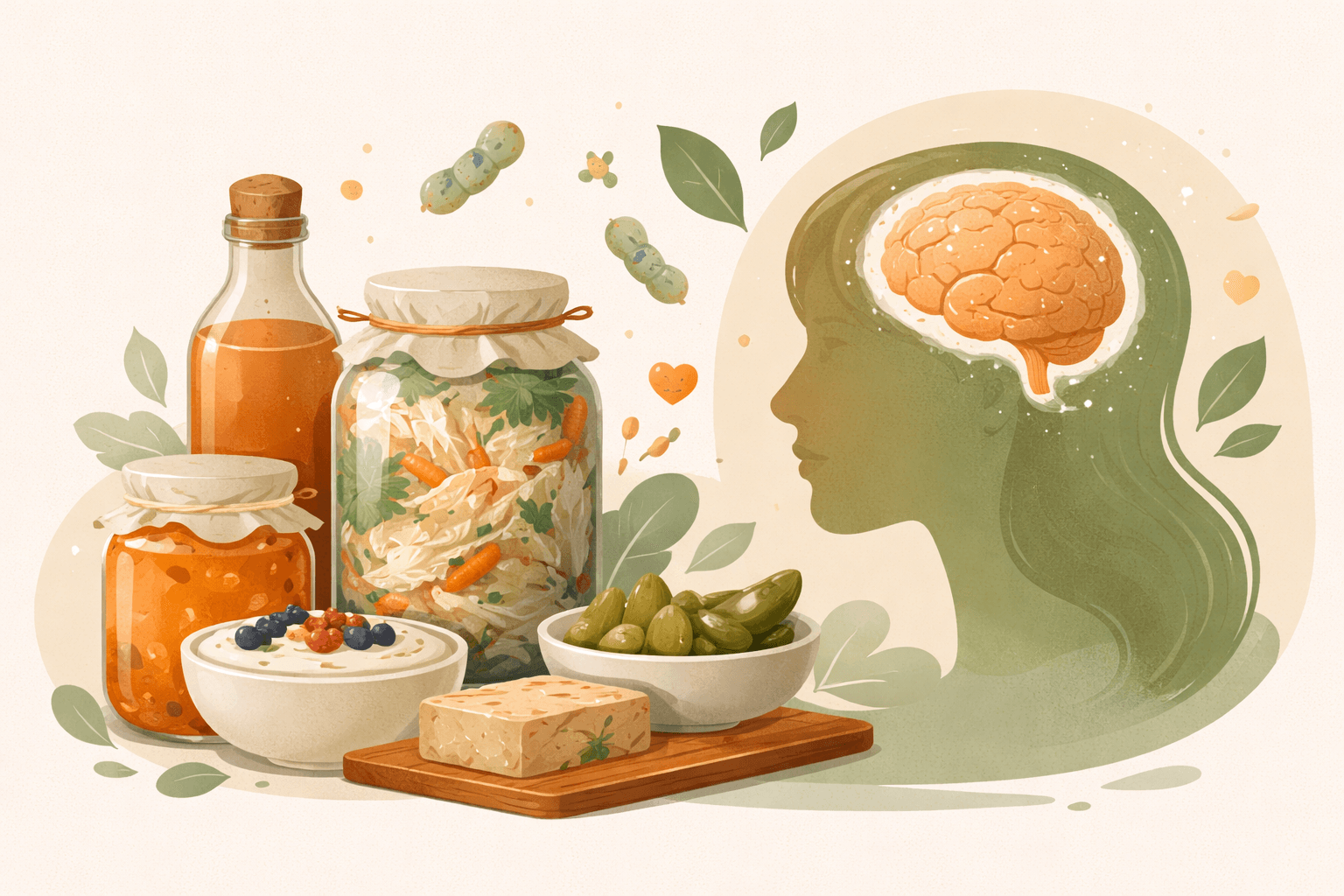
Psychobiotics and Mental Health: Are Fermented Foods Proto‑Psychobiotics?
Psychobiotics are probiotics and microbial metabolites that may influence mental health via the gut–brain axis. While many clinical trials test encapsulated strains, everyday fermented foods—kimchi, kefir, miso, yogurt, sauerkraut, tempeh, and others—naturally contain lactic acid bacteria and yeasts that may act as “proto‑psychobiotics.” This article focuses on what research suggests about fermented foods and mood/anxiety, how the vagus nerve fits in, and what we can infer from strain‑specific psychobiotic trials in the Lactobacillus and Bifidobacterium genera.
Key idea: Fermented foods may help mood by shaping the microbiome, lowering inflammation, and producing neuroactive compounds, though the most robust symptom data to date come from trials of specific probiotic strains rather than whole foods. Evidence level overall: moderate.
How the Gut–Brain Axis Connects to Mood (and Where the Vagus Nerve Fits)
- The gut and brain communicate through neural (especially the vagus nerve), immune, endocrine, and microbial‑metabolite pathways. Reviews highlight the vagus nerve as a key bidirectional highway for gut signals influencing emotion regulation and stress responses (Breit et al., 2018). Evidence level: strong (for the existence of gut–brain pathways), moderate (for mood outcomes via diet‑microbe interactions).
- In mice, the psychobiotic Lactobacillus rhamnosus (JB‑1) reduced stress hormones and anxiety‑/depression‑like behaviors; cutting the vagus nerve abolished the effect (Bravo et al., 2011). This supports a vagus‑dependent mechanism. Evidence level: emerging (animal data with plausible human relevance).
What’s in Fermented Foods That May Help?
- Live microbes: Common genera include Lactobacillus (e.g., L. plantarum, L. brevis, L. helveticus), Bifidobacterium (in some dairy ferments), Leuconostoc, Lactococcus, and kefir‑specific microbes like Lactobacillus kefiri and certain yeasts. Evidence level: strong (for presence of microbes in ferments), emerging (for consistent mood effects per food).
- Neuroactive and signaling metabolites: Fermentation can yield gamma‑aminobutyric acid (GABA) from L. brevis and L. plantarum, short‑chain fatty acids (SCFAs) from fiber‑fermenting consortia, bioactive peptides, and tryptophan‑pathway intermediates that may influence inflammation and neural signaling. Evidence level: moderate (mechanistic plausibility and human biomarker shifts), emerging (direct links to mood change from foods).
Human Studies: What We Know About Fermented Foods and Mood
- Diet RCT on fermented foods and inflammation: A 10‑week randomized trial found that a diet high in fermented foods increased microbiome diversity and decreased multiple inflammatory markers (Wastyk et al., Cell, 2021). Mood was not a primary endpoint, but lower inflammation is associated with better mental health in other research. Evidence level: strong for immune effects; indirect for mood.
- Observational link with social anxiety: In young adults, higher fermented‑food intake correlated with fewer social anxiety symptoms, with the effect most evident in individuals high in neuroticism (Hilimire et al., 2015). Evidence level: emerging (cross‑sectional, not causal).
- Indirect support from psychobiotic RCTs: While not food studies, clinical trials using strains often found in fermented foods suggest mood benefits:
- Bifidobacterium longum NCC3001 improved depression scores and altered brain activity in patients with IBS (Pinto‑Sanchez et al., Gastroenterology, 2017). Evidence level: strong (placebo‑controlled RCT in a clinical population).
- Lactobacillus helveticus R0052 plus Bifidobacterium longum R0175 reduced anxiety and depressive symptoms and lowered cortisol in healthy adults (Messaoudi et al., 2011). Evidence level: moderate (replicated in similar designs, sample sizes modest).
- Bifidobacterium longum 1714 was associated with reduced daily stress and improved memory in healthy volunteers (Allen et al., 2016). Evidence level: moderate (small RCTs, mechanistic signals).
- A 2018 meta‑analysis reported small‑to‑moderate reductions in depressive symptoms with probiotics versus placebo (Ng et al., 2018), and prior systematic reviews have reached similar conclusions (Wallace & Milev, 2017). Evidence level: moderate (heterogeneous trials but consistent direction of effect).
Taken together, randomized diet data show fermented foods can beneficially reshape the microbiome and dampen inflammation, while psychobiotic trials point to mood/stress improvements from certain Lactobacillus and Bifidobacterium strains—the same genera often present in traditional ferments. Direct RCTs testing specific fermented foods for anxiety or depression remain limited, so conclusions for mood are still cautious.
Traditional Fermentation as Proto‑Psychobiotics
Cultures have long used fermentation to preserve foods and support digestion—a viewpoint aligning with today’s gut‑brain science.
- Kimchi (Korea): Rich in Lactobacillus plantarum and L. brevis, kimchi fermentation also produces organic acids and bioactive peptides. Traditional perspectives value kimchi for balance and vitality; modern studies associate Lactobacillus‑rich ferments with potential GABA production and immune modulation. Evidence level: traditional (historical use), emerging (mood outcomes).
- Kefir (Caucasus/Eastern Europe): A complex symbiotic community of bacteria and yeasts; animal and in vitro work suggest potential GABA and anti‑inflammatory effects. Evidence level: traditional to emerging (limited human mood data).
- Miso (Japan): Fermented soy with Aspergillus oryzae and salt‑tolerant bacteria such as Tetragenococcus; provides peptides and fermentation metabolites. Miso is revered in Japanese dietary traditions for daily balance. Evidence level: traditional (longstanding use), emerging (limited direct mood data; heat may inactivate microbes when prepared hot, though metabolites remain).
How Might Fermented Foods Influence Stress and Mood?
- Vagal signaling: Microbial metabolites (e.g., GABA, SCFAs) and microbe‑host interactions may stimulate vagal afferents, altering brain regions tied to emotion (Bravo et al., 2011; Breit et al., 2018). Evidence level: emerging to moderate.
- Immune and inflammatory tone: Reduced systemic inflammation after fermented‑food intake (Wastyk et al., 2021) may support mood, given links between inflammation and depressive symptoms. Evidence level: strong for inflammation change; moderate for mood relevance.
- Tryptophan metabolism: Microbes can affect the kynurenine pathway and serotonin availability in the gut, with downstream effects on brain signaling. Evidence level: emerging (human mood endpoints still limited).
Context, Caveats, and Practical Notes
- Strain specificity matters: Not all Lactobacillus or Bifidobacterium are the same. The clinical evidence for mood is strongest for specific named strains (e.g., B. longum NCC3001; L. helveticus R0052 + B. longum R0175). Evidence level: strong (strain‑level effects are well documented across probiotic research).
- Whole foods are variable: Microbial content of kimchi, kefir, and miso varies by culture, recipe, and storage. Some products may be pasteurized or heated, reducing live microbes while leaving metabolites. Evidence level: strong (food science), emerging (impact on mood outcomes).
- Individual tolerance differs: Fermented foods can be high in histamine or salt, and some people report GI sensitivity. Evidence level: moderate (food intolerance literature), not a medical diagnosis.
- More direct RCTs are needed: High‑quality trials testing specific fermented foods for mood/anxiety symptoms are still relatively rare, and results may differ by population and baseline diet. Evidence level: strong (consensus gap in literature).
Where This Leaves Psychobiotics and Ferments
- Fermented foods: Research suggests they may help by increasing microbial diversity and reducing inflammation, with early signals for mood correlations. Evidence level: moderate (indirect and observational support, mechanistic plausibility).
- Psychobiotic strains: Multiple RCTs indicate that certain Lactobacillus and Bifidobacterium strains may reduce stress and depressive symptoms. Evidence level: moderate to strong depending on strain and population.
- East meets West: Traditional daily ferments can be viewed as proto‑psychobiotics—long used for digestive balance and now investigated for gut–brain benefits. Evidence level: traditional (historical rationale) bridging to emerging/moderate (modern data).
Bottom Line
- Fermented foods appear to beneficially shape the microbiome and lower inflammatory markers, changes that may support better mood and stress resilience over time. Evidence level: strong for microbiome/inflammation; moderate for mood relevance.
- Specific psychobiotic strains from Lactobacillus and Bifidobacterium show small‑to‑moderate improvements in stress and depressive symptoms in randomized trials. Evidence level: moderate to strong (strain‑dependent).
- Traditional ferments like kimchi, kefir, and miso can be considered proto‑psychobiotics: rich in microbes and metabolites with plausible gut–brain effects, though direct mood RCTs are limited. Evidence level: traditional to emerging.
- The vagus nerve likely mediates part of these effects, translating gut signals to the brain; animal studies are compelling, and human translation is underway. Evidence level: emerging to moderate.
References (select)
- Bravo JA et al. PNAS, 2011; vagus‑mediated effects of L. rhamnosus JB‑1 in mice.
- Breit S et al. Front Psychiatry, 2018; review of the vagus nerve in the gut–brain axis.
- Wastyk HC et al. Cell, 2021; fermented‑foods diet increased diversity and reduced inflammation.
- Hilimire MR et al. Psychiatry Res, 2015; fermented foods and social anxiety in young adults.
- Messaoudi M et al. Br J Nutr, 2011; L. helveticus R0052 + B. longum R0175 reduced anxiety/depression symptoms.
- Pinto‑Sanchez MI et al. Gastroenterology, 2017; B. longum NCC3001 improved depression in IBS.
- Allen AP et al. Transl Psychiatry, 2016; B. longum 1714 and stress/cognition.
- Ng QX et al. J Affect Disord, 2018; meta‑analysis of probiotics for depressive symptoms.
- Wallace CJK & Milev R, Ann Gen Psychiatry, 2017; systematic review of probiotics and depression.