

Promising research with growing clinical support
Resveratrol Bioavailability: Why Most of It Never Reaches Your Cells
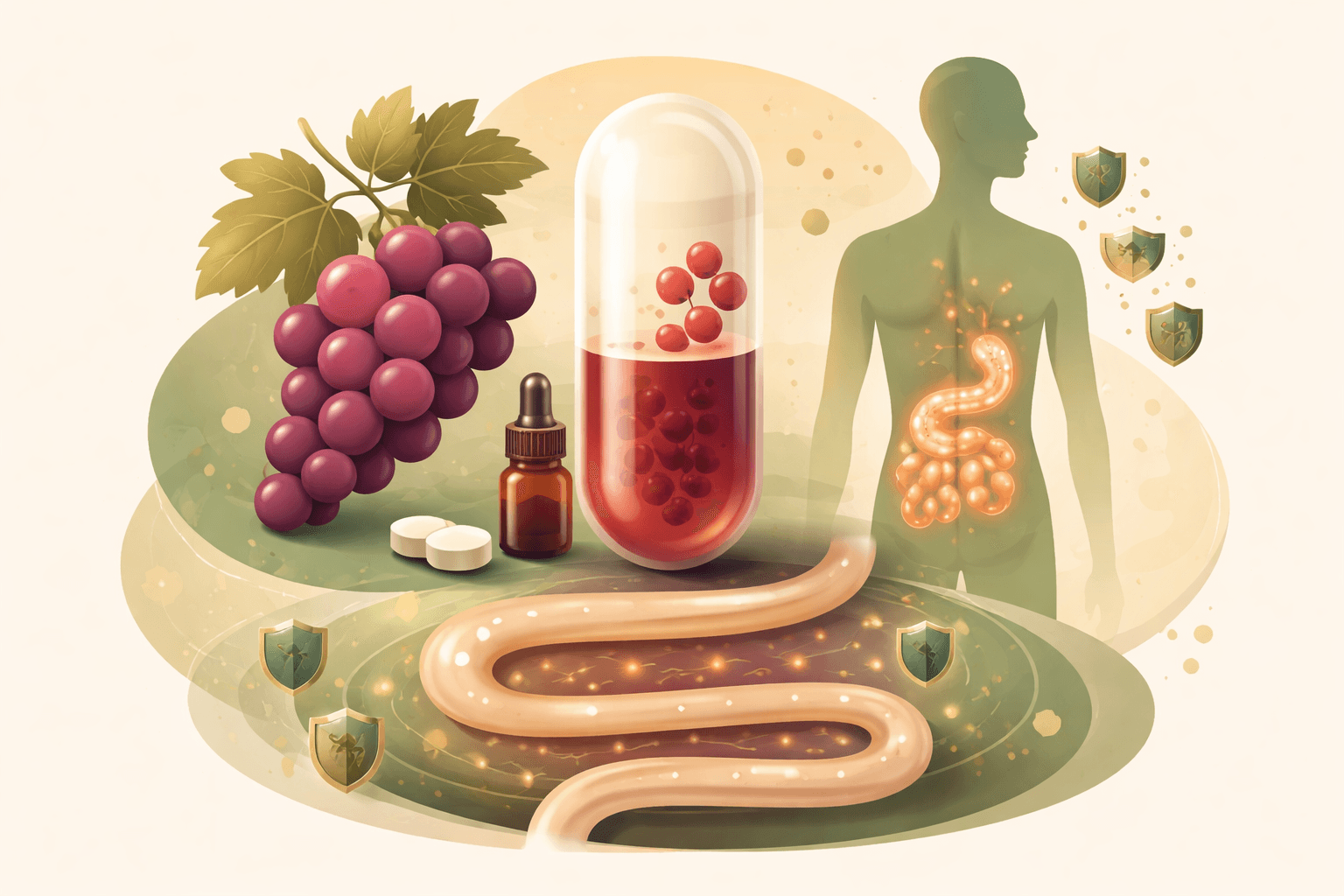
Why resveratrol’s poor bioavailability limits its impact, how this shapes sirtuin research and trial results, and which polyphenols show stronger evidence for healthy aging.
This content is for informational purposes only and does not constitute medical advice. Always consult a qualified healthcare provider before starting, stopping, or changing any supplement or medication regimen.
Resveratrol Bioavailability: Why Most of It Never Reaches Your Cells
The idea that a glass of red wine might support longevity grew from the “French Paradox”—observations in the early 1990s that French populations had relatively low rates of coronary disease despite diets not especially low in saturated fat. Polyphenols in wine, especially resveratrol from grape skins, were proposed as one explanation. Yet decades later, research suggests the story is more complex: resveratrol shows intriguing molecular effects in cells and animals, but human benefits have been inconsistent. A key reason is bioavailability—how much of a compound is absorbed, transformed, and ultimately reaches target tissues in an active form (Evidence: strong).
This focused review unpacks why resveratrol’s journey through the body limits its impact, how this intersects with sirtuin research and controversy, and where other polyphenols may currently show stronger clinical signals.
What “bioavailability” means for resveratrol
• Absorption vs. activation: After oral intake, resveratrol is absorbed in the intestine, but undergoes rapid “first-pass” metabolism in gut cells and the liver. It is efficiently converted to glucuronide and sulfate conjugates before reaching systemic circulation, so the free (aglycone) resveratrol level in blood is typically very low, while metabolites dominate (Evidence: strong; Drug Metab Dispos 2004; Cancer Res 2007).
• Pharmacokinetics in humans: Phase I pharmacokinetic studies show peak plasma concentrations of parent resveratrol are often in the low nanomolar range, with much higher levels of sulfate and glucuronide metabolites, and short half-lives on the order of hours. Repeated dosing leads mainly to metabolite accumulation (Evidence: strong; Cancer Res 2007; Cancer Prev Res 2010).
• Tissue distribution: In the colon, where oral resveratrol has direct contact, measurable levels can be detected in tissue after high intakes. Systemic organs likely see far less parent compound. Whether conjugates can be deconjugated locally to regenerate active resveratrol is still being investigated (Evidence: moderate; Cancer Prev Res 2010).
Do metabolites matter? The “reservoir” hypothesis
Because conjugated metabolites predominate in blood, researchers have asked whether they act as a reservoir that tissues can convert back to free resveratrol via sulfatase and glucuronidase enzymes. In vitro and animal data suggest this may occur under certain conditions (for example, at sites of inflammation), and some metabolites may have independent activity on transporters or signaling pathways. Human in vivo confirmation, however, is limited and inconsistent (Evidence: emerging; Mol Nutr Food Res 2012; Br J Pharmacol 2013).
Sirtuin activation and the assay controversy
Resveratrol rose to fame after reports that it activates sirtuins—enzymes linked to cellular stress responses and longevity in yeast and animal models. Early high-profile studies suggested direct activation of SIRT1 and improvements in metabolic health in mice, particularly on high-fat diets (Evidence: moderate; Nature 2003; Nature 2006; Cell 2006).
But later work revealed that the original activation assays relied on fluorescently tagged substrates; the tags themselves influenced the readout, raising questions about whether resveratrol directly activates SIRT1 in physiological contexts (Evidence: strong; J Biol Chem 2010). Subsequent studies proposed a more nuanced mechanism: resveratrol may enhance SIRT1 activity on specific natural substrates and indirectly activate AMPK and related pathways, producing downstream metabolic effects (Evidence: moderate; Science 2013).
In humans, biomarker changes consistent with AMPK or SIRT1 engagement have been reported in some small trials but are not uniform across studies (Evidence: moderate; Diabetes Res Clin Pract 2015; Obesity 2015). The net picture: resveratrol can influence sirtuin-related networks, but the extent and clinical significance—especially given bioavailability constraints—remain unsettled.
Clinical results: signals and shortfalls
Randomized trials of resveratrol in humans have tested outcomes ranging from insulin sensitivity to blood pressure and inflammatory markers. Meta-analyses generally report small, condition-dependent effects and substantial heterogeneity:
• Glycemic control: In people with type 2 diabetes or metabolic syndrome, resveratrol may modestly improve fasting glucose, insulin resistance, or HbA1c, but findings vary by baseline health, duration, and formulation (Evidence: moderate; Nutr Metab 2014; Crit Rev Food Sci Nutr 2018).
• Blood pressure and lipids: Some analyses suggest slight reductions in systolic blood pressure at higher intakes and small LDL-cholesterol changes, but many trials show no effect; overall certainty is limited by small sample sizes and diverse protocols (Evidence: moderate; Hypertens Res 2015; J Nutr 2016).
• Inflammation and endothelial function: Modest improvements in C-reactive protein or flow-mediated dilation appear in some studies, particularly in higher-risk groups, but are not consistent across the literature (Evidence: moderate; Nutrients 2018; Phytother Res 2019).
Crucially, no randomized trial has demonstrated effects on hard aging outcomes or lifespan in humans (Evidence: strong). In rodents, lifespan extension is inconsistent and appears more likely under metabolic stress (for example, high-fat diets) rather than standard feeding (Evidence: moderate; Nature 2006; J Gerontol A 2011).
Formulation workarounds—and their limits
To address low bioavailability, researchers have explored micronized powders, cyclodextrin complexes, liposomal and nanoparticle carriers, and co-administration with bioenhancers that inhibit conjugation. These strategies can increase plasma exposure to parent resveratrol in pharmacokinetic studies, but convincing evidence that such gains translate into robust clinical benefits remains limited (Evidence: emerging; Ann N Y Acad Sci 2017; Front Nutr 2020). One proprietary high-dose formulation encountered tolerability issues in oncology settings, underscoring the gap between improved pharmacokinetics and real-world outcomes (Evidence: moderate; Br J Haematol 2013).
How other polyphenols compare
While resveratrol’s bioavailability remains a bottleneck, several polyphenols show stronger or more consistent human evidence for select cardiometabolic markers—often aided by food matrices or optimized formulations:
• EGCG (green tea catechin): Meta-analyses report small reductions in LDL-cholesterol and modest improvements in blood pressure and body weight, particularly alongside lifestyle change (Evidence: strong; Am J Clin Nutr 2011/2013; Int J Cardiol 2014).
• Quercetin (flavonol): Quercetin may reduce systolic and diastolic blood pressure by a few mmHg in adults—an effect size relevant at the population level (Evidence: strong; Br J Nutr 2016). Bioavailability is moderate and improves when consumed with foods containing fats or specific glycosides (Evidence: moderate).
• Curcumin (from turmeric): Despite very low intrinsic bioavailability, modern formulations substantially increase systemic exposure. Trials and meta-analyses suggest modest reductions in C-reactive protein and improvements in certain metabolic syndrome parameters (Evidence: strong for inflammatory markers; J Clin Pharm Ther 2014; Crit Rev Food Sci Nutr 2017). Traditional pairing with piperine is one historical example of bioenhancement (Evidence: moderate).
Traditional perspectives and matrices that matter
Polyphenol-rich botanicals have long histories in traditional systems:
• East Asian and Traditional Chinese Medicine: Polygonum cuspidatum (Hu Zhang), a major natural source of resveratrol, has been used for circulatory and liver-related indications. Decoctions and multi-herb formulas may alter polyphenol solubility and transformation during preparation (Evidence: traditional; Pharmacogn Rev 2015).
• East Asian dietary practice: Green tea (EGCG) is consumed with meals, where proteins, lipids, and minerals may modulate catechin absorption and tolerability (Evidence: moderate).
• Ayurveda and broader culinary medicine: Turmeric (curcumin) traditionally cooked in oil and combined with spices like black pepper—an approach modern pharmacology recognizes as enhancing bioavailability (Evidence: traditional to moderate).
These examples highlight a recurring theme: the food or herbal matrix, preparation method, and co-ingredients can shape polyphenol pharmacokinetics and, potentially, clinical effects.
Where the French Paradox fits now
The original French Paradox observation preceded modern analyses that account for confounders such as dietary patterns, portion sizes, reporting biases, and broader lifestyle factors. While red wine contributes polyphenols including resveratrol, their quantities are typically small relative to doses used in trials, and alcohol itself introduces health trade-offs (Evidence: strong; Lancet 1992; recent epidemiology on alcohol risk 2018–2022). Today, many researchers view the paradox as a prompt to investigate dietary patterns and food matrices rather than a single-compound explanation (Evidence: strong).
Bottom line
• Resveratrol’s low systemic bioavailability—due to rapid conjugation and first-pass metabolism—helps explain why striking cell and animal results have not consistently translated to human benefits (Evidence: strong).
• Sirtuin-activation claims evolved: initial excitement met valid assay critiques, and current views emphasize context-specific SIRT1 effects and indirect AMPK-related mechanisms (Evidence: moderate).
• Human trials show small, condition-dependent improvements in select cardiometabolic markers, but results are mixed and no effects on human longevity outcomes are established (Evidence: strong for lack of lifespan data; moderate for mixed risk-marker data).
• Formulations can increase exposure, yet clear clinical advantages remain to be demonstrated (Evidence: emerging).
• Other polyphenols—EGCG, quercetin, curcumin—currently show stronger or more consistent evidence for some endpoints, often aided by traditional preparation methods or modern bioenhancement strategies (Evidence: strong to moderate, endpoint-dependent).
As research progresses, the focus is shifting from single “miracle” molecules toward how whole dietary patterns, matrices, and combinations influence polyphenol bioavailability and, ultimately, healthy aging.
Selected references
• Renaud S, de Lorgeril M. Wine, alcohol, platelets, and the French paradox. Lancet. 1992. • Howitz KT et al. Small molecule activators of sirtuins extend Saccharomyces cerevisiae lifespan. Nature. 2003. • Baur JA et al. Resveratrol improves health and survival of mice on a high-calorie diet. Nature. 2006. • Lagouge M et al. Resveratrol improves mitochondrial function. Cell. 2006. • Pacholec M et al. SIRT1 activation by resveratrol is substrate-dependent. J Biol Chem. 2010. • Hubbard BP et al. Mechanism-based activation of SIRT1 by resveratrol. Science. 2013. • Walle T. Bioavailability of resveratrol. Drug Metab Dispos. 2004. • Boocock DJ et al. Phase I pharmacokinetics of resveratrol. Cancer Res. 2007. • Patel KR et al. Resveratrol in human colorectal tissue. Cancer Prev Res. 2010. • Liu K et al. Resveratrol and glycemic control: meta-analysis. Nutr Metab. 2014. • Sahebkar A et al. Effects on blood pressure: systematic review. Hypertens Res. 2015. • Serban C et al. Quercetin and blood pressure: meta-analysis. Br J Nutr. 2016. • Hartley L et al. Green tea and lipid profiles: systematic review. Am J Clin Nutr. 2011/2013. • Sahebkar A. Curcumin and CRP: meta-analysis. J Clin Pharm Ther. 2014. • Popat R et al. High-dose resveratrol formulation in myeloma: safety signals. Br J Haematol. 2013.
Health Disclaimer
This content is for informational purposes only and does not constitute medical advice. Always consult a qualified healthcare provider before starting, stopping, or changing any supplement or medication regimen.