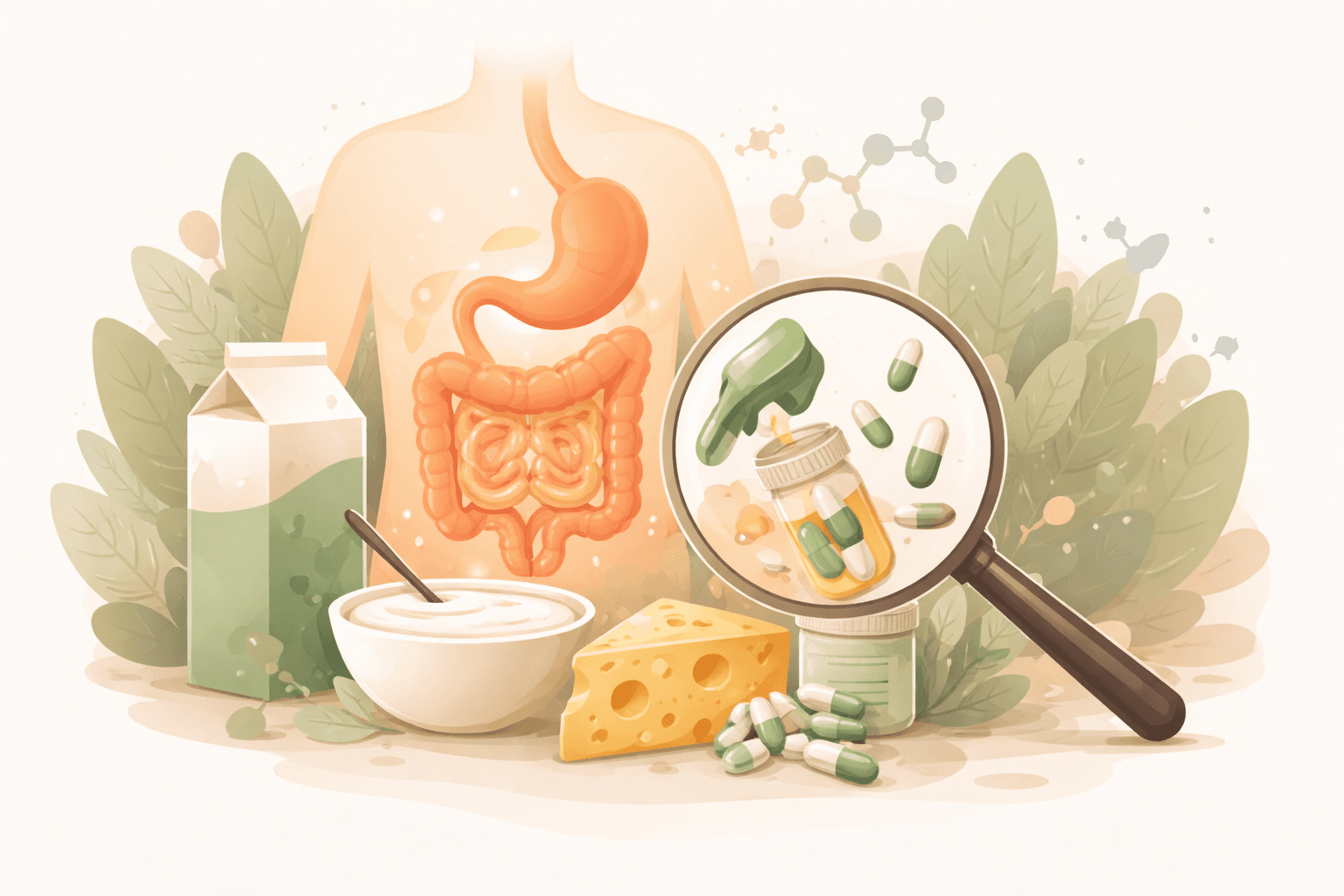
Digestive Enzymes and Food Intolerance (Supporting Article)
Lactose intolerance is one of the most common food intolerances worldwide. It stems from low activity of lactase—the small-intestinal enzyme that breaks lactose into glucose and galactose. When lactose isn’t fully digested, it travels to the colon where bacteria ferment it, producing gas and drawing water into the bowel. The result can be bloating, abdominal discomfort, and loose stools after dairy. This focused review looks at when lactase enzyme supplements actually help, what the research says about fermented dairy, and where the marketing hype begins.
Key point: Lactase supplements and lactose-reduced dairy may help many people with lactose malabsorption, but benefits vary by dose of lactose, product quality, gut context, and the specific food consumed. (Evidence: strong for symptom reduction with lactase or lactose-reduced dairy; moderate for probiotics and fermented dairy.)
What Lactase Enzymes Do—and Don’t Do
- The mechanism: Exogenous lactase (often beta-galactosidase from yeasts or fungi) hydrolyzes lactose before it reaches the colon, which may reduce gas and diarrhea. (Evidence: strong; digestive physiology is well established.)
- What they don’t do: Lactase does not treat milk-protein allergy or non-lactose causes of dairy reactions (for example, high fat triggering reflux or IBS-related visceral hypersensitivity). (Evidence: strong.)
How Well Do Lactase Supplements Work?
- Systematic reviews suggest that lactase supplements and lactose-reduced milk can meaningfully reduce breath hydrogen (a marker of malabsorption) and improve symptoms in lactose-intolerant adults. The AHRQ/Annals of Internal Medicine review concluded that lactase-treated products and yogurt with live cultures improved tolerance compared with untreated milk (Shaukat et al., Ann Intern Med, 2010). (Evidence: strong.)
- Randomized, placebo-controlled crossover trials in confirmed lactose malabsorbers report lower breath hydrogen and fewer symptoms when lactase is taken with a lactose load (e.g., DiPalma et al., Am J Gastroenterol, 1996; Suarez et al., N Engl J Med, 1995). Effects tend to be dose- and timing-dependent and may vary across brands. (Evidence: strong for efficacy; moderate for real-world variability.)
- Real foods vs test drinks: Benefits are clearest in trials using a standardized lactose drink. In everyday meals, outcomes can vary because fat, fiber, and meal timing influence gastric emptying and how much intact lactose reaches the enzyme. (Evidence: moderate.)
Lactase-Treated Milk and Drops: An Alternative Route
- Pre-hydrolyzing milk with lactase (commercial lactose-free milk or adding lactase drops to milk in advance) reduces the lactose load before consumption and may improve tolerance similarly to on-the-spot tablets. Trials comparing lactase-treated milk to regular milk show reduced breath hydrogen and fewer symptoms (Shaukat et al., 2010; de Vrese et al., J Nutr, 2001). (Evidence: strong.)
- Practical considerations: Enzymes are proteins and can be inactivated by heat or long storage at unfavorable conditions; product quality control varies. (Evidence: moderate.)
Who Is Most Likely to Benefit?
- Confirmed lactose malabsorbers (positive hydrogen breath test or clear symptom pattern after typical dairy) are the primary candidates. (Evidence: strong.)
- People with coexisting gut conditions (IBS, small intestinal bacterial overgrowth, celiac disease not in remission) may experience partial relief because multiple mechanisms can drive symptoms. Lactase may help lactose-specific symptoms but won’t address broader dysbiosis or inflammation. (Evidence: moderate.)
- Genetics and aging: Lactase non-persistence is genetically programmed in many populations, with expression declining after weaning. While many notice worsening tolerance across adulthood, data suggest genetics and gut health—not aging alone—drive most of the change. (Evidence: moderate; Shaukat et al., 2010.)
How Does Fermented Dairy Fit In?
- Yogurt with live cultures: Research suggests yogurt is better tolerated than milk because the bacteria provide beta-galactosidase and the semi-solid matrix slows gastric emptying, aiding digestion. RCTs show reduced breath hydrogen and symptoms with live-culture yogurt compared to milk of equal lactose content (Savaiano et al., Am J Clin Nutr, 1984; de Vrese et al., J Nutr, 2001). (Evidence: strong.)
- Kefir and traditional fermentation: Small trials report that kefir may reduce symptoms vs milk in lactose malabsorbers (Hertzler & Clancy, J Am Diet Assoc, 2003). Traditional practices of fermenting dairy—common from the Caucasus to South Asia—effectively pre-digest lactose and may support tolerance in some individuals. (Evidence: moderate.)
- Aged cheeses: Many hard, aged cheeses are naturally low in lactose due to fermentation and whey removal. People who react to milk may tolerate these better. (Evidence: strong for low lactose content; moderate for symptom benefit.)
What About Probiotics?
- Strain matters: A meta-analysis found that certain probiotic strains modestly improved lactose digestion and reduced symptoms, but effects were variable across studies and strains (Yang et al., World J Gastroenterol, 2013). Strains from Lactobacillus and Bifidobacterium with beta-galactosidase activity appear most promising. (Evidence: moderate.)
- Practical note: Benefits may take time and can be subtle; not all products contain sufficient viable strains or the right species to affect lactose handling. (Evidence: moderate.)
Common Pitfalls and Hype
- “Broad-spectrum” digestive enzyme blends: Many products bundle proteases, lipases, and carbohydrases and imply they fix dairy intolerance. Unless a product contains adequate lactase, research does not support broad claims for lactose-specific symptom relief. (Evidence: moderate.)
- Dairy allergy confusion: Enzymes for lactose do not address immune-mediated milk protein allergy. Symptoms like hives, wheeze, or anaphylaxis require medical evaluation. (Evidence: strong.)
- High-lactose loads: Even with supplementation, very large lactose doses may exceed what the enzyme can handle, especially if timing or product quality is suboptimal. (Evidence: moderate.)
Bridging Western Research and Traditional Practices
- Western trials validate a principle long used in food traditions: ferment before you eat. Yogurt, kefir, and cultured dairy effectively reduce lactose exposure while delivering live microbes that may assist digestion. (Evidence: strong for yogurt tolerance; moderate for kefir and strain-specific effects.)
- Culinary strategies—pairing dairy with meals, choosing cultured products, and selecting naturally low-lactose cheeses—mirror laboratory findings on gastric emptying and enzyme-substrate contact time. (Evidence: moderate.)
Safety Snapshot
- Lactase supplements are generally well tolerated. Reported adverse effects are uncommon and mild. People with complex medical conditions or those managing blood sugars should review labels and discuss new products with a clinician. (Evidence: moderate.)
How to Think About Trying Lactase
- Consider your pattern: If small amounts of yogurt or aged cheese are fine but milk causes distress, lactose malabsorption is plausible.
- Trial-and-observe: Research suggests that using lactase with the first bites of lactose-containing foods or choosing pre-hydrolyzed dairy may reduce symptoms for many people. Individual responses vary. (Evidence: strong.)
- Keep context in mind: If symptoms persist despite careful trials, other factors (overall FODMAP load, IBS, gut infections, or inflammation) may be involved and warrant professional evaluation. (Evidence: moderate.)
Bottom Line
- For confirmed or likely lactose malabsorption, lactase supplements and lactose-reduced or fermented dairy may help reduce gas, bloating, and diarrhea compared with untreated milk. (Evidence: strong.)
- Yogurt with live cultures and many aged cheeses are often better tolerated than milk of equal lactose content. (Evidence: strong.)
- Probiotic supplements may help some individuals, but benefits are strain-specific and modest on average. (Evidence: moderate.)
- Enzyme blends without lactase will not address lactose-specific intolerance, and lactase cannot treat milk-protein allergy. (Evidence: strong.)
- As with most nutrition strategies, outcomes are individual. A structured self-trial—preferably alongside guidance from a healthcare professional—may clarify what works best for you.
Selected References
- Shaukat A, Levitt MD, Taylor BC, et al. Systematic review: Lactose intolerance and health. Ann Intern Med. 2010;152(12):797–803 (AHRQ Comparative Effectiveness Review).
- Suarez FL, Savaiano DA, Levitt MD. A comparison of symptoms after the intake of milk or lactose-hydrolyzed milk by people with self-reported severe lactose intolerance. N Engl J Med. 1995;333:1–4.
- de Vrese M, Stegelmann A, Richter B, et al. Probiotics—compensation for lactase insufficiency. J Nutr. 2001;131(10):2447–2451.
- Yang J, Wang HP, Zhou L, Xu CF. Effect of probiotics on lactose intolerance: A meta-analysis. World J Gastroenterol. 2013;19(10):1707–1713.
- Hertzler SR, Clancy SM. Kefir improves lactose digestion and tolerance in adults with lactose maldigestion. J Am Diet Assoc. 2003;103:582–587.
- DiPalma JA, Collins MS, et al. Enzyme supplementation improves lactose digestion and intolerance in adult lactose malabsorbers. Am J Gastroenterol. 1996;91:1388–1392.