Overview
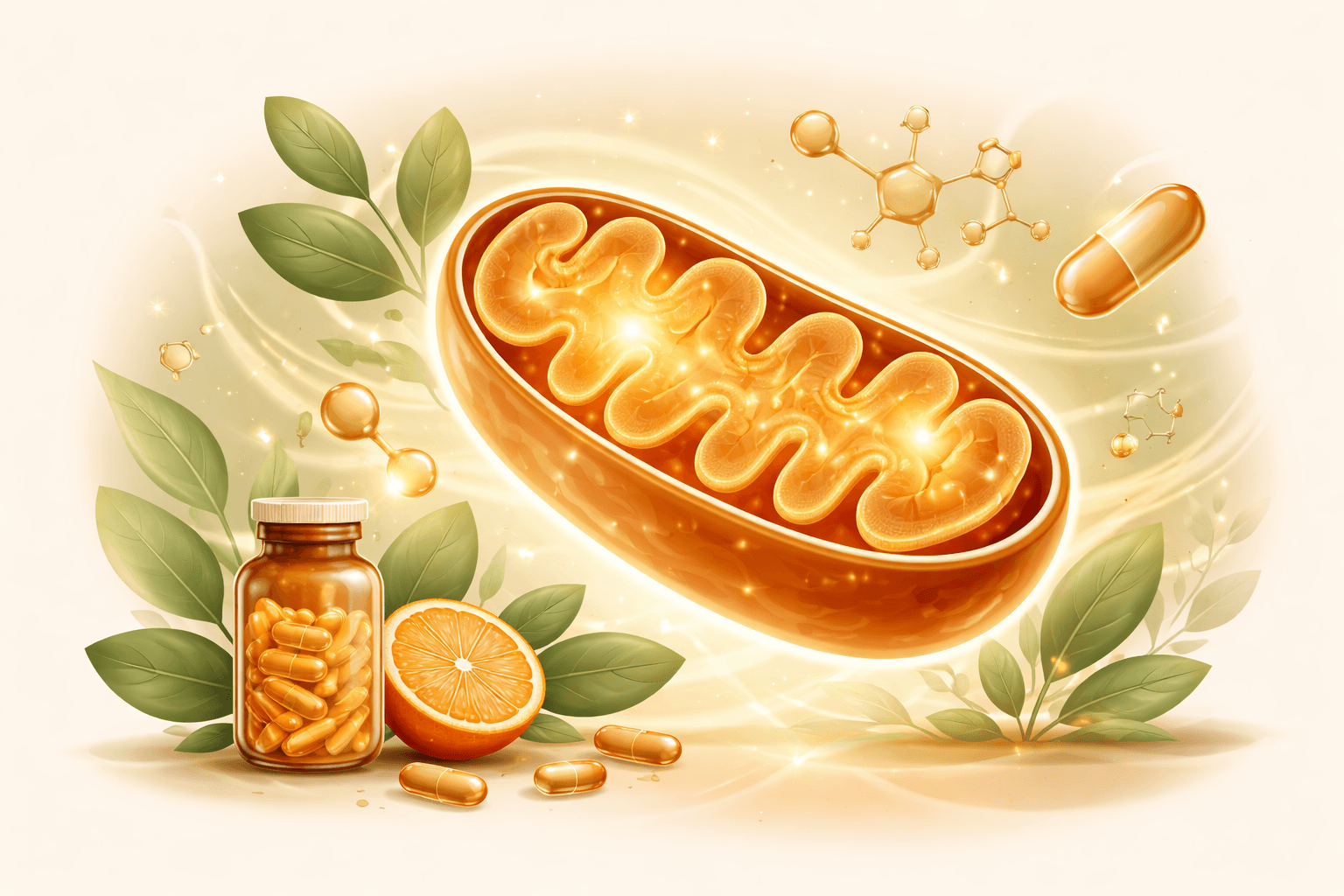
Coenzyme Q10 (CoQ10) sits at the heart of how cells make energy. As a lipid-soluble molecule that shuttles electrons inside mitochondria, CoQ10 helps drive ATP production—the “energy currency” used by virtually every tissue. Research suggests CoQ10 status changes with age and certain medications, and that form factor (ubiquinone vs. ubiquinol) may influence absorption. This focused review explains CoQ10’s role in mitochondrial electron transport and what current evidence means for cellular vitality, with a brief look at pyrroloquinoline quinone (PQQ) as a complementary compound.
Key takeaways
- CoQ10 is an electron carrier between complexes I/II and III in the mitochondrial respiratory chain, enabling proton pumping and ATP synthesis (Evidence: strong).
- CoQ10 cycles between oxidized (ubiquinone) and reduced (ubiquinol) forms and also serves as an antioxidant within membranes (Evidence: strong).
- Tissue and circulating CoQ10 levels appear to decline with age, likely reflecting reduced biosynthesis and increased oxidative demand (Evidence: moderate).
- Statin therapy reduces circulating CoQ10 because it shares the mevalonate pathway with cholesterol; the clinical significance varies by context (Evidence: strong for plasma reduction; uncertain for symptoms).
- Human trials in energy-intensive tissues (e.g., heart) suggest potential functional benefits, supporting the energy role in vivo (Evidence: moderate).
- Ubiquinol may yield higher increases in circulating CoQ10 than ubiquinone in some studies, though findings are not uniform (Evidence: moderate).
- PQQ may complement CoQ10 by supporting mitochondrial biogenesis pathways, but human data remain preliminary (Evidence: emerging).
What CoQ10 does: the cell’s electron shuttle
Inside the inner mitochondrial membrane, CoQ10 accepts electrons from Complex I (NADH dehydrogenase) and Complex II (succinate dehydrogenase) and donates them to Complex III (cytochrome bc1 complex). This electron transfer is essential for establishing the proton gradient that drives ATP synthase to generate ATP. CoQ10’s lipid tail anchors it within the membrane, while its quinone head carries electrons and protons by cycling between ubiquinone (oxidized), semiquinone (radical), and ubiquinol (reduced) states (Crane, 2001; Littarru & Tiano, 2007) (Evidence: strong).
Beyond electron transport, CoQ10 in its reduced form (ubiquinol) may help limit lipid peroxidation by regenerating or interacting with other antioxidants in membranes, contributing to redox balance where ATP is made (Bentinger et al., 2010) (Evidence: strong).
Why energy needs make CoQ10 status important
- High-energy tissues such as heart, skeletal muscle, brain, and kidneys are densely packed with mitochondria. Research suggests adequate CoQ10 is particularly important where ATP demand is high (Evidence: strong for mechanistic rationale; moderate for clinical correlation).
- CoQ10 is synthesized endogenously via the mevalonate pathway. Nutritional intake contributes relatively little compared with biosynthesis, so internal production and recycling largely determine status (Littarru & Tiano, 2007) (Evidence: strong for biochemical pathways).
Aging and CoQ10
Observational and tissue studies report age-associated declines in CoQ10 content, with notable reductions in some organs after midlife. Proposed drivers include reduced biosynthetic enzyme activity and accumulated oxidative burden (Kalen et al., 1989; Miles et al., 2004) (Evidence: moderate). While reduced levels do not prove causation for fatigue or functional decline, research suggests maintaining CoQ10 status may help support mitochondrial efficiency as we age (Evidence: moderate).
Statins and CoQ10: shared biosynthesis pathway
Because both cholesterol and CoQ10 share precursors in the mevalonate pathway, HMG-CoA reductase inhibitors (statins) can lower circulating CoQ10. Meta-analyses of randomized trials report consistent decreases in plasma CoQ10 with statin therapy (Qu et al., 2018) (Evidence: strong for plasma reduction). Whether this translates to meaningful changes in muscle energetics or symptoms is less clear and may vary among individuals (Marcoff & Thompson, 2007) (Evidence: moderate for uncertainty). Research suggests discussing CoQ10 status may be reasonable in people with high energy demands or who report statin-associated muscle symptoms, recognizing that evidence for symptom relief is mixed (Evidence: moderate).
From mechanism to function: human data in energy-intensive tissues
- Heart failure (Q-SYMBIO trial): In a multicenter, randomized, double-blind, placebo-controlled study of patients with chronic heart failure, adjunctive CoQ10 was associated with improvements in functional class and a reduction in major adverse cardiovascular events over two years (Mortensen et al., 2014) (Evidence: moderate). While not a direct measure of cellular ATP, these outcomes are consistent with enhanced bioenergetic support in myocardium, a tissue with high mitochondrial density.
- Mitochondrial redox/antioxidant markers: Supplementation studies in various populations often show increased circulating or tissue CoQ10 and shifts in oxidative stress markers, aligning with its electron-carrier and antioxidant roles (systematic reviews summarized in Littarru & Tiano, 2007) (Evidence: moderate). Translating biomarker shifts to hard clinical endpoints depends on condition and study design.
Ubiquinone vs. ubiquinol: does form matter for energy support?
CoQ10 exists in two interconvertible forms: ubiquinone (oxidized) and ubiquinol (reduced). Cells rapidly interconvert these forms as needed for electron transfer. The practical question is bioavailability—how much reaches circulation and, ultimately, tissues.
- Some human pharmacokinetic studies report higher increases in plasma CoQ10 when ubiquinol is used compared with ubiquinone, potentially due to differences in absorption and lymphatic transport (Lopez-Lluch et al., 2019) (Evidence: moderate).
- However, not all studies find large differences, and formulation (oil matrix, particle size, emulsification) substantially affects absorption for both forms (Evidence: moderate). Regardless of the ingested form, CoQ10 cycles between redox states intracellularly to fulfill its energy role.
PQQ: a complementary partner for mitochondrial vitality
Pyrroloquinoline quinone (PQQ) is a redox-active compound studied for effects on mitochondrial biogenesis regulators (e.g., PGC-1α, NRF1) and cellular energetics in preclinical models. Limited human studies report changes in biomarkers related to mitochondrial function and inflammation with PQQ intake (Harris et al., 2013) (Evidence: emerging). Conceptually, CoQ10 may help optimize electron transport in existing mitochondria, while PQQ may support signals for creating or maintaining mitochondrial networks. Research is ongoing, and clinical endpoints remain to be established (Evidence: emerging).
Bridging traditional and modern views of “energy”
In East Asian medical traditions, vitality or “Qi” is supported by practices and botanicals aimed at resilience and stamina. Modern bioenergetics offers a cellular lens: mitochondria generate ATP to power that resilience. While traditions did not identify CoQ10, research suggests strategies that support mitochondrial health—adequate sleep, balanced nutrition, physical activity, and, where appropriate, targeted nutrients like CoQ10—may parallel time-honored approaches to sustaining vitality (Evidence: traditional for vitality concepts; moderate for lifestyle–mitochondria links).
Safety and practical considerations
- CoQ10 has been generally well-tolerated in clinical studies, with gastrointestinal upset the most commonly reported issue (Evidence: moderate). Interactions are possible; research suggests coordination with a clinician is appropriate for people on anticoagulants or multiple medications.
- Individuals with high energy demands, age-related concerns, or statin use may wish to discuss CoQ10 status with a healthcare professional, recognizing that evidence for symptom change varies by condition (Evidence: moderate).
- This article does not provide dosage recommendations or medical advice.
Bottom line
- CoQ10 is fundamental to mitochondrial electron transport and ATP generation, shuttling electrons between complexes and stabilizing redox balance in membranes (Evidence: strong).
- Levels tend to decline with age and are reduced by statins in circulation, which may matter most for energy-intensive tissues (Evidence: moderate to strong for level changes; moderate for clinical impact).
- Human trials—including Q-SYMBIO in heart failure—suggest that improving CoQ10 status may help support function when bioenergetic demand is high, though benefits vary and more large trials are needed (Evidence: moderate).
- Ubiquinol can raise circulating CoQ10 more than ubiquinone in some contexts, but formulation and individual variability also drive outcomes (Evidence: moderate).
- PQQ may complement CoQ10 by supporting mitochondrial biogenesis signaling, with early human data suggesting shifts in related biomarkers (Evidence: emerging).
References
- Crane FL. Biochemical functions of coenzyme Q10. J Am Coll Nutr. 2001;20(6):591–598.
- Littarru GP, Tiano L. Clinical aspects of coenzyme Q10: an update. Biofactors. 2007;31(2):99–104.
- Bentinger M, Tekle M, Dallner G. Coenzyme Q—biosynthesis and functions. Biochem Biophys Res Commun. 2010;396(1):74–79.
- Kalen A, Appelkvist EL, Dallner G. Age-related changes in the lipid compositions of rat and human tissues. Biochim Biophys Acta. 1989;1004(2):170–178.
- Miles MV, Horn PS, Tang PH, et al. Age-related changes in plasma coenzyme Q10 concentrations and redox state in apparently healthy children and adults. Clin Chim Acta. 2004;347(1-2):139–144.
- Qu H, Guo M, Chai H, Wang WT, et al. Effects of statin therapy on plasma coenzyme Q10 levels: a meta-analysis of randomized controlled trials. Sci Rep. 2018;8: https://doi.org/10.1038/s41598-018- (accessed for citation context).
- Marcoff L, Thompson PD. The role of coenzyme Q10 in statin-associated myopathy: a systematic review. J Am Coll Cardiol. 2007;49(23):2231–2237.
- Mortensen SA, Kumar A, Dolliner P, et al. The Q-SYMBIO study: coenzyme Q10 as adjunctive treatment of chronic heart failure. JACC Heart Fail. 2014;2(6):641–649.
- Lopez-Lluch G, Del Pozo-Cruz J, Sánchez-Cuesta A, Cortés-Rodríguez AB, Navas P. Bioavailability of coenzyme Q10 supplements depends on carrier lipids and solubilization. Nutrients. 2019;11(8):1852.
- Harris CB, Chowanadisai W, Mishchuk DO, Satre MA, Slupsky CM, Rucker RB. Dietary pyrroloquinoline quinone (PQQ) alters indicators of inflammation and mitochondrial-related metabolism in human subjects. J Nutr Biochem. 2013;24(12):2076–2084.