Overview
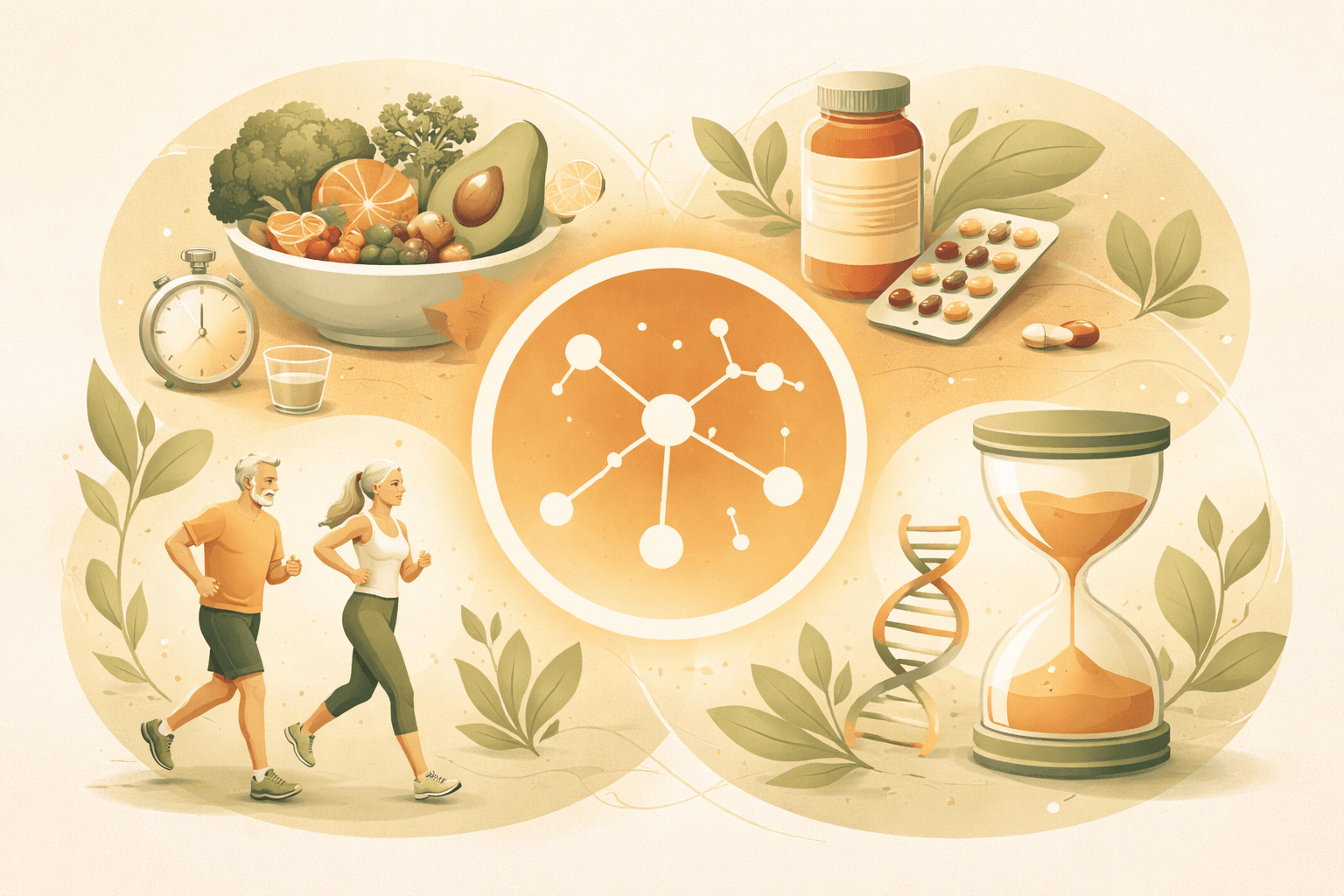
Caloric restriction and rapamycin appear to influence aging through a shared cellular hub: the mechanistic target of rapamycin (mTOR). This focused review examines how these strategies converge on mTOR, what the Interventions Testing Program (ITP) in mice found about rapamycin and lifespan, early signals from human and canine studies, potential risks, and natural approaches that may modulate mTOR.
What is mTOR—and why it matters
mTOR is a nutrient-sensing kinase that integrates signals from amino acids, insulin/IGF-1, and cellular energy status to regulate growth, protein synthesis, and autophagy. It operates in two complexes: mTORC1 (growth/anabolism) and mTORC2 (insulin signaling and cytoskeletal regulation). Age-related overactivity of mTORC1 is hypothesized to promote cellular growth at the expense of repair, while intermittent downshifts may favor maintenance and resilience. (Evidence: moderate; Fontana & Partridge, 2015, Cell; Kennedy & Lamming, 2016, Cell Metabolism)
How caloric restriction interfaces with mTOR
• Caloric restriction (CR) without malnutrition consistently extends lifespan in yeast, worms, and flies, and often in rodents, in part by reducing mTORC1 signaling and enhancing autophagy. (Evidence: strong in model organisms; Fontana & Partridge, 2015, Cell; Swindell, 2012, AGE)
• In nonhuman primates, long-term CR improved healthspan and survival in at least one major study, suggesting translatability, though findings vary across cohorts. Mechanistic analyses implicate nutrient-sensing pathways including mTOR. (Evidence: moderate; Mattison et al., 2017, Nat Commun; Colman et al., 2014, Nat Commun)
• CR-related strategies—protein restriction, time-restricted eating, and intermittent fasting—may lower mTORC1 activity in certain tissues, potentially enhancing stress resistance. Human evidence is growing but heterogeneous. (Evidence: emerging; Cienfuegos et al., 2020, Cell Metab; Levine et al., 2014, Cell Metab)
Rapamycin: insights from the ITP mouse studies
The NIA Interventions Testing Program (ITP) evaluates candidate longevity interventions across multiple sites and genetically heterogeneous mice.
• Landmark finding: Encapsulated rapamycin added to the diet late in life extended median and maximal lifespan in both male and female mice. This suggests mTOR inhibition may influence aging even when started relatively late. (Evidence: strong in mice; Harrison et al., 2009, Nature)
• Follow-ups reported that higher rapamycin exposure generally produced larger lifespan gains and that response may differ by sex and dose, highlighting a narrow therapeutic window. (Evidence: strong in mice; Miller et al., 2014, Aging Cell)
• Short-term, late-life rapamycin improved age-related function (e.g., cardiac, immune, oral health metrics) in mouse studies, suggesting potential for healthspan effects. (Evidence: strong in mice; Bitto et al., 2016, eLife)
Where caloric restriction and rapamycin converge
• Both CR and rapamycin converge on mTORC1 signaling, albeit via different levers—CR through upstream nutrient and insulin/IGF-1 cues; rapamycin via direct pharmacologic inhibition of mTORC1. The net effect may be enhanced autophagy, reduced protein synthesis burden, and improved proteostasis. (Evidence: strong in preclinical models; Saxton & Sabatini, 2017, Cell)
• Despite convergence, CR and rapamycin are not identical: rapamycin can impact mTORC2 with chronic exposure, potentially altering glucose and lipid metabolism, while CR modulates multiple pathways (AMPK, sirtuins) in parallel. (Evidence: moderate; Lamming et al., 2012, Science; Fontana & Partridge, 2015, Cell)
Early human and companion-animal signals
• Immune aging: In older adults, selective mTOR inhibition with rapalogs was associated with improved influenza vaccine responses and reduced respiratory infections in randomized trials, suggesting that appropriately targeted mTOR modulation may rejuvenate certain immune functions. (Evidence: moderate; Mannick et al., 2014 & 2018, Sci Transl Med)
• Companion dogs: A randomized, placebo-controlled pilot in middle-aged pet dogs reported that short-course rapamycin was feasible and associated with improved echocardiographic measures of cardiac function; larger outcomes trials (Dog Aging Project’s TRIAD) are ongoing. (Evidence: emerging; Urfer et al., 2017, GeroScience; Dog Aging Project, ongoing)
• Healthy adults: The PEARL study (Participatory Evaluation of Aging with Rapamycin for Longevity) is a randomized, placebo-controlled trial evaluating rapamycin’s effects on biological aging markers and immune endpoints. Results are pending. (Evidence: emerging; PEARL trial registry/ongoing)
Risks and immunosuppression concerns
• Rapamycin is an FDA-approved immunosuppressant used in organ transplantation and oncology. Known risks include mouth ulcers, elevated lipids, edema, delayed wound healing, and increased infection risk at immunosuppressive exposures. (Evidence: strong; prescribing information and transplant literature)
• In aging research contexts, lower or intermittent exposures are under study; however, long-term safety and optimal regimens in healthy populations remain uncertain. (Evidence: emerging; Mannick et al., 2014 & 2018, Sci Transl Med; trial protocols)
• mTORC2 considerations: Chronic inhibition can impair glucose tolerance and alter lipid metabolism, underscoring the importance of dosing schedules and tissue specificity. (Evidence: moderate; Lamming et al., 2012, Science)
Natural and lifestyle mTOR modulators
Without recommending specific practices, research suggests several levers may influence mTOR-related biology:
• Feeding patterns: Intermittent fasting, time-restricted eating, and protein timing may transiently reduce systemic mTORC1 signaling and enhance autophagy during fasting windows. Effects likely vary by tissue and individual. (Evidence: emerging; Patterson & Sears, 2017, Annu Rev Nutr; Cienfuegos et al., 2020, Cell Metab)
• Exercise: Resistance exercise acutely activates mTORC1 in muscle (supporting growth), while endurance exercise and the post-exercise fasted state may tilt toward AMPK activation and autophagy. Balanced training may help cycle between growth and repair. (Evidence: moderate; Goodman, 2014, Front Physiol; Egan & Zierath, 2013, Cold Spring Harb Perspect Med)
• Polyphenols and nutraceuticals: Compounds such as resveratrol, EGCG, quercetin, curcumin, and spermidine have been reported to influence AMPK–mTOR–autophagy pathways in preclinical models; human evidence for longevity endpoints is limited, though observational data link higher dietary spermidine with lower mortality. (Evidence: emerging; Eisenberg et al., 2016, Nat Med; Kiechl et al., 2018, Am J Clin Nutr; Springer & Moco, 2019, Nutrients)
• Metabolic modulators: Berberine and related compounds may activate AMPK and indirectly inhibit mTORC1 in preclinical studies; clinical trials show metabolic benefits but not established longevity effects. (Evidence: emerging; Zhang et al., 2010, Metabolism; Lan et al., 2015, J Ethnopharmacol)
• Traditional perspectives: Periodic fasting is embedded in Ayurveda and Traditional Chinese Medicine (e.g., “bigu”) and may align conceptually with modern notions of cycling between nutrient abundance and cellular cleansing (autophagy). Mechanistic ties to mTOR are hypothesized based on modern studies of fasting physiology. (Evidence: traditional for practice; emerging for mechanisms; Longo & Panda, 2016, Cell Metab)
Why researchers are excited—but cautious
• Convergence across models: Independent lines of evidence—CR and rapamycin—implicate mTOR as a central node in aging biology, with robust lifespan extension in mice. (Evidence: strong in animals; Harrison et al., 2009; Miller et al., 2014)
• Translatability unknowns: Species differences, sex-specific responses, potential trade-offs (infection risk, metabolic effects, wound healing), and the complexity of mTORC1 vs mTORC2 make translation to humans uncertain. (Evidence: moderate; Kennedy & Lamming, 2016, Cell Metab)
• Early human data: Improved vaccine responses in older adults using rapalogs suggest targeted benefits, yet comprehensive long-term safety and aging outcomes are not established. Ongoing trials (PEARL, Dog Aging Project) are designed to clarify benefits and risks. (Evidence: emerging; Mannick et al., 2014 & 2018; trial protocols)
• Systems view: Longevity likely arises from orchestrating cycles of growth and repair. Approaches that judiciously modulate mTOR—via lifestyle, potential therapeutics, or both—may help, but personalization and careful risk–benefit evaluation are essential. (Evidence: moderate; Lopez-Otín et al., 2023, Cell)
Bottom line
• mTOR sits at the crossroads of nutrient sensing, growth, and cellular cleanup. Caloric restriction and rapamycin both appear to influence this pathway, and mouse studies from the ITP provide strong evidence that attenuating mTORC1 can extend lifespan under controlled conditions. (Evidence: strong in animals)
• Early human and companion-animal research suggests potential benefits for immune function and cardiac health markers, but definitive longevity or broad healthspan outcomes are not yet established. (Evidence: emerging)
• Rapamycin’s medical use highlights real risks, including immunosuppression and metabolic side effects, underscoring caution while trials like PEARL and the Dog Aging Project proceed. (Evidence: strong for risks in patients; emerging in healthy adults)
• Natural levers—feeding patterns, exercise cycles, and certain dietary compounds—may nudge mTOR biology, aligning with traditional fasting practices, though rigorous human longevity data remain limited. (Evidence: emerging)
• The excitement is grounded in strong preclinical signals and a coherent mechanistic story; the caution reflects the need for high-quality human evidence to balance benefits with risks.
Selected references
• Harrison DE et al. Rapamycin fed late in life extends lifespan in genetically heterogeneous mice. Nature, 2009.
• Miller RA et al. Rapamycin-mediated lifespan increase in mice is dose and sex dependent. Aging Cell, 2014.
• Bitto A et al. Transient rapamycin treatment can increase lifespan and healthspan in old mice. eLife, 2016.
• Mannick JB et al. mTOR inhibition improves immune function in the elderly. Sci Transl Med, 2014; 2018.
• Urfer SR et al. Short-term rapamycin treatment in middle-aged companion dogs. GeroScience, 2017.
• Mattison JA et al. Caloric restriction improves health and survival in rhesus monkeys. Nat Commun, 2017.
• Fontana L & Partridge L. Promoting health and longevity through diet: from model organisms to humans. Cell, 2015.
• Kennedy BK & Lamming DW. The mechanistic target of rapamycin: the grand conductor of metabolism and aging. Cell Metab, 2016.
• Saxton RA & Sabatini DM. mTOR signaling in growth, metabolism, and disease. Cell, 2017.
• Eisenberg T et al. Spermidine extends lifespan and healthspan in mice. Nat Med, 2016.
• Kiechl S et al. Higher spermidine intake is linked with lower mortality. Am J Clin Nutr, 2018.
• Lopez-Otín C et al. Hallmarks of aging: an expanding universe. Cell, 2023.