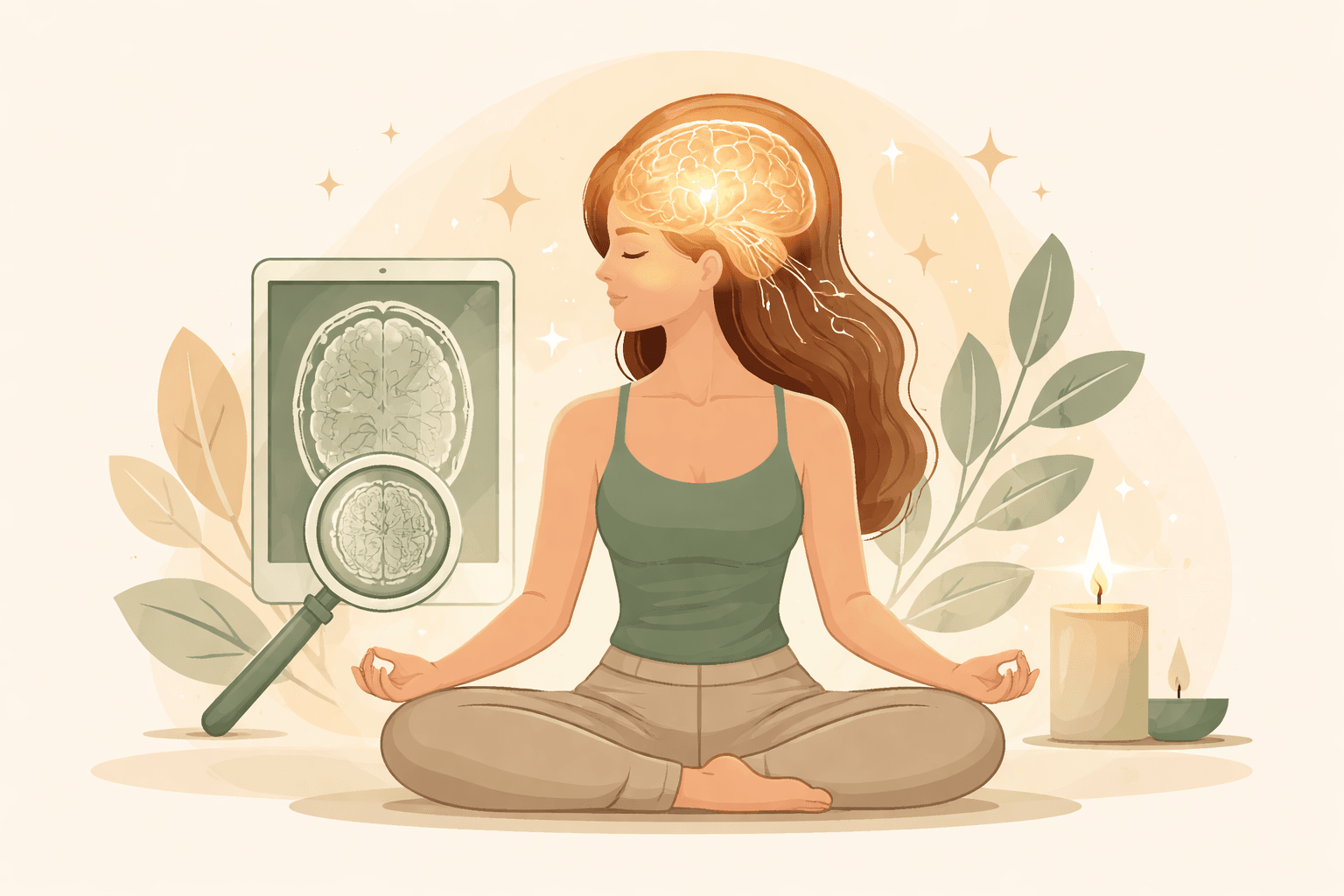
Meditation and Brain Structure: What Neuroimaging Reveals
For more than 2,500 years, contemplative traditions have claimed that steady practice transforms the mind. Modern neuroimaging now suggests the brain itself may change as well. Structural MRI and diffusion tensor imaging (DTI) studies have linked meditation to measurable differences in cortical thickness, gray matter density, subcortical volumes, and white matter integrity. While the field is still maturing—with small samples and methodological variability—the convergence of findings across laboratories provides a cautious but compelling picture of meditation-related neuroplasticity.
This focused review summarizes what research suggests about where and how the brain may change with meditation, how these findings relate to anxiety and mood outcomes, and whether different practices show distinct patterns. Evidence levels are provided for key claims.
What “changing the brain” means
In imaging research, structural brain change typically refers to:
- Cortical thickness or surface area measured by MRI (Evidence concept: standard)
- Gray matter density or volume in cortical and subcortical regions (Evidence concept: standard)
- White matter integrity indexed by DTI (e.g., fractional anisotropy) (Evidence concept: standard)
Changes are usually inferred from cross-sectional comparisons (experienced meditators vs. non-meditators) or longitudinal pre–post designs following a meditation program.
Core structural findings
Prefrontal cortex and insula: Long-term meditators show greater cortical thickness in regions involved in attention and interoception, including the dorsolateral prefrontal cortex and anterior insula. A landmark study reported thicker cortices in experienced meditators and less age-related thinning (Lazar et al., NeuroReport, 2005). Meta-analysis also highlights consistent effects in the insula and anterior cingulate cortex (ACC) (Fox et al., Neuroscience & Biobehavioral Reviews, 2014). (Evidence: moderate)
Hippocampus: An eight-week mindfulness-based program was associated with increased gray matter concentration in the left hippocampus, a region central to memory and stress regulation (Hölzel et al., Psychiatry Research: Neuroimaging, 2011). Cross-sectional work also reports larger hippocampal volumes in long-term practitioners (Luders et al., NeuroImage, 2009). (Evidence: moderate)
Amygdala: Following mindfulness training, decreased gray matter density has been observed in the amygdala—the brain’s threat-detection hub—with reductions correlating to lower perceived stress (Hölzel et al., Social Cognitive and Affective Neuroscience, 2010). (Evidence: moderate)
ACC-related white matter: Short-term integrative body–mind training, a form of focused attention with relaxation, was linked to increased white matter integrity around the ACC after about 11 hours of practice spread over several weeks (Tang et al., Proceedings of the National Academy of Sciences, 2010). (Evidence: emerging to moderate)
Whole-brain patterns: A systematic review and meta-analysis encompassing structural studies in meditators identified convergent differences in frontopolar cortex, sensory cortices/insula, hippocampus, ACC, and corpus callosum. Effect sizes were small-to-moderate, and study quality varied (Fox et al., 2014). (Evidence: moderate)
What might these shifts mean functionally? In broad strokes, research suggests meditation may help strengthen networks for top-down regulation (prefrontal/ACC), interoceptive awareness (insula), contextual memory and stress buffering (hippocampus), and recalibration of emotional reactivity (amygdala). (Evidence: moderate)
Do brain changes relate to anxiety and depression outcomes?
Randomized trials and meta-analyses of mindfulness-based interventions report small-to-moderate improvements in anxiety and depressive symptoms compared with active controls (Goyal et al., JAMA Internal Medicine, 2014). While these outcome studies do not prove that structural brain changes cause symptom relief, converging evidence suggests that remodeling in emotion- and attention-related circuits may contribute to benefits observed on stress and mood. (Evidence for symptom improvement: strong; Evidence for direct structure–symptom mediation: emerging)
Do different meditation styles map to different brain patterns?
Mindfulness-based practices (e.g., Mindfulness-Based Stress Reduction): The most consistent structural findings come from mindfulness training, with longitudinal increases reported in hippocampus and cortical midline structures, and decreases in amygdala density paralleling stress reduction (Hölzel et al., 2010; 2011). (Evidence: moderate)
Loving-kindness/compassion practices: Functional changes in networks supporting empathy and positive affect are well-documented. Structural evidence is growing; for example, modular compassion training was linked to region-specific cortical changes in social cognition networks in a large longitudinal program (Valk et al., Science Advances, 2017). (Evidence: emerging to moderate)
Mantra-based practices/Transcendental Meditation: Functional imaging studies suggest altered default-mode dynamics and attentional control, but structural findings are fewer and more heterogeneous. Some cross-sectional research reports gray matter differences in frontal and temporal regions among mantra practitioners, though designs and samples vary. (Evidence: emerging)
Overall, mindfulness has the most longitudinal structural evidence to date, with compassion and mantra-based approaches showing promising but less extensive support.
Is there a dose–response relationship?
Practice history: In cross-sectional work, more lifetime practice hours and years of practice have correlated with greater cortical thickness in attention-related regions (Lazar et al., 2005). (Evidence: emerging to moderate)
Program duration: Detectable structural changes have been reported after several weeks of standardized training in both gray matter (Hölzel et al., 2011) and white matter (Tang et al., 2010). (Evidence: moderate)
Meta-analytic signals: Some moderation analyses suggest that greater accumulated practice may modestly predict larger structural effects in specific regions, with heterogeneity across studies (Fox et al., 2014). (Evidence: emerging)
These trends hint at a dose–response pattern, though exact thresholds and trajectories remain uncertain.
How this aligns with contemplative traditions
Classical Buddhist, yogic, and Daoist texts describe cultivation of sustained attention, equanimity, and compassion. Modern imaging studies situate these qualities in neural systems governing executive regulation (prefrontal/ACC), interoceptive clarity (insula), emotional salience (amygdala), and memory/context (hippocampus). While ancient frameworks speak in terms of mind training rather than synapses, research suggests that long-practiced contemplative methods may help reshape the neural architecture supporting attention and emotional balance. (Evidence: traditional for historical claims; moderate for neurobiological alignment)
Important caveats
- Causality and confounds: Many studies are observational or pre–post without active controls, leaving room for expectancy effects, lifestyle differences, and motion artifacts. (Evidence: strong caveat)
- Heterogeneity: “Meditation” encompasses diverse techniques; structural effects may be practice-specific and person-specific. (Evidence: strong caveat)
- Measurement limits: Gray matter metrics are indirect proxies; different pipelines can yield different results. Replication with preregistered, adequately powered trials is needed. (Evidence: strong caveat)
Bottom line
- Research suggests meditation may be associated with increased cortical thickness in attention and interoception regions, larger hippocampal gray matter, and reduced amygdala density following training. (Evidence: moderate)
- Mindfulness-based programs show the most consistent longitudinal structural findings, with growing evidence for compassion training and early signals for mantra-based approaches. (Evidence: moderate to emerging)
- Meta-analyses indicate small-to-moderate structural effects in insula, ACC, and hippocampus, aligning with networks for attention, interoception, and emotion regulation. (Evidence: moderate)
- Randomized trials show small-to-moderate improvements in anxiety and depression with mindfulness training; structural changes may contribute, though direct causal links remain under study. (Evidence: strong for outcomes; emerging for mediation)
- Early dose–response patterns suggest that both short-term training and longer practice histories may relate to detectable brain changes, but precise parameters are not established. (Evidence: emerging)
As imaging methods mature and larger, well-controlled trials accumulate, our understanding of how contemplative practice may reshape the brain—and how that relates to stress resilience and mood—will continue to sharpen.