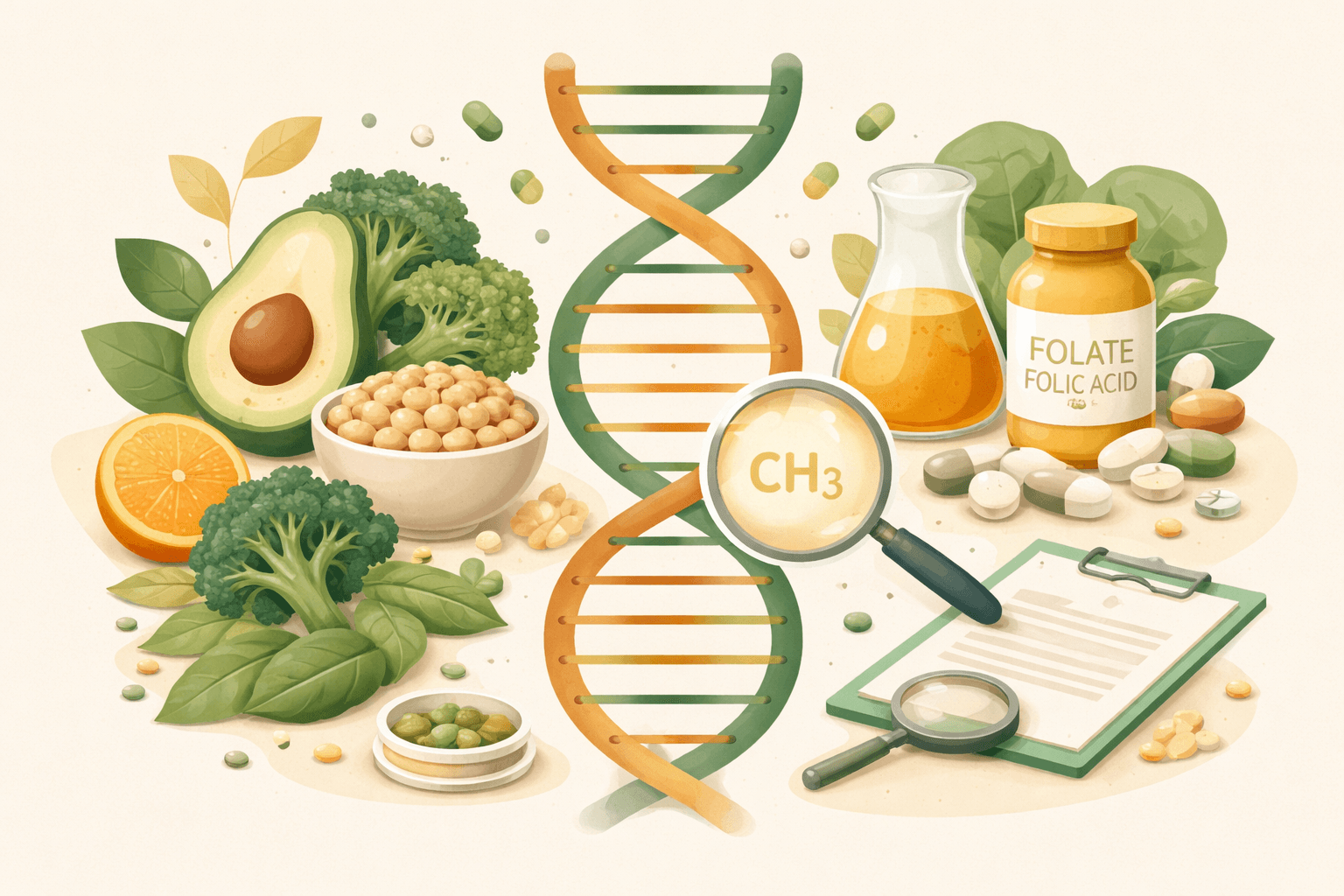
Methylation touches nearly every cell process your body runs—from turning genes on and off to making neurotransmitters and recycling homocysteine. Folate sits at the center of this cycle. But not all “folate” comes in the same form. Here’s a clear look at folate (the forms naturally present in foods and 5-methyltetrahydrofolate) versus folic acid (the synthetic form used in fortification and many supplements), what the science says about each for methylation, and how to choose a food-first approach.
Key terms, simply explained
- Methylation: A biochemical “tagging” process that supports DNA regulation, neurotransmitter production, detoxification, and cell repair. Folate and vitamin B12 donate and move methyl groups through this cycle. (Evidence: strong)
- 5-MTHF: 5-methyltetrahydrofolate, the primary active folate circulating in blood and used by methionine synthase to convert homocysteine to methionine. (Evidence: strong)
- Folic acid: A synthetic, oxidized form of folate used in grain fortification and many supplements; it must be converted by the enzyme dihydrofolate reductase (DHFR) into active forms. (Evidence: strong)
- MTHFR: An enzyme (methylenetetrahydrofolate reductase) that makes 5-MTHF from other folate forms. Common genetic variants (such as C677T) can reduce enzyme activity and modestly raise homocysteine when folate status is low. (Evidence: strong)
Why the form of folate matters
- Absorption and activation: Both folic acid and natural food folates are absorbed in the small intestine. Folic acid requires multiple steps—chiefly DHFR reduction—before it becomes 5-MTHF. Human DHFR is relatively slow, so high intakes may leave a small amount of unmetabolized folic acid (UMFA) circulating in blood. Research links UMFA presence to high supplemental/fortified intakes, but its clinical impact remains uncertain. (Evidence: strong for UMFA occurrence; emerging for health effects)
- 5-MTHF as the “ready-to-use” form: Supplemental L-5-MTHF (also labeled methylfolate) bypasses MTHFR and DHFR steps and appears in blood as 5-MTHF directly. Systematic reviews suggest 5-MTHF is at least as effective as folic acid for raising folate status and lowering homocysteine, and may be more effective in people with the MTHFR 677TT genotype. (Evidence: moderate)
What outcomes does the research support?
- Neural tube defect (NTD) prevention
- Large population interventions and Cochrane reviews show folic acid fortification/supplementation around conception substantially reduces NTD risk. This is one of the strongest public health successes of nutrition policy. Whole-food folate also supports NTD prevention, but fortification with folic acid improved outcomes at scale. (Evidence: strong)
- Homocysteine and cardiovascular risk
- Both folic acid and 5-MTHF lower homocysteine, a functional marker influenced by folate, B12, and B6. Meta-analyses indicate that lowering homocysteine reduces stroke risk in populations without grain fortification or where baseline folate status is low. The China Stroke Primary Prevention Trial (JAMA 2015) reported reduced stroke with folic acid added to antihypertensive therapy. In countries with long-standing fortification (and higher baseline folate), folic acid has not consistently reduced coronary events, likely because homocysteine is already near optimal. (Evidence: strong for homocysteine lowering; moderate for clinical event reduction, context-dependent)
- MTHFR variants and choice of folate form
- The common MTHFR C677T variant occurs in about 30–40% of many populations (heterozygous) and 8–15% (homozygous), with variation by ancestry. TT carriers tend to have slightly higher homocysteine when folate status is low. Trials and reviews suggest methylfolate can equal or outperform folic acid in improving folate status and homocysteine in TT individuals, but overall health outcomes depend on total B vitamin status, not genotype alone. (Evidence: moderate)
- Mood and cognition
- Adjunctive L-methylfolate has improved depressive symptoms in some randomized trials of SSRI nonresponders, independent of overt folate deficiency. Effects are modest and not universal. For cognition or dementia prevention, B vitamins (including folate) may slow brain atrophy in people with elevated homocysteine, but results on clinical outcomes are mixed. (Evidence: moderate for depression adjunct; emerging-to-moderate for cognition depending on subgroup)
- Unmetabolized folic acid (UMFA): signal without clear harm?
- UMFA is commonly detectable in fortified populations and with high-dose folic acid use. Observational studies have explored links with immune function and cancer recurrence, but causality is unproven and RCTs are limited. Current consensus holds that UMFA’s clinical significance is unclear; maintaining adequate, not excessive, total folate intake and ensuring sufficient B12 appear prudent. (Evidence: emerging)
Food-first strategies for healthy methylation
- Emphasize naturally folate-rich foods: leafy greens (spinach, romaine, chard), asparagus, Brussels sprouts, avocado, legumes (lentils, chickpeas, black beans), citrus, and beets. Liver—used traditionally in many cultures—provides concentrated folate plus B12 and choline, other methylation supports. Cooking losses of folate can be substantial, so mix raw and lightly cooked options. (Evidence: strong for nutrient content; traditional use: traditional)
- Round out the methylation team: Adequate B12 (animal foods such as seafood, eggs, dairy; or fortified foods), B6 (poultry, fish, potatoes, bananas), riboflavin (dairy, eggs, almonds), and choline (eggs, soy, liver) support the cycle and homocysteine clearance. Research suggests that homocysteine reflects the balance of these nutrients more than any single gene. (Evidence: strong)
- Fortified foods can help, with context: In many countries, enriched grains contribute substantially to folate intake and have reduced NTDs. For individuals with limited grain intake or specific genotypes, 5-MTHF supplements may help normalize homocysteine similarly to folic acid. Coordination with healthcare professionals is appropriate when interpreting lab markers. (Evidence: strong for NTDs; moderate for individual optimization)
Eastern and traditional perspectives
- Traditional dietary patterns often paired leafy greens, legumes, and organ meats—combinations that supply folate, B12, iron, and choline. In East Asian and Mediterranean cuisines, herb-rich greens and pulses were staples, while many traditional European and Asian diets valued liver periodically for “blood-building.” Modern research on methylation provides a biochemical rationale for these time-tested practices: diverse, nutrient-dense foods support cellular renewal and resilience. (Evidence: traditional; mechanistic support: moderate)
How to interpret your homocysteine in this context
- Homocysteine is a practical functional marker of methylation status affected by folate, B12, B6, riboflavin, kidney function, and lifestyle factors. Lowering elevated homocysteine with B vitamins reduces stroke risk in low-folate settings, but translating homocysteine changes to broad disease risk reduction in fortified populations remains uncertain. Research suggests it’s most useful as one piece of a bigger nutrition picture. (Evidence: strong for marker utility; moderate for outcome prediction)
Evidence at a glance
- Folic acid and 5-MTHF both improve folate status and lower homocysteine; 5-MTHF may benefit MTHFR 677TT carriers more. (Evidence: moderate)
- Folic acid fortification/supplementation reduces neural tube defects at the population level. (Evidence: strong)
- Homocysteine lowering reduces stroke risk in low-folate populations; effects are mixed in fortified regions. (Evidence: moderate)
- UMFA occurs with high folic acid exposure; health implications remain unclear. (Evidence: emerging)
- Food-first patterns rich in natural folate, B12, B6, and choline support methylation. (Evidence: strong)
Bottom line
Both folic acid and methylfolate can support healthy methylation. Folic acid has a proven public health track record for preventing neural tube defects and reliably lowers homocysteine, especially where baseline folate is low. Methylfolate delivers the bioactive form directly and may offer an edge for those with lower MTHFR activity, while avoiding unmetabolized folic acid. Whatever the form, research suggests that a food-first approach—leafy greens, legumes, and, for those who eat them, nutrient-dense animal foods like eggs and liver—paired with adequate B12 and B6, is foundational. Lab markers such as homocysteine can provide context, but overall diet quality remains the most important lever for methylation health.
References (select)
- Cochrane reviews and large public health studies on folic acid and neural tube defects (e.g., periconceptional folate interventions)
- China Stroke Primary Prevention Trial (JAMA, 2015) on folic acid and stroke reduction in a non-fortified population
- Systematic reviews comparing L-5-MTHF and folic acid on folate status and homocysteine
- Reviews on unmetabolized folic acid (UMFA) prevalence and uncertain clinical significance
- Trials of adjunctive L-methylfolate in SSRI-resistant depression