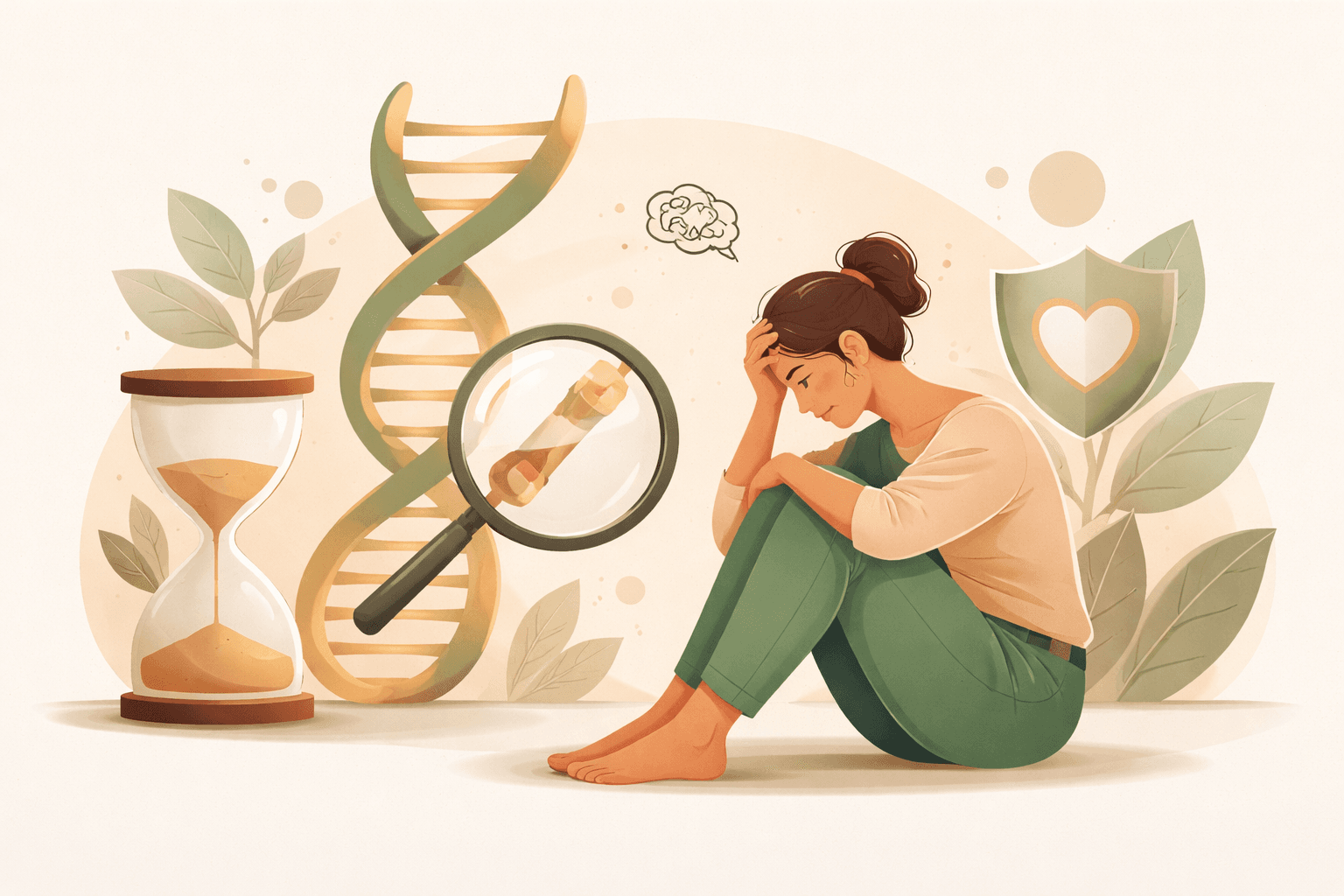
Chronic Stress and Telomere Length: What the Science Really Says
Chronic psychological stress is often framed as an “accelerator” of aging. One proposed mechanism involves telomeres—the protective DNA caps at the ends of chromosomes that tend to shorten as cells divide. Nobel laureate Elizabeth H. Blackburn, along with colleagues such as Elissa Epel, helped illuminate how stress biology may intersect with telomere dynamics. But how strong is the evidence that stress shortens telomeres—and can stress reduction meaningfully influence them?
This focused review breaks down what research suggests about the stress–telomere connection, how plausible mechanisms may operate, where the data are strongest or most uncertain, and what telomere testing can and cannot tell you.
A quick primer: Telomeres and stress
Telomeres help maintain chromosomal stability during cell division. In most adult somatic cells, telomeres gradually shorten with each replication, a process influenced by genetics, inflammation, oxidative stress, and lifestyle exposures. When telomeres become critically short, cells may enter senescence or die, which is why telomere dynamics are often discussed in the context of biological aging. [Evidence: strong for telomere biology basics]
Chronic psychological stress activates the hypothalamic–pituitary–adrenal (HPA) axis and sympathetic nervous system, elevating cortisol and catecholamines. Over time, this can increase oxidative stress and inflammatory signaling—two processes that are thought to accelerate telomere attrition. [Evidence: strong for stress physiology; moderate for direct linkage to telomere attrition]
What the human studies show
Caregiver stress signal. A landmark cross-sectional study of mothers caring for chronically ill children reported that higher perceived stress and longer caregiving duration were associated with shorter leukocyte telomere length and lower telomerase activity (Epel et al., PNAS, 2004). While influential, the study design cannot prove causation. [Evidence: moderate]
Meta-analyses: small but real associations, with caveats. A systematic review and meta-analysis found that perceived stress correlates with shorter leukocyte telomere length, but effect sizes are small and results vary by measurement method (Mathur et al., Psychoneuroendocrinology, 2016). Another meta-analysis reported that early-life adversity and maltreatment are linked to shorter telomeres later in life (Ridout et al., Biological Psychiatry, 2018). These findings are consistent but modest, underscoring that stress is one factor among many. [Evidence: moderate]
Depression and anxiety. Reviews often find shorter telomeres in major depression and some anxiety disorders, but heterogeneity is high and reverse causation is possible (e.g., health behaviors, inflammation). [Evidence: moderate]
Overall, research suggests chronic and early-life stress are associated with shorter leukocyte telomeres on average, but magnitudes are small, methods differ across studies, and genetics and lifestyle co-factors play a substantial role. [Evidence: moderate]
How stress could influence telomeres: plausible pathways
Oxidative stress. Telomeric DNA is rich in guanine, which is highly susceptible to oxidative damage. Oxidative stress can accelerate telomere shortening independent of cell division (von Zglinicki, Trends Biochem Sci, 2002). [Evidence: strong]
Inflammation. Chronic stress elevates inflammatory mediators (for example, IL-6, TNF-α). Inflammation drives immune cell turnover and can increase reactive oxygen species, potentially hastening telomere attrition. [Evidence: strong for inflammation–stress; moderate for direct telomere effect]
Telomerase modulation. Telomerase adds telomeric repeats to chromosome ends. Some studies suggest stress may reduce telomerase activity, while stress reduction may increase it; however, these shifts do not necessarily translate to durable changes in telomere length over short time frames. [Evidence: emerging]
Can stress reduction maintain or improve telomere biology?
Intervention studies are still small and varied, but several suggest that mind–body stress reduction may support telomere maintenance, primarily by modulating telomerase activity or slowing attrition rather than reliably lengthening telomeres.
Mindfulness and meditation. A meta-analysis reported that mindfulness-based interventions and meditation are associated with increased telomerase activity (Schutte & Malouff, Psychoneuroendocrinology, 2014). A 3-month intensive meditation retreat increased telomerase activity versus controls (Jacobs et al., Psychoneuroendocrinology, 2011). Telomere length findings are less consistent, with some trials in cancer survivors showing maintenance rather than elongation compared with controls (e.g., Carlson et al., Cancer, 2015). [Evidence: emerging-to-moderate]
Multimodal lifestyle change that includes stress management. In men with low-risk prostate cancer, a comprehensive lifestyle program that included plant-forward nutrition, moderate activity, and stress management was associated with increased telomerase activity after 3 months (Ornish et al., Lancet Oncology, 2008) and with a small increase in telomere length at 5-year follow-up (Ornish et al., Lancet Oncology, 2013). Because the intervention was multimodal and sample sizes were small, stress-specific effects cannot be isolated. [Evidence: emerging]
Traditional mind–body practices. Eastern traditions long emphasized practices aimed at calming the mind and nervous system—such as meditation, tai chi, qigong, and yogic breathing. Small trials and pilot studies suggest such practices may improve perceived stress and sometimes increase telomerase activity, though telomere length changes remain inconsistent across studies. [Evidence: emerging; traditional]
Taken together, stress reduction appears to support healthier stress biology and may help preserve telomere integrity over time, but robust, long-term randomized controlled trials isolating stress alone are still limited. [Evidence: moderate]
Practical implications without the hype
Focus on the experience of stress, not just the list of stressors. Perceived stress shows the clearest link to telomere measures. Practices that reliably lower perceived stress—such as mindfulness training, cognitive-behavioral strategies, social support, adequate sleep, time in nature, and gentle physical activity—may help support telomere maintenance as part of a broader longevity strategy. [Evidence: moderate]
Expect subtle, long-term effects. Telomeres change slowly, and measurement noise is substantial. Short-term stress reduction can improve mood, sleep, and inflammation quickly, but durable telomere length changes, if they occur, likely accrue over years. [Evidence: strong for general benefits; emerging for telomere changes]
Bridge Eastern and Western approaches thoughtfully. Traditional practices like meditation, tai chi, and qigong were developed to calm the mind and regulate breath—goals that align with modern stress-biology targets. Early research suggests these practices may favorably influence telomerase or slow attrition; ongoing trials are clarifying magnitude and durability. [Evidence: emerging; traditional]
What telomere tests can (and can’t) tell you about stress and aging
Commercial tests typically measure average leukocyte telomere length from a blood sample, often by qPCR or Flow-FISH. Important caveats:
High variability. Telomere length varies widely between individuals at the same age, across different tissues, and even among different leukocyte subtypes. Single measurements provide a snapshot with considerable biological and technical variability (Aubert & Lansdorp, Physiol Rev, 2008). [Evidence: strong]
Limited individual prognostic value. While populations with shorter leukocyte telomeres show higher risk for certain diseases on average, a single person’s score is an imprecise index of “biological age” and is influenced by genetics, early-life conditions, and current health behaviors (Aviv, Eur Heart J, 2018). [Evidence: strong]
Not a stress meter. Telomere tests do not quantify current stress load. Improvements in well-being may not translate into near-term, measurable telomere changes given slow dynamics and measurement noise. [Evidence: strong]
In short, telomere testing may offer broad context but should not drive individual medical decisions or replace attention to validated health metrics (blood pressure, lipids, glucose, sleep quality, mood). [Evidence: strong]
Critiques of oversimplified narratives
“Stress always shortens telomeres.” Associations are small on average and influenced by many confounders. Some stressed individuals do not show shorter telomeres, and genetics plays a major role. [Evidence: strong]
“Any meditation will lengthen telomeres.” Trials most consistently report increases in telomerase activity or maintenance of telomere length, not guaranteed elongation. Effects, when present, are modest and context-dependent. [Evidence: moderate]
“Your telomere score equals your biological age.” Telomere length is one biomarker among many and is not a standalone aging clock. [Evidence: strong]
Bottom line
- Chronic and early-life stress are associated with shorter leukocyte telomeres on average, though effect sizes are modest and methods matter. [Evidence: moderate]
- Mechanistically, oxidative stress, inflammation, and HPA-axis activation plausibly link stress to accelerated telomere attrition. [Evidence: strong-to-moderate]
- Stress-reduction strategies—especially mindfulness and other mind–body practices—may increase telomerase activity and help maintain telomere length over time, but robust, long-term trials are still emerging. [Evidence: emerging-to-moderate]
- Telomere tests provide limited, noisy snapshots and should not be overinterpreted as a stress gauge or definitive biological age. [Evidence: strong]
Prioritizing sustainable stress management is a sound longevity move—regardless of what your telomere readout says—because it consistently benefits sleep, mood, inflammation, and overall well-being. Any telomere benefit is likely a downstream bonus of a calmer, healthier stress response.