

Applied Kinesiology
Also known as: AK, Muscle Testing, Applied Kinesthesiology
Overview
Applied Kinesiology (AK) is an alternative assessment system that developed in the 1960s, most commonly associated with chiropractor George J. Goodheart Jr. It uses manual muscle testing as a central tool to evaluate how the body responds to physical contact, foods, supplements, emotional stimuli, or other inputs. Within AK theory, changes in muscle strength or resistance are interpreted as clues about structural, biochemical, or energetic imbalances. People often seek this modality as part of a holistic evaluation, especially when they are interested in individualized wellness frameworks that extend beyond symptom-based assessment.
In practice, AK differs from standard orthopedic or neurologic muscle testing used in conventional medicine. In AK, the muscle response is not only used to assess neuromuscular function, but is also interpreted as reflecting broader body systems, including organ function, nutrient needs, meridian balance, jaw alignment, posture, and emotional stress. Practitioners may combine muscle testing with chiropractic examination, posture analysis, palpation, reflex point assessment, or lifestyle review. Supporters describe AK as an integrative method intended to connect multiple dimensions of health into one assessment model.
At the same time, AK remains controversial in mainstream healthcare. Research has raised concerns about the reliability and reproducibility of its diagnostic claims, particularly when muscle testing is used to identify allergies, nutrient deficiencies, internal disease, or other non-musculoskeletal conditions. While manual muscle testing itself has recognized roles in rehabilitation and physical examination, the broader interpretive framework of applied kinesiology has not been established as a validated diagnostic system in conventional evidence-based medicine.
Because of this, applied kinesiology is best understood as a complementary and historically significant alternative modality rather than a universally accepted diagnostic approach. Interest in AK persists because it reflects a wider cultural demand for personalized, whole-person assessment. However, major health organizations and many clinical researchers emphasize that serious symptoms and medical concerns require evaluation through appropriately validated medical methods, and that alternative assessments are not substitutes for standard diagnosis.
Medical Perspectives
Two Ways of Seeing Health

Western
scientific · clinical
Western medicine applies science, technology, and clinical experience to treat symptoms through testing, diagnosis, and targeted intervention.

Eastern
traditional · alternative
Eastern medicine focuses on treating the body naturally by applying traditional knowledge practiced for thousands of years, emphasizing balance and whole-person wellness.
Gold Bamboo presents both perspectives side-by-side so you can make informed decisions. We don't advocate for one over the other — your health choices are yours.
Western Medicine Perspective
Western Medicine Perspective
From a conventional medicine standpoint, the key issue in applied kinesiology is the distinction between manual muscle testing as a physical exam tool and applied kinesiology as a diagnostic theory. In mainstream practice, muscle testing can help assess strength, nerve function, pain inhibition, or rehabilitation progress. These uses are grounded in anatomy, neurology, and musculoskeletal medicine. However, conventional medicine does not generally accept the AK claim that subtle changes in muscle resistance can reliably diagnose internal illness, food sensitivities, toxic exposures, or specific nutritional needs.
Published studies and reviews have often found that AK-related testing shows poor inter-examiner reliability, inconsistent results, and limited diagnostic accuracy when evaluated under controlled conditions. Research examining AK for allergy detection, nutrient assessment, and various medical diagnoses has not demonstrated dependable validity. For this reason, organizations such as the American Cancer Society and evidence review bodies have described AK as lacking sufficient scientific support for diagnosing disease. Concerns also exist that reliance on unvalidated testing may delay appropriate medical workup.
That said, some clinicians note that the popularity of AK reflects real patient interests: individualized care, attention to posture and biomechanics, and an expanded discussion of diet, stress, and lifestyle. In these areas, AK may overlap with broader wellness-oriented care models. Still, within western evidence standards, the broader claims of applied kinesiology are generally regarded as unproven or unsupported, and any findings derived from AK are typically viewed as hypothesis-generating rather than diagnostic.
Eastern & Traditional Perspective
Eastern/Traditional Medicine Perspective
From an eastern and traditional medicine perspective, applied kinesiology is often interpreted less as a laboratory-style diagnostic method and more as a functional, energetic assessment approach. Although AK originated in chiropractic practice rather than classical Asian medicine, its language and clinical style often resonate with systems such as Traditional Chinese Medicine (TCM), naturopathy, and some integrative healing traditions. In these frameworks, symptoms may be viewed as expressions of imbalance across interconnected systems rather than isolated disease entities.
AK practitioners frequently incorporate ideas that parallel traditional concepts, including the relationship between structure, flow, stress, and vitality. In TCM-oriented interpretations, muscle testing may be linked conceptually to meridian theory, where disruptions in energetic flow are thought to influence function throughout the body. In naturopathic or holistic settings, testing may also be used to explore how foods, environmental factors, emotional states, or supplements appear to affect the body's overall balance. These interpretations are generally rooted in traditional or practitioner-derived models rather than modern biomedical validation.
Ayurvedic and other traditional systems similarly emphasize individualized patterns, constitutional differences, and the dynamic relationship between body and mind. While applied kinesiology is not a classical Ayurvedic method, its appeal aligns with the broader traditional principle that assessment should be personalized, observational, and whole-system oriented. The limitation, from an evidence perspective, is that these cross-system integrations are largely theoretical and practice-based, and there is not strong scientific consensus confirming that AK muscle responses accurately map onto traditional energetic imbalances.
As a result, eastern and traditional perspectives may regard applied kinesiology as a potentially useful interpretive tool within holistic practice, while also recognizing that its claims are shaped more by tradition, practitioner experience, and integrative philosophy than by robust clinical proof. Consultation with qualified healthcare professionals remains important when evaluating persistent, severe, or unexplained symptoms.
Supplements & Products
Recommended Products

Applied Kinesiology, Revised Edition: A Training Manual and Reference Book of Basic Principles and Practices: Frost Ph.D., Robert, Goodheart Jr. D.C., George J.
<strong>Offering the history and fundamentals of Applied Kinesiology as well as some more advanced techniques</strong>, Robert Frost’s valuable book will benefit anyone interested in this modality whe

THORNE - Basic Nutrients 2/Day - Comprehensive Daily Multivitamin with Optimal Bioavailability - Vitamin & Mineral Formula - Gluten, Dairy & Soy-Free - 60 Capsules - 30 Servings
Buy THORNE - Basic Nutrients 2/Day - Comprehensive Daily Multivitamin with Optimal Bioavailability - Vitamin & Mineral Formula - <strong>Gluten, Dairy & Soy-Free</strong> - 60 Capsules - 30 Se
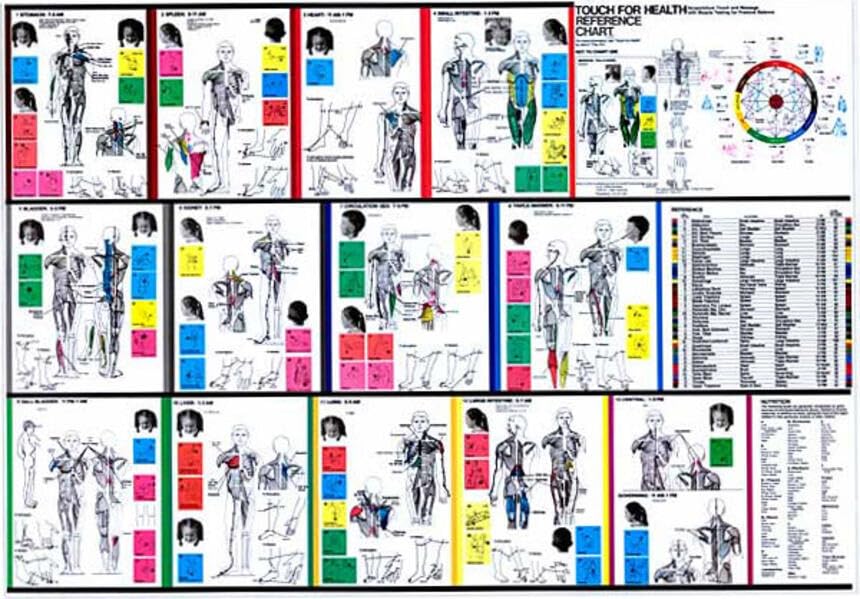
Touch for Health Reference Chart: Thie DC, John
Touch for Health Reference Chart <strong>Large (43"x29") Full Color, Laminated Chart</strong>. Quick reference to all the reflex points, meridians, muscle locations (color coded with the tes
Evidence & Sources
Based on traditional practice; limited modern clinical research available
- National Center for Complementary and Integrative Health (NCCIH)
- American Cancer Society
- Cochrane Library
- Journal of Manipulative and Physiological Therapeutics
- Chiropractic & Osteopathy
- International Journal of Neuroscience
- World Health Organization (WHO)
This content is for informational purposes only and does not constitute medical advice. Always consult a qualified healthcare provider before starting, stopping, or changing any supplement or medication regimen.