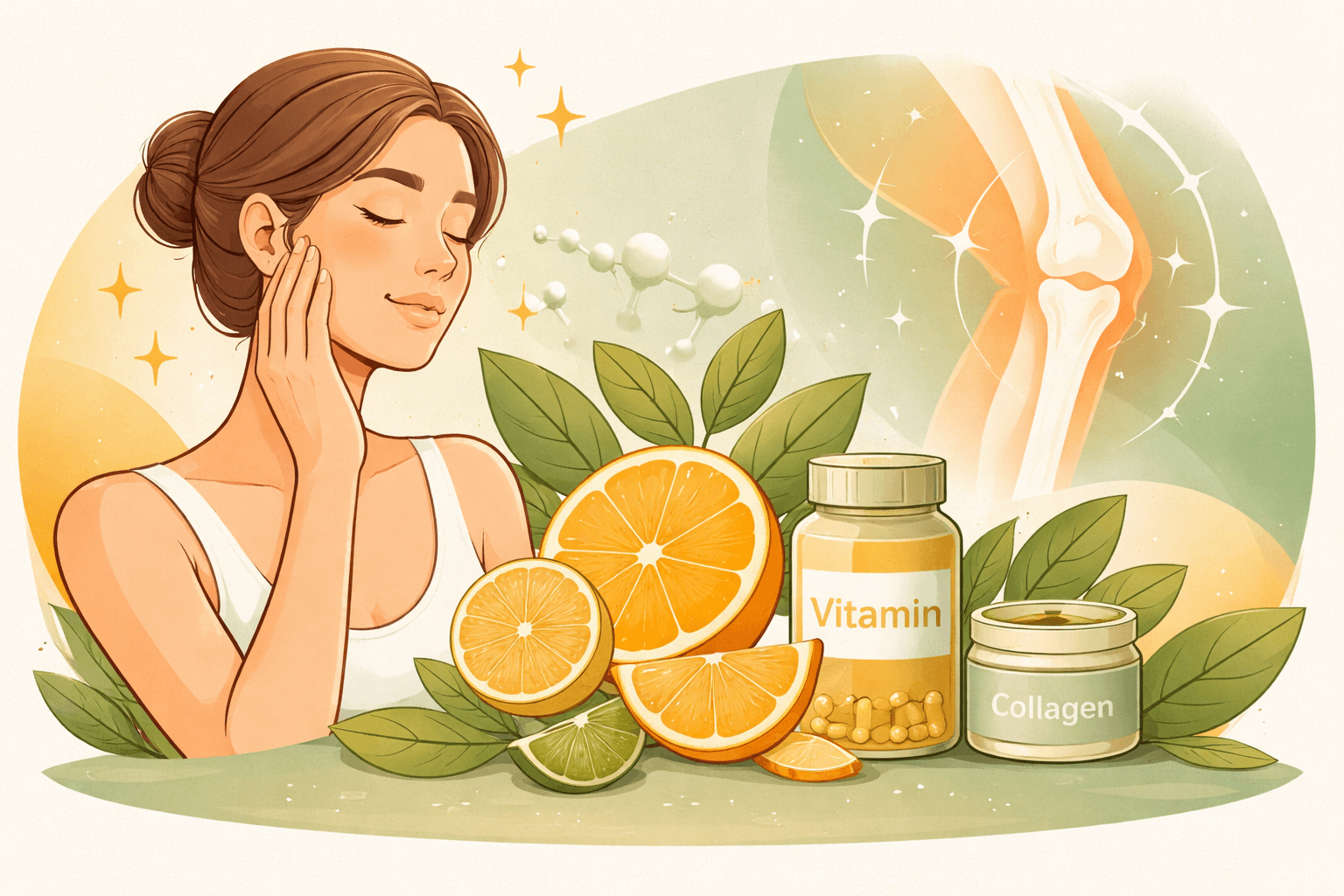
Vitamin C Beyond Colds: Collagen Synthesis for Skin and Joints
Most people associate vitamin C with the common cold, but one of its most fundamental roles is far more structural: building and maintaining collagen. Collagen is the body’s primary scaffolding protein, essential for the integrity of skin, tendons, ligaments, cartilage, blood vessels, and bone matrix. Research suggests vitamin C status may influence how well this scaffolding is assembled and maintained, with implications for skin appearance, wound repair, and joint health (Evidence: strong to moderate).
Key takeaway up front: vitamin C does not “make collagen” by itself, but it is an indispensable cofactor for the enzymes that stabilize and mature collagen molecules. Without it, the collagen network falters—that’s why scurvy, the clinical manifestation of severe deficiency, presents with bleeding gums, skin fragility, and poor wound healing (Evidence: strong).
Why Vitamin C Is Indispensable for Collagen
Enzymatic cofactor for hydroxylation: Collagen’s triple-helix structure requires post-translational hydroxylation of specific proline and lysine residues by prolyl and lysyl hydroxylases. Vitamin C (ascorbate) maintains iron in the ferrous (Fe2+) state at these enzymes’ active sites, enabling hydroxylation that stabilizes the helix and supports cross-linking between collagen fibrils. Inadequate ascorbate compromises helix stability and cross-linking, weakening connective tissue integrity (Evidence: strong; classic biochemical work and decades of confirmatory studies, e.g., Murad et al., 1981; Pullar et al., Nutrients 2017 – review).
Support for fibroblast function and oxidative balance: Beyond cofactor duties, vitamin C helps regenerate other antioxidants such as vitamin E and may protect collagen-producing fibroblasts from oxidative stress, conditions in which collagen turnover is dysregulated (Evidence: moderate; mechanistic and cell studies, Pullar et al., 2017 – review).
Gene expression influences: Research suggests ascorbate can influence collagen-related gene expression and modulate signaling pathways (e.g., HIF-related) that impact extracellular matrix remodeling, though human data isolating these effects are limited (Evidence: emerging; mechanistic and translational data, Pullar et al., 2017 – review).
What Clinical Research Shows for Skin
Wound repair: Severe vitamin C deficiency impairs wound healing, and repletion resolves characteristic symptoms—a cause-effect relationship recognized for over a century (Evidence: strong; historical clinical evidence). In non-scorbutic populations, small randomized trials and systematic reviews suggest that vitamin C, often as part of multi-nutrient regimens, may improve certain wound outcomes, including pressure injuries and surgical healing, particularly in individuals with low baseline status. However, heterogeneity in study designs and co-supplementation make effect sizes uncertain (Evidence: moderate; Cochrane and narrative reviews of micronutrients for pressure ulcers; Pullar et al., 2017 – review).
Topical vitamin C and photoaged skin: Multiple randomized, placebo-controlled trials of topical L-ascorbic acid (often 10–20%) report improvements in fine wrinkling, elasticity, and dermal collagen markers, alongside reduced signs of photodamage (Evidence: moderate; RCTs: Traikovich, 1999; Humbert et al., 2003; summarized in Al-Niaimi & Chiang, 2017 – review). Penetration depends on formulation and pH; stabilized or properly formulated products appear most effective (Evidence: moderate).
Oral intake and skin appearance: Observational research associates higher dietary vitamin C intake or higher plasma ascorbate with better skin appearance—less wrinkling and dryness—especially in sun-exposed women (Evidence: moderate for association; Cosgrove et al., Am J Clin Nutr 2007). Placebo-controlled trials with oral supplementation often use multi-ingredient formulas (vitamin C with other antioxidants or collagen peptides), which have shown improvements in wrinkles and elasticity in some studies; isolating vitamin C’s specific contribution remains challenging (Evidence: emerging to moderate; multiple RCTs with combination interventions; Pullar et al., 2017 – review).
What Clinical Research Shows for Joints and Connective Tissue
Osteoarthritis progression: In the Framingham Osteoarthritis Cohort, higher vitamin C intake was associated with a lower risk of knee osteoarthritis progression and cartilage loss over time (Evidence: moderate for association; McAlindon et al., Ann Rheum Dis 1996). Subsequent cohorts and reviews report mixed findings, suggesting potential benefit may depend on baseline status, overall diet, or disease stage (Evidence: emerging; Li et al., Nutrients 2016 – review). Randomized trials isolating vitamin C for osteoarthritis symptoms or structure are limited.
Tendon and ligament biology: Experimental models show that ascorbate stimulates collagen synthesis in tendon/ligament fibroblasts and may improve matrix quality during repair (Evidence: emerging; preclinical data summarized in reviews). Human interventional evidence in tendinopathy is not yet definitive.
How Much Does Delivery Format Matter?
Oral vs. intravenous levels: Plasma ascorbate is tightly regulated with oral intake, achieving a plateau within a physiological range. Intravenous (IV) administration can briefly produce much higher plasma concentrations that are not attainable orally—an approach explored in critical care and oncology contexts, not for everyday collagen support (Evidence: strong for pharmacokinetics; Padayatty et al., Ann Intern Med 2004). For skin and connective tissue maintenance in the general population, research emphasizes sufficiency rather than extreme plasma peaks (Evidence: moderate; expert reviews).
Liposomal vitamin C: Early human pharmacokinetic studies suggest liposomal-encapsulated vitamin C may produce modestly higher plasma concentrations and area-under-the-curve than standard oral forms, though still far below IV exposure. Whether these pharmacokinetic differences translate into superior clinical outcomes for skin or joint health is not yet demonstrated (Evidence: emerging; small crossover trials, e.g., Davis et al., Nutr Metab Insights 2016; narrative reviews).
Traditional Perspectives and Food-Based Sources
Amla (Emblica officinalis): In Ayurveda, amla—often used in rasayana (rejuvenation) formulas—is traditionally associated with skin vitality and connective tissue resilience. Amla provides vitamin C along with tannins and polyphenols that may protect ascorbate and add antioxidant effects. Limited human studies report improvements in skin parameters with amla extracts, but these often examine complex phytochemical profiles rather than isolated vitamin C (Evidence: traditional for use; emerging for modern clinical data).
Acerola (Malpighia emarginata) and camu camu (Myrciaria dubia): Both are exceptionally rich in vitamin C and used traditionally in tropical regions. One small human study in smokers found camu camu juice improved markers of oxidative stress and inflammation more than an equivalent amount of isolated vitamin C, suggesting synergistic phytochemicals may contribute (Evidence: emerging; Inoue et al., J Cardiol 2008). As whole foods, these sources deliver vitamin C alongside flavonoids that could support collagen indirectly by modulating oxidative stress and inflammation (Evidence: emerging to moderate).
Everyday dietary sources: Citrus, kiwifruit, berries, peppers, and cruciferous vegetables are well-established contributors to vitamin C intake. Observational links between diets rich in fruits and vegetables and healthier skin and joints likely reflect combined effects of vitamin C and other bioactives (Evidence: moderate; dietary pattern studies).
Context and Expectations
Vitamin C is necessary, not singular: Collagen formation also depends on adequate protein (amino acids such as glycine, proline, lysine), copper-dependent lysyl oxidase activity for cross-linking, and overall micronutrient sufficiency. Vitamin C is one critical piece in a larger matrix biology puzzle (Evidence: strong for multi-nutrient dependence; biochemistry and nutrition texts, Pullar et al., 2017 – review).
Status matters most: Research suggests benefits are most apparent when correcting low or marginal status, in states of high oxidative stress, or when tissue repair demand is elevated (e.g., wound healing). In well-nourished individuals, incremental gains may be subtler (Evidence: moderate; clinical and observational data across contexts).
Bridging Western and Eastern Views
Western research anchors vitamin C’s role in defined enzymology—keeping iron reduced for prolyl/lysyl hydroxylases—while Eastern traditions emphasize whole-plant sources (amla) within rejuvenative frameworks. Both perspectives converge on maintaining tissue integrity and resilience. Modern studies of traditional fruits like amla and camu camu point to potential synergy between vitamin C and polyphenols, a concept consistent with systems-based approaches to tissue health (Evidence: emerging).
Bottom Line
- Vitamin C is essential for collagen maturation and stability, influencing skin integrity, wound repair, and connective tissue resilience (Evidence: strong).
- Clinical research suggests benefits are clearest when correcting low status and in targeted contexts like wound healing; topical formulations show consistent improvements in photoaged skin, while oral trials often involve multi-ingredient blends (Evidence: moderate).
- Observational data link higher vitamin C intake with healthier-looking skin and slower osteoarthritis progression, though randomized evidence isolating vitamin C’s joint effects is limited (Evidence: moderate for association; emerging for causation).
- Liposomal delivery modestly increases plasma levels compared with standard oral forms; superiority for skin or joint outcomes remains unproven (Evidence: emerging). IV vitamin C achieves very high plasma concentrations, but this approach is studied for critical care or oncology—not routine collagen support (Evidence: strong for pharmacokinetics; mixed clinical indications).
- Traditional vitamin C–rich fruits like amla, acerola, and camu camu align with both nutrient sufficiency and polyphenol synergy, complementing a diverse, plant-forward diet (Evidence: emerging to moderate).
References (selected)
- Pullar JM, Carr AC, Vissers MCM. The Roles of Vitamin C in Skin Health. Nutrients. 2017.
- Padayatty SJ et al. Vitamin C Pharmacokinetics: Oral vs IV. Ann Intern Med. 2004.
- Traikovich SS. Topical ascorbic acid and photodamage. Arch Otolaryngol Head Neck Surg. 1999.
- Humbert PG et al. Efficacy of topical stabilized vitamin C. Dermatology. 2003.
- Cosgrove MC et al. Dietary nutrients and skin aging in women. Am J Clin Nutr. 2007.
- McAlindon TE et al. Dietary intake and knee OA progression. Ann Rheum Dis. 1996.
- Li S et al. Nutrition and Osteoarthritis. Nutrients. 2016.
- Davis JL et al. Liposomal-encapsulated ascorbic acid pharmacokinetics. Nutr Metab Insights. 2016.
- Inoue T et al. Camu camu vs vitamin C tablets on oxidative stress markers. J Cardiol. 2008.