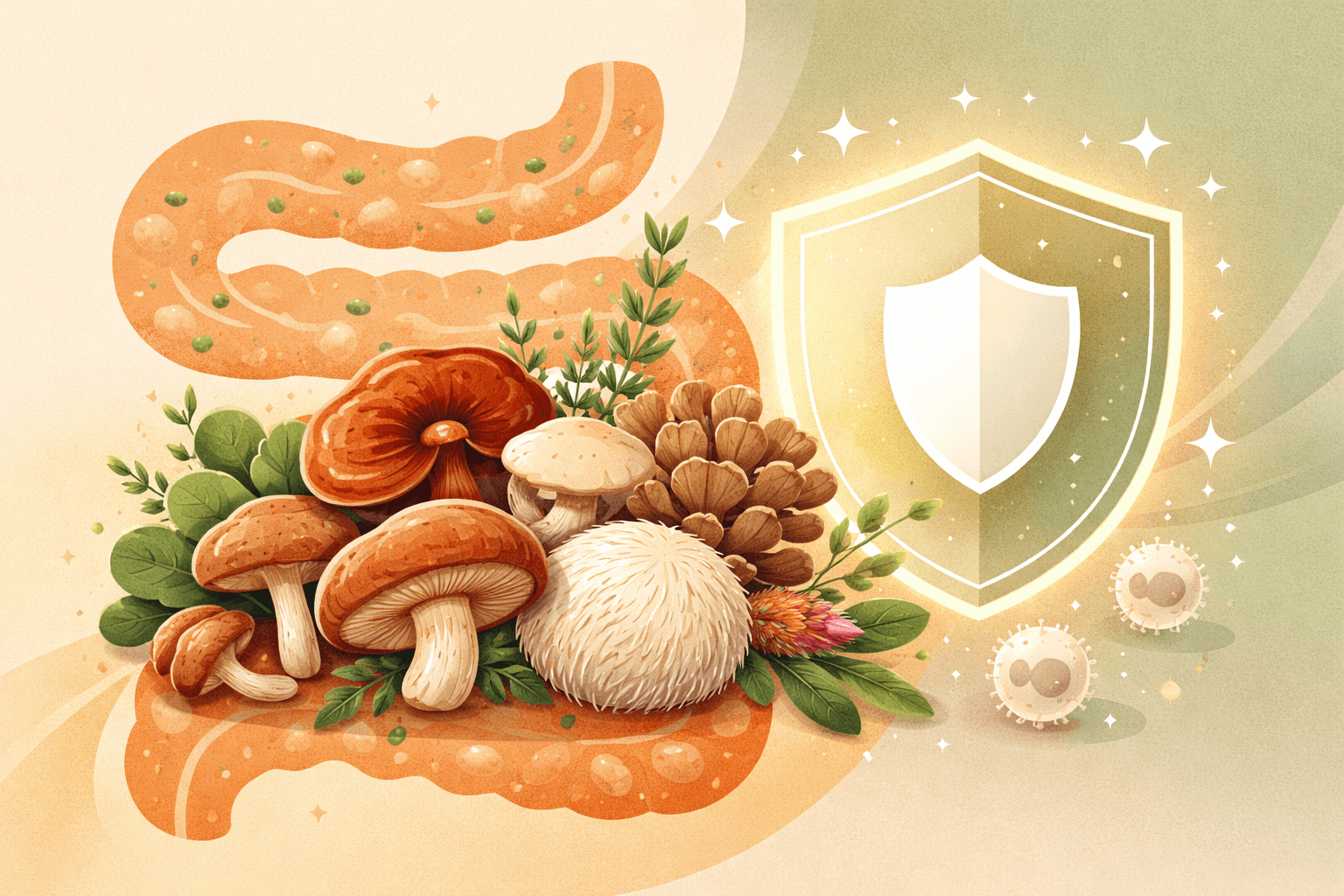
Why mushroom beta‑glucans matter for immune function
Beta‑glucans are specialized polysaccharides concentrated in the cell walls of medicinal mushrooms such as reishi (Ganoderma lucidum), turkey tail (Trametes versicolor), maitake (Grifola frondosa), and others. Research suggests these complex fibers interact with frontline immune cells to enhance surveillance and coordination—an effect often described as “immunomodulatory” rather than simply “stimulating.” In Traditional Chinese Medicine (TCM), reishi (lingzhi) has been used for centuries to “nourish Zheng Qi,” a concept paralleling resilient, well-regulated defense responses. Modern immunology provides plausible mechanisms for this traditional use through beta‑glucan biology. (Evidence: traditional; mechanistic evidence: strong)
What are beta‑glucans—and why structure matters
Beta‑glucans are chains of glucose linked primarily by β‑(1→3) backbones with β‑(1→6) branches. Their biological activity depends on features like branching frequency, molecular weight, and solubility, which vary by species and extraction method. Mushroom beta‑glucans differ from cereal fibers (e.g., oats, barley) and from yeast beta‑glucans, leading to different receptor interactions and immune outcomes. (Evidence: strong mechanistic/biochemical)
Key points:
- Mushroom beta‑glucans are largely β‑(1→3)(1→6) structures with immunomodulatory effects in vitro and in vivo. (Evidence: strong mechanistic)
- Species composition varies: turkey tail and maitake are typically rich in water‑soluble beta‑glucans; reishi also contains triterpenes that affect inflammation via different pathways. (Evidence: moderate)
How beta‑glucans interact with the immune system
Research suggests mushroom beta‑glucans engage pattern‑recognition receptors on innate immune cells, leading to more efficient responses against pathogens while helping maintain balance.
Primary pathways:
- Dectin‑1: A C‑type lectin receptor on macrophages, dendritic cells, and neutrophils recognizes β‑(1→3) glucan backbones, triggering phagocytosis, reactive oxygen species, and cytokine signaling via Syk/CARD9 pathways. (Evidence: strong mechanistic)
- Complement receptor 3 (CR3): Soluble and particulate beta‑glucans can prime CR3, potentially enhancing recognition of opsonized targets. (Evidence: moderate)
- Toll‑like receptor crosstalk: Beta‑glucan–Dectin‑1 signaling can synergize with TLR2/6, shaping cytokine profiles (e.g., IL‑10, TNF‑α, IL‑6) toward context‑appropriate responses. (Evidence: strong mechanistic)
Trained immunity: Brief beta‑glucan exposure may “train” monocytes/macrophages via epigenetic and metabolic reprogramming (e.g., H3K4me3 marks, glycolytic shift), resulting in a faster, more robust response to later challenges. This concept bridges innate and adaptive‑like memory and helps explain why effects can persist beyond immediate exposure. (Evidence: strong mechanistic; early human translational evidence: emerging)
What human studies show so far
- General respiratory health: Multiple randomized controlled trials (RCTs) with oral beta‑glucans—most robustly with purified yeast sources—report modest reductions in the incidence or duration of upper‑respiratory symptoms in healthy or stressed adults, along with changes in immune markers (e.g., salivary IgA, NK cell activity). Systematic reviews highlight benefit heterogeneity related to dose, source, and population. (Evidence: moderate overall; stronger for yeast beta‑glucans; mushroom‑specific human data: emerging)
- Mushroom‑derived polysaccharides: Small RCTs and controlled studies using reishi, maitake, or turkey tail extracts have reported immune endpoints such as increased NK cell activity, altered T‑cell subsets, and cytokine modulation in healthy volunteers or clinical populations. Sample sizes are often small and products vary, limiting generalizability. (Evidence: emerging)
- Turkey tail PSK/PSP (context note): Polysaccharide‑K (PSK) and polysaccharopeptide (PSP), protein‑bound beta‑glucan complexes from Trametes versicolor, have been studied as adjuncts to conventional therapy in certain cancers in Japan and China. Systematic reviews of legacy trials suggest PSK/PSP may support immune function and, in some settings, clinical outcomes when combined with standard treatments. Findings depend on cancer type and regimen, with methodological variability across studies. These data should be interpreted within clinical contexts and do not imply disease treatment claims for over‑the‑counter products. (Evidence: moderate for adjunctive settings; product‑specific)
Bottom line on human data: Research suggests oral beta‑glucans can modulate innate and mucosal immune markers and may reduce common illness burden in select groups. Evidence is strongest for well‑characterized, purified beta‑glucans; mushroom‑specific beta‑glucan trials are growing but remain heterogeneous. (Evidence: moderate overall)
Extraction methods that shape immune activity
The way mushrooms are processed critically affects the beta‑glucan content and bioactivity.
- Hot‑water extraction: Beta‑glucans are largely water‑soluble; traditional decoctions and modern hot‑water extracts effectively liberate these polysaccharides from the fungal cell wall, increasing availability. (Evidence: strong mechanistic/traditional)
- Alcohol extraction: Ethanol pulls out triterpenes (notably from reishi) that may influence inflammatory signaling, liver enzymes, and oxidative stress. These are largely complementary to beta‑glucans but require alcohol for efficient extraction. (Evidence: moderate)
- Dual extracts: Combining hot‑water and alcohol steps yields both water‑soluble beta‑glucans and alcohol‑soluble triterpenes in one product. Dual extracts align with TCM practices that value the full spectrum of mushroom constituents. (Evidence: moderate)
- Fruiting body vs. mycelium on grain: Some commercial powders grown on grain may contain substantial starch (alpha‑glucans) that inflate “total polysaccharide” numbers without reflecting beta‑glucan content. Beta‑glucan–specific assays (e.g., enzymatic methods used in cereal science) are preferred for label transparency. (Evidence: moderate)
Practical quality cues (non‑prescriptive):
- Look for products that disclose beta‑glucan percentage using beta‑glucan–specific testing, not just “total polysaccharides.” (Evidence: moderate)
- Choose hot‑water or dual extracts when immune modulation is the focus, reflecting how beta‑glucans are solubilized. (Evidence: strong for extraction principle)
- Species‑specific standardization (e.g., reishi triterpenes plus beta‑glucans; turkey tail polysaccharopeptides) may better match the research literature. (Evidence: moderate)
Species snapshots through an immune lens
- Reishi (Ganoderma lucidum): Research suggests reishi polysaccharides engage Dectin‑1–dependent pathways and modulate cytokines, while triterpenes influence inflammatory cascades and antioxidant responses. Human studies report changes in NK activity and T‑cell function, though protocols vary. TCM regards lingzhi as a premier “Fu Zheng” tonic for balanced defense. (Evidence: mechanistic: strong; human: emerging to moderate; traditional: strong)
- Turkey tail (Trametes versicolor): Rich in beta‑glucans and protein‑bound complexes (PSK/PSP). Clinical literature in adjunctive settings indicates immunologic benefits; over‑the‑counter extracts vary widely from trial materials. (Evidence: moderate in adjunctive clinical contexts; over‑the‑counter relevance: emerging)
- Maitake (Grifola frondosa): Noted for highly branched beta‑glucans that may robustly activate innate cells in preclinical models; small human studies show NK‑related changes. (Evidence: mechanistic: strong; human: emerging)
Bridging traditional and modern views
TCM’s use of lingzhi and other fungi to “support righteous Qi” emphasizes resilience, recovery, and harmonious responses over blunt stimulation. Modern immunology’s concept of immunomodulation—and more recently, trained immunity—offers a mechanistic framework for how mushroom beta‑glucans may help the body respond efficiently without chronically over‑activating inflammatory pathways. (Evidence: traditional; mechanistic: strong)
What we still don’t know
- Optimal composition: The most effective beta‑glucan structures, molecular weights, and branching patterns for human outcomes remain under investigation. (Evidence: emerging)
- Standardization: Variability in species, growth substrates, and extraction complicates comparisons across studies and products. Wider use of beta‑glucan–specific assays would improve clarity. (Evidence: moderate)
- Clinical endpoints: Beyond symptom days and surrogate markers, larger, well‑controlled trials are needed to confirm effects on real‑world outcomes across diverse populations. (Evidence: emerging)
Safety and considerations
Edible and medicinal mushrooms are generally well tolerated in research settings, though gastrointestinal upset and allergic reactions can occur. Individuals with mushroom allergies, complex medical conditions, or those using immunomodulating therapies should be cautious and consult qualified professionals when evaluating products. This article does not provide medical advice. (Evidence: moderate)
Bottom line
- Mushroom beta‑glucans primarily act on innate immune receptors such as Dectin‑1, coordinating more efficient surveillance and response; they may also induce trained immunity. (Evidence: strong mechanistic)
- Human studies suggest oral beta‑glucans can modulate immune markers and may reduce common illness burden, with the strongest clinical evidence to date for purified beta‑glucans and growing—yet variable—data for mushroom‑specific extracts. (Evidence: moderate)
- Extraction matters: hot‑water (for beta‑glucans) and dual extracts (for beta‑glucans plus triterpenes) align with both tradition and mechanism. Seek transparency on beta‑glucan content rather than total polysaccharides. (Evidence: strong for extraction principle; moderate for product transparency)
- Traditional practices around lingzhi’s “balanced defense” now intersect with immunology’s nuanced view of modulation rather than indiscriminate stimulation. (Evidence: traditional + mechanistic)