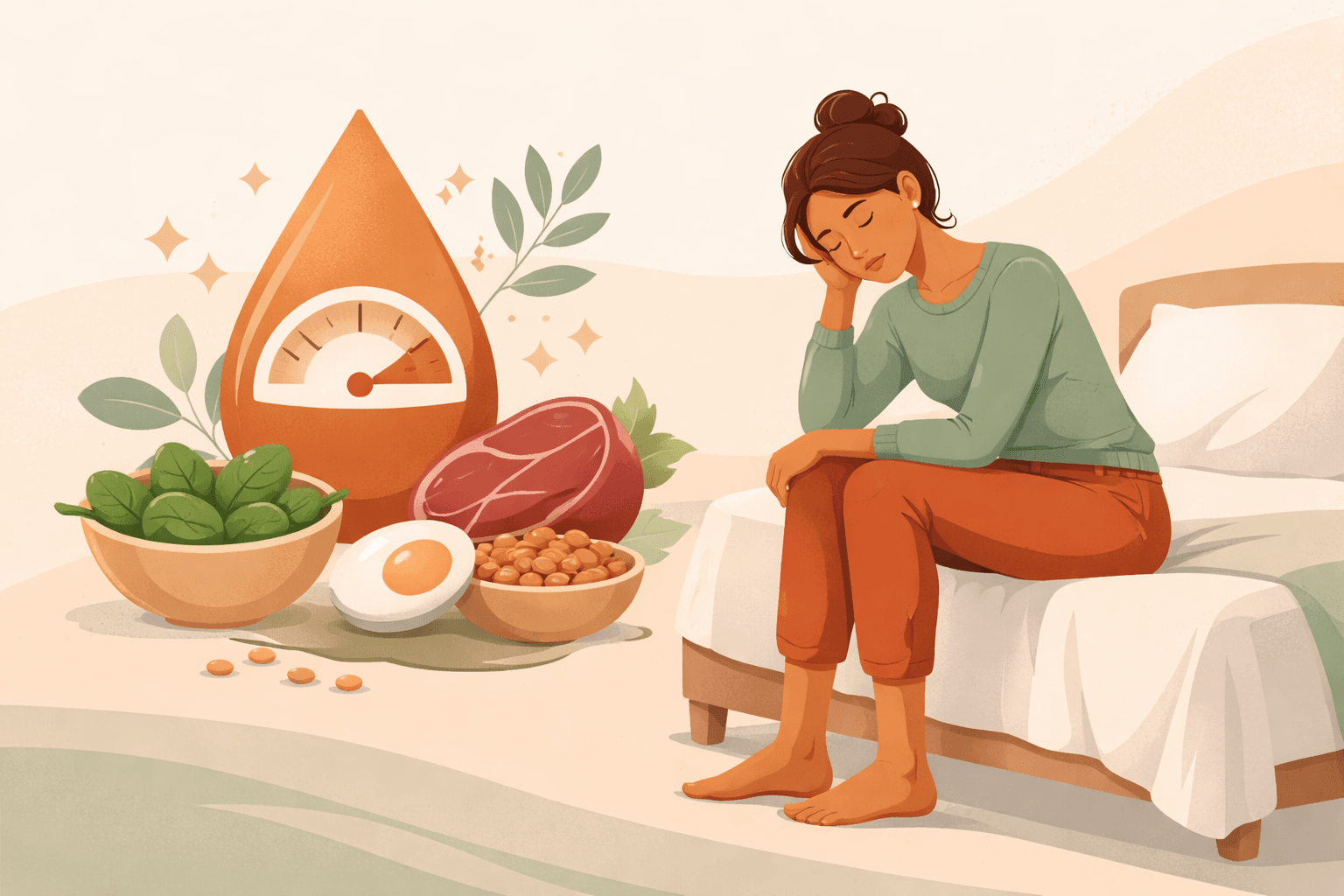
Iron deficiency is often equated with anemia, but research suggests a subtler form—low iron stores without anemia—may underlie fatigue, brain fog, and even restless legs in otherwise “normal” lab results. If your hemoglobin looks fine but you still feel depleted, ferritin—the protein that stores iron—may offer a clearer picture.
What Ferritin Tells You That Hemoglobin Can Miss
- Ferritin reflects the body’s iron reserves and typically falls before hemoglobin drops. Hemoglobin is a late marker; by the time it’s low, iron deficiency is usually advanced (Evidence: strong; reviews in the New England Journal of Medicine, Camaschella 2015; WHO Guideline on Ferritin, 2020).
- Diagnostic cutoffs vary by guideline and context, and ferritin can rise with inflammation or infection. Research suggests pairing ferritin with markers like C-reactive protein (CRP), transferrin saturation (TSAT), or soluble transferrin receptor (sTfR) improves accuracy when inflammation is present (Evidence: strong; WHO 2020; Pasricha et al., Lancet Haematology 2021).
- In population studies, many people with normal hemoglobin have depleted iron stores on ferritin testing—a pattern often called non-anemic iron deficiency (NAID) (Evidence: strong; systematic reviews in Lancet Haematology 2021).
Symptoms Linked to Low Ferritin (Even Without Anemia)
- Fatigue and low energy: A randomized controlled trial in non-anemic menstruating women with low ferritin reported reduced fatigue after iron repletion compared with placebo (Vaucher et al., CMAJ 2012) (Evidence: strong for fatigue improvement in this group).
- Cognitive effects and “brain fog”: Trials in iron-deficient, non-anemic young women found improvements in attention, memory, and processing speed after iron repletion (Murray-Kolb & Beard, American Journal of Clinical Nutrition 2007) (Evidence: moderate; benefits appear most in those with the lowest baseline ferritin).
- Restless legs syndrome (RLS): A Cochrane review concluded that iron therapy may reduce RLS severity when iron stores are low, even if hemoglobin is normal (Trotti et al., 2019) (Evidence: moderate to strong; strongest when ferritin is low and secondary causes are addressed).
- Exercise intolerance: Reviews in athletes note that low ferritin can impair endurance and perceived exertion despite normal hemoglobin, likely due to effects on mitochondrial enzymes and oxygen utilization (Peeling et al., Sports Medicine 2008; Sim et al., Int J Sport Nutr Exerc Metab 2019) (Evidence: moderate).
Who’s More Likely to Have Low Ferritin with Normal Hemoglobin?
- People with heavy menstrual bleeding or frequent postpartum demands (Evidence: strong; WHO 2020; ACOG guidance).
- Endurance athletes, especially females and adolescents (Evidence: moderate; Sports Medicine reviews).
- Individuals with low dietary iron intake (e.g., some plant-forward diets) or high intake of absorption inhibitors like phytates and polyphenols (Evidence: strong; Hallberg et al., Am J Clin Nutr 1989; Hurrell & Egli, Public Health Nutr 2010).
- Frequent blood donors (Evidence: strong; AABB and population studies).
- People with gastrointestinal conditions affecting absorption (e.g., celiac disease, inflammatory bowel disease) (Evidence: strong; gastroenterology guidelines and reviews).
Ferritin Versus Other Iron Markers: How Testing Is Approached
- Ferritin: Best single marker of iron stores but rises with inflammation, liver disease, or infection (Evidence: strong; WHO 2020).
- Transferrin saturation (TSAT) and serum iron: Can suggest restricted iron availability when low, but fluctuate with diet and time of day (Evidence: moderate; hematology reviews).
- Soluble transferrin receptor (sTfR) and sTfR/log ferritin index: Less affected by inflammation and may identify functional deficiency (Evidence: moderate; meta-analyses in clinical chemistry literature).
- CRP or other inflammation markers: Help interpret ferritin when inflammatory conditions are suspected (Evidence: strong; WHO 2020).
Note: Cutoffs and panels vary by laboratory and clinical context. Testing and interpretation should be individualized by a qualified clinician.
What About Iron Overload? A Necessary Counterbalance
- While low ferritin is common, iron overload also exists. Hereditary hemochromatosis—most often due to HFE gene variants—can raise TSAT and ferritin and, over time, damage the liver, pancreas, joints, and heart if unrecognized (Evidence: strong; Bacon et al., Hepatology 2011; Adams & Barton, N Engl J Med 2007).
- Family history of hemochromatosis, unexplained high ferritin, or elevated TSAT may prompt targeted evaluation before any iron repletion is considered (Evidence: strong; hepatology guidelines).
- This is one reason why self-directed iron use without testing is discouraged in clinical practice.
Dietary Patterns and Traditional Foodways That May Support Iron Status
- Heme vs. non-heme iron: Heme iron from animal foods (e.g., meat, poultry, seafood) is absorbed more efficiently than non-heme iron from plants (Evidence: strong; Hallberg & Hulthén, 2000s nutrition literature). Pairing plant sources with enhancers can help.
- Enhance non-heme absorption: Vitamin C–rich foods (citrus, berries, peppers), organic acids, and some fermentation processes may increase non-heme iron uptake (Evidence: strong; Hallberg et al., Am J Clin Nutr 1989; Hurrell & Egli 2010).
- Reduce inhibitors: Phytates (in some whole grains/legumes), polyphenols (tea, coffee), and calcium can inhibit non-heme iron absorption when consumed with iron-rich meals (Evidence: strong; nutrition reviews). Traditional methods like soaking, sprouting, fermenting, and sourdough leavening may reduce phytate content (Evidence: moderate; food science studies).
- Cooking in cast iron: Studies show that cooking acidic, moisture-rich foods (tomato sauce, stews) in cast iron can increase the iron content of the meal, particularly beneficial where dietary iron is low (Evidence: moderate; food composition studies, e.g., Geerligs et al., 2003; Adish et al., J Am Diet Assoc 1999).
- Community innovations: Household iron ingots (e.g., “iron fish”) added to cooking have improved iron status in some trials, though effects vary by diet and water chemistry (Evidence: moderate; Charles et al., Trop Med Int Health 2015; Rappaport et al., Nutrients 2017).
- Traditional systems: Ayurveda has long used iron-based preparations (e.g., Loha Bhasma). Contemporary reviews note historical use for weakness and pallor, but modern evidence is limited and product quality varies; safety and standardization remain concerns (Evidence: traditional/emerging; pharmacognosy reviews).
When to Consider Asking About Ferritin
Research suggests that people with persistent fatigue, brain fog, exercise intolerance, hair shedding, or restless legs—especially those with heavy menstrual losses, endurance training, frequent blood donation, or gastrointestinal conditions—may benefit from discussing ferritin testing with a clinician, even if a recent hemoglobin was “normal” (Evidence: moderate to strong; RCTs and systematic reviews cited above). Any testing or treatment plan should account for potential inflammation and rule out overload conditions before repletion strategies are considered.
Bringing It Together: A Practical Lens
- Ferritin provides an earlier, more sensitive read on iron status than hemoglobin alone (Evidence: strong).
- Non-anemic iron deficiency may contribute to fatigue, cognitive symptoms, and restless legs (Evidence: moderate to strong, with RCTs supporting benefit from repletion in selected groups).
- Interpreting ferritin alongside TSAT, sTfR, and CRP can improve accuracy, especially when inflammation is present (Evidence: strong).
- Balance matters: rule out iron overload risk before any iron repletion (Evidence: strong).
- Food-first strategies draw on both modern nutrition science and traditional practices (vitamin C pairing, reducing inhibitors, cast-iron cooking), while acknowledging that some traditional remedies lack robust modern verification (Evidence: moderate to traditional).
Bottom Line
Low ferritin with normal hemoglobin is a common, often overlooked form of iron deficiency that may underlie fatigue, brain fog, exercise intolerance, and restless legs. Ferritin, interpreted in context and alongside complementary markers, offers a more complete view of iron status than hemoglobin alone. Research supports food-based strategies and, in selected groups, demonstrates symptom improvement when iron stores are restored. Because both deficiency and overload carry risks, testing and interpretation with a qualified clinician is the safest path forward.
Select Evidence and Reviews
- WHO. Serum ferritin concentrations for the assessment of iron status. 2020 (guideline).
- Pasricha S-R et al. Lancet Haematology. 2021. Iron deficiency across the life course (review).
- Vaucher P et al. CMAJ. 2012. RCT: iron repletion reduces fatigue in non-anemic women.
- Murray-Kolb LE, Beard JL. Am J Clin Nutr. 2007. Iron repletion and cognition in non-anemic women.
- Trotti LM et al. Cochrane Database Syst Rev. 2019. Iron for restless legs syndrome.
- Peeling P et al. Sports Med. 2008; Sim M et al. Int J Sport Nutr Exerc Metab. 2019. Iron in athletes.
- Hallberg L et al. Am J Clin Nutr. 1989; Hurrell R, Egli I. Public Health Nutr. 2010. Enhancers/inhibitors of iron absorption.
- Bacon BR et al. Hepatology. 2011; Adams PC, Barton JC. N Engl J Med. 2007. Hereditary hemochromatosis.
- Adish AA et al. J Am Diet Assoc. 1999; Charles CV et al. Trop Med Int Health. 2015. Cast iron and iron ingot interventions.