

Promising research with growing clinical support
Ice Baths After Lifting: Do They Blunt Muscle Gains?
A focused review on whether ice baths after lifting blunt muscle gains—what studies and reviews show, where cold helps (soreness), and how timing fits different training goals.
This content is for informational purposes only and does not constitute medical advice. Always consult a qualified healthcare provider before starting, stopping, or changing any supplement or medication regimen.
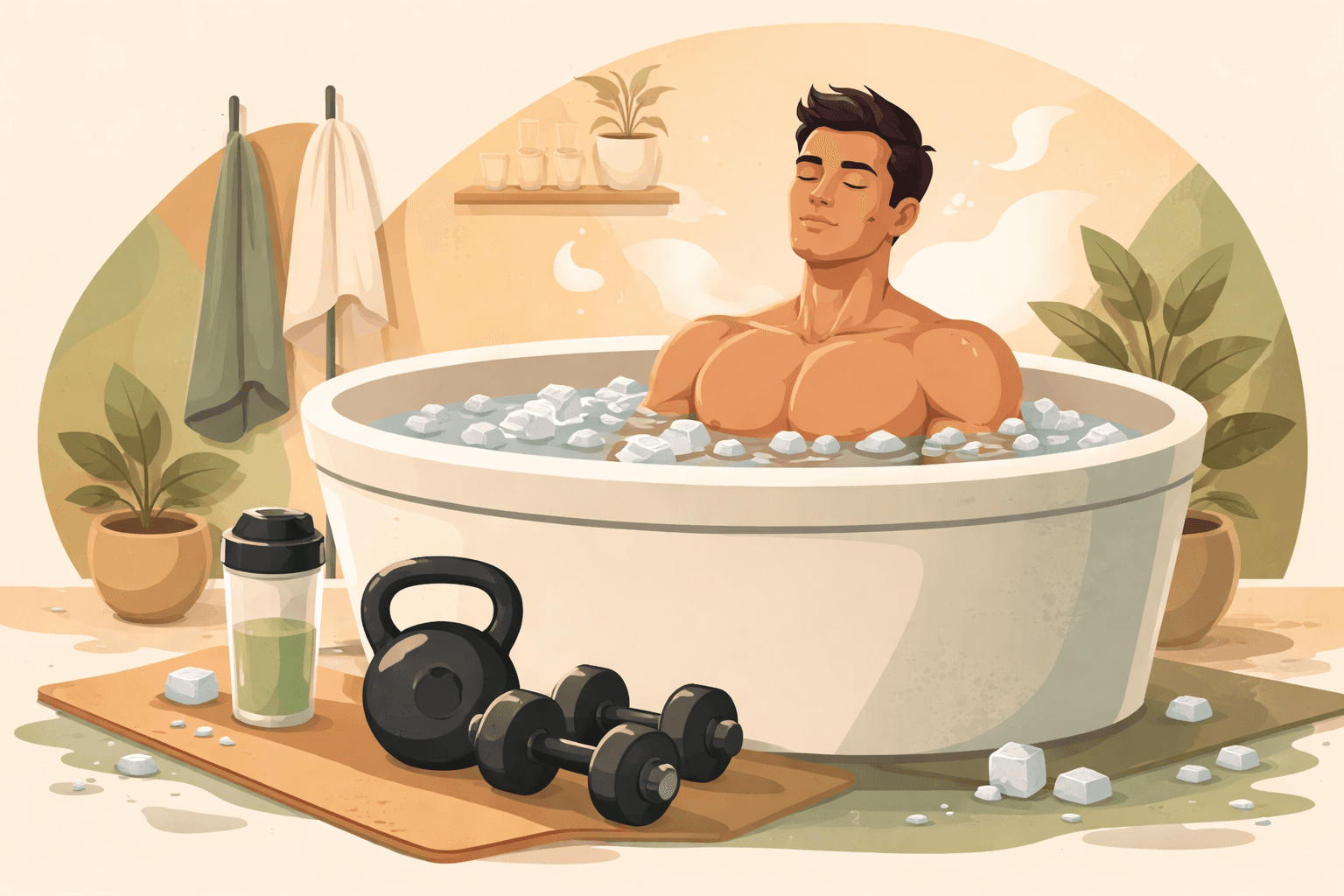
Cold plunges have surged in popularity, helped by high-profile voices like the Huberman Lab podcast and the broader “Wim Hof method” movement. Many athletes now step from the squat rack straight into an ice bath hoping to speed recovery. But for strength and hypertrophy goals, research suggests timing matters: regular cold-water immersion (CWI) immediately after lifting may dampen the very adaptations you want.
This article focuses on the long-tail question: ice baths after lifting—do they blunt muscle gains? It also briefly places the topic in a wider context (inflammation/DOMS, contrast therapy, brown fat, and traditional practices) to help you interpret the evidence.
Key takeaways are summarized at the bottom.
Why cold might reduce strength and hypertrophy adaptations
- Blunting anabolic signaling: A pivotal randomized study found that 10–12 weeks of strength training combined with regular post-exercise CWI attenuated muscle protein synthesis signaling (e.g., mTOR pathway) and satellite cell activity, leading to smaller gains in muscle mass and strength compared with active recovery (Roberts et al., 2015, The Journal of Physiology). Evidence level: moderate–strong (longitudinal RCT, replicated mechanistic signals).
- Replicated in reviews: Systematic reviews suggest that chronic use of CWI after resistance sessions can modestly reduce hypertrophy and strength adaptations, even though it may reduce soreness (Ihsan et al., Sports Medicine, 2016; Peake et al., 2017, review). Evidence level: moderate (converging reviews, small but consistent effect sizes in trained and untrained populations).
- Why would this happen? The working hypothesis is that acute dampening of inflammation and muscle damage—often perceived as “good recovery”—can also reduce the molecular signals that trigger remodeling and growth after lifting. In simple terms, the cold may help you feel better but signal your muscles to adapt less. Evidence level: moderate (coherent mechanistic data; human training data with small-to-moderate effects).
Does cold help with soreness and next-day performance?
- DOMS and perceived recovery: Meta-analyses generally show small-to-moderate reductions in delayed-onset muscle soreness after CWI compared with passive rest (Leeder et al., 2012, Br J Sports Med; Hohenauer et al., 2015, Int J Sports Physiol Perform; Machado et al., 2016, Sports Med). Evidence level: strong (multiple systematic reviews/meta-analyses).
- Performance measures: The same reviews report minimal or inconsistent improvements in strength or power in the 24–72 hours after CWI. In many cases, soreness drops more than objective performance improves. Evidence level: moderate (meta-analytic but heterogeneous protocols).
Contrast water therapy vs. ice baths alone
- Contrast water therapy (alternating warm and cold exposures) is a traditional Nordic-style approach. Systematic reviews indicate contrast therapy may reduce soreness to a similar or slightly greater extent than CWI in some settings, but clear superiority for performance restoration is not consistent (e.g., Higgins et al., 2017, J Strength Cond Res; Machado et al., 2016, Sports Med). Evidence level: moderate (systematic reviews; mixed protocols).
- Practical implication commonly used by practitioners: contrast therapy may be a middle-ground for perceived recovery on dense schedules, while the risks of blunting hypertrophy likely parallel those seen with CWI if used immediately and repeatedly after lifting. Evidence level: emerging (logical extrapolation; limited head-to-head hypertrophy data).
Cold shock proteins and brown fat: interesting, but not a hypertrophy hack
- Cold shock proteins: Proteins like RBM3 and CIRP increase with cold exposure and may protect cells under stress in animal and cell models; some human data suggest neuroprotective potential, but direct links to enhanced muscle growth or strength recovery remain unproven (Peretti et al., 2015, Nature; Danno et al., 1997; translational reviews). Evidence level: emerging (preclinical and early translational evidence).
- Brown adipose tissue (BAT): Mild cold activates BAT thermogenesis in adults (Cypess et al., 2009, N Engl J Med; van Marken Lichtenbelt et al., 2009, N Engl J Med). While this may influence energy expenditure and metabolic health, it does not appear to enhance post-lift muscle anabolism. Evidence level: strong for BAT activation; emerging for any direct recovery or hypertrophy benefit.
When cold may make sense—and when it may not
- If your primary goal is hypertrophy or maximal strength development, research suggests repeatedly using cold immersion immediately after lifting may undermine long-term gains (Roberts et al., 2015; Ihsan et al., 2016). Evidence level: moderate–strong.
- If your top priority is feeling ready for frequent competitions, two-a-day sessions, or travel-compromised schedules, reducing soreness and perceived fatigue via CWI or contrast therapy may help you maintain training quality, with the trade-off that long-term hypertrophy signaling could be muted if used chronically after lifting. Evidence level: moderate for soreness; moderate for potential hypertrophy trade-off.
- Endurance vs. strength: Reviews suggest cold may be less likely to hamper endurance adaptations and may even aid thermal strain management and recovery in hot environments (Ihsan et al., 2016; Peake et al., 2017). Evidence level: moderate (reviews; domain-specific variability).
The “Huberman effect,” Wim Hof, and Nordic traditions—bridging perspectives
- Popularity and catecholamines: Public enthusiasm has grown alongside podcasts and social media. Acute cold exposure can increase catecholamines (e.g., norepinephrine), which some interpret as energizing or focus-enhancing; in research using cold-stress paradigms and the Wim Hof method, elevated epinephrine and moderated inflammatory responses have been observed (Kox et al., 2014, PNAS). Evidence level: moderate (controlled human studies in specific contexts).
- Traditional practices: Nordic cultures have long embraced cold plunges and sauna-cold alternation for vigor and resilience; East Asian and Eastern European traditions also use cold for circulation and mental fortitude. These practices align with perceived recovery and stress-hardening philosophies rather than muscle hypertrophy per se. Evidence level: traditional (historical and cultural use).
How to think about timing without protocols
- Many coaches periodize recovery strategies. During blocks focused on muscle size/strength, they often limit immediate post-lift cold exposure to avoid dampening adaptation signals; during congested competition periods, they may re-introduce cold for perceived recovery. This reflects a trade-off model rather than a one-size-fits-all rule. Evidence level: moderate (supported by mechanistic data and longitudinal studies for resistance training; applied practice consensus).
Bottom line
- Ice baths right after lifting may blunt long-term hypertrophy and strength gains if used repeatedly, even though they can reduce soreness. Evidence level: moderate–strong.
- Contrast water therapy offers similar perceived recovery benefits to CWI, but clear advantages for performance are inconsistent; it likely carries similar adaptation trade-offs when used immediately post-lift. Evidence level: moderate.
- Cold shock proteins and brown fat activation are scientifically intriguing but do not currently translate into better muscle-building outcomes after strength work. Evidence level: emerging.
- Cold exposure remains a useful tool when the priority is short-term readiness, heat stress management, or psychological benefits rooted in traditional practices. Align cold use with your primary goal for the training block.
References (selected)
- Roberts et al. Post-exercise cold water immersion attenuates acute anabolic signaling and long-term adaptations in muscle to strength training. The Journal of Physiology. 2015.
- Ihsan M, Watson G, Abbiss CR. What are the physiological mechanisms for post-exercise cold water immersion in the recovery from prolonged endurance and intermittent exercise? Sports Medicine. 2016 (review).
- Leeder J et al. Cold water immersion and recovery from strenuous exercise: a meta-analysis. Br J Sports Med. 2012.
- Hohenauer E et al. Cold-water immersion and recovery post-exercise: a systematic review and meta-analysis. Int J Sports Physiol Perform. 2015.
- Machado AF et al. Cryotherapy for muscle recovery after exercise: a systematic review and meta-analysis. Sports Medicine. 2016.
- Kox M et al. Voluntary activation of the sympathetic nervous system and attenuation of the innate immune response in humans. PNAS. 2014.
- Cypess AM et al. Identification and importance of brown adipose tissue in adult humans. N Engl J Med. 2009.
- van Marken Lichtenbelt WD et al. Cold-activated brown adipose tissue in healthy men. N Engl J Med. 2009.
Health Disclaimer
This content is for informational purposes only and does not constitute medical advice. Always consult a qualified healthcare provider before starting, stopping, or changing any supplement or medication regimen.