Introduction
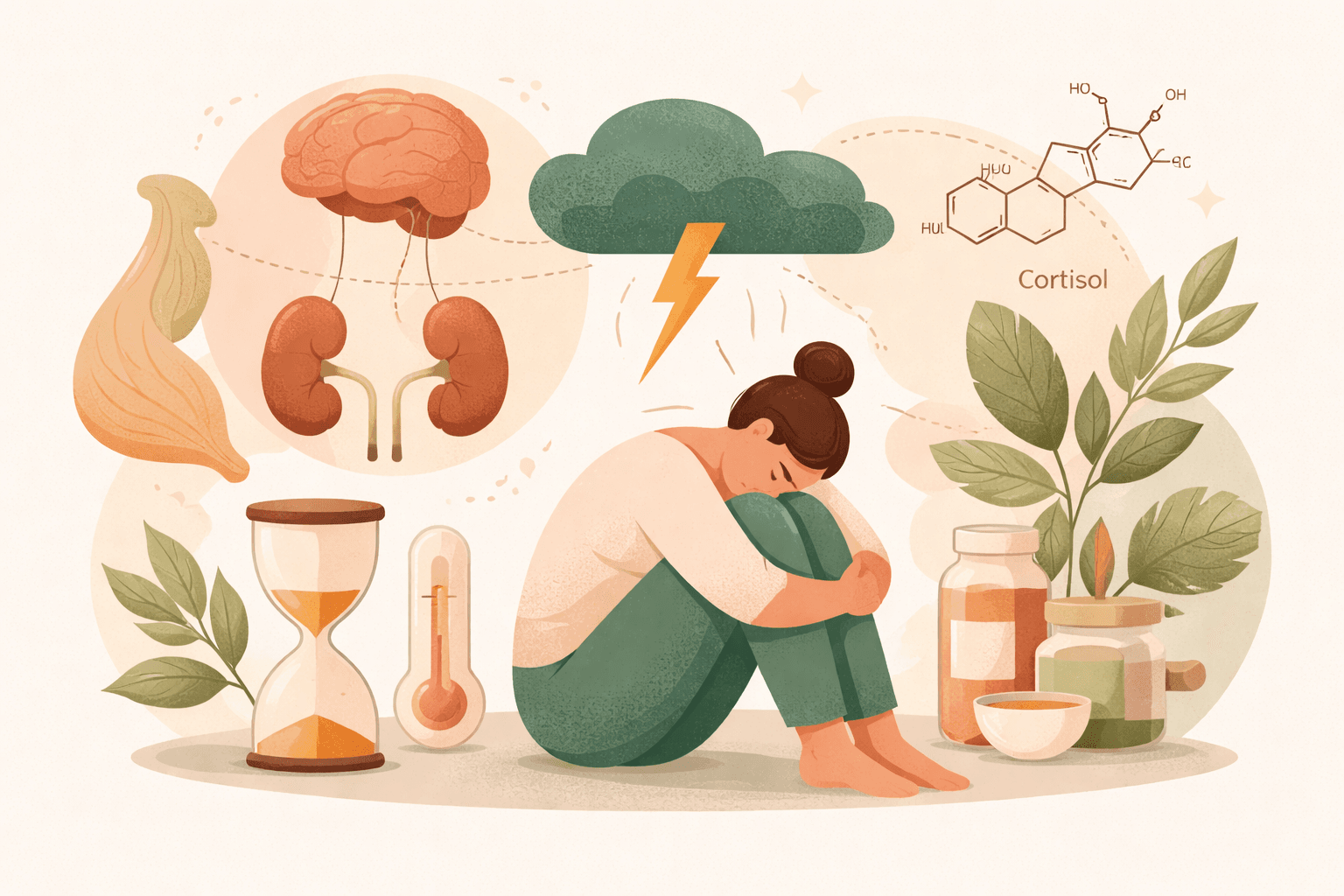
Burnout feels physical as much as psychological: unrelenting fatigue, sleep disruption, brain fog, and reduced stress tolerance. Research suggests these symptoms often reflect changes in the brain–hormone stress network—known as the hypothalamic–pituitary–adrenal (HPA) axis—rather than the adrenal glands “wearing out.” This article focuses on HPA axis dysregulation in burnout, what cortisol patterns look like, why “adrenal fatigue” is not a recognized diagnosis, and where adaptogen research and traditional perspectives fit.
What the HPA Axis Does (in Brief)
- The HPA axis coordinates the body’s response to stress. The brain (hypothalamus and pituitary) signals the adrenal cortex to release cortisol, a hormone that helps regulate energy, immune activity, and circadian rhythms. [Evidence: strong]
- Cortisol follows a daily (diurnal) pattern: a sharp rise within 30–45 minutes after waking (the cortisol awakening response, or CAR) and a gradual decline toward evening. This rhythm helps set daytime alertness and nighttime rest. [Evidence: strong]
How Burnout Can Alter Cortisol Rhythms
- Research suggests chronic stress and burnout may shift the HPA axis into a “conservation mode” marked by a blunted CAR, a flatter daytime cortisol slope, and reduced cortisol reactivity to acute stressors. [Evidence: moderate]
- A meta-analysis of studies in burnout reported small but consistent alterations in basal cortisol patterns, particularly a blunted CAR, and signs of hypo-reactivity to lab stress tests. These effects vary across individuals and study methods. (Penz et al., Psychoneuroendocrinology, 2018) [Evidence: moderate]
- Earlier theoretical and empirical work on “hypocortisolism” proposes that after prolonged high-demand periods, the HPA axis may downshift, leading to lower-than-expected cortisol outputs in some contexts. (Fries et al., Psychoneuroendocrinology, 2005) [Evidence: moderate]
Why This Matters for Symptoms
- A blunted morning rise and a flattened day–night cortisol slope have been linked to low energy on waking, poorer stress tolerance, and sleep–wake disruption. (Chida & Steptoe, Psychoneuroendocrinology, 2009; multiple observational studies) [Evidence: moderate]
- Altered reactivity—producing “too little” cortisol in response to a challenge—may contribute to brain fog, reduced motivation, and prolonged recovery after stressful days. [Evidence: emerging]
- Importantly, “altered” does not mean “failed.” In most people with burnout, adrenal glands still make cortisol; the issue is central regulation and timing rather than glandular failure. [Evidence: strong]
The “Adrenal Fatigue” Controversy
- “Adrenal fatigue” is not recognized by endocrinology. A systematic review concluded there is no consistent evidence that chronic stress leads to primary adrenal failure in otherwise healthy individuals, and common screening methods (like single-sample salivary cortisol) are not diagnostic. (Cadegiani & Kater, BMC Endocrine Disorders, 2016) [Evidence: strong]
- This does not dismiss people’s symptoms. Rather, it reframes the biology: burnout-related fatigue and brain fog are better explained by HPA axis dysregulation and broader neuroimmune changes than by “worn-out” adrenal glands. [Evidence: strong]
How Researchers Measure Cortisol in Burnout Studies
- Multi-sample diurnal saliva collections (e.g., upon waking, post-awakening, midday, evening) are commonly used to map the CAR and daily slope. Single cortisol readings provide limited insight. [Evidence: strong]
- Laboratory stress challenges (e.g., Trier Social Stress Test) can reveal whether cortisol and ACTH responses are blunted or heightened in individuals with burnout. Findings more often suggest blunting. [Evidence: moderate]
Where Adaptogens Fit: Evidence for Stress Resilience
Adaptogens are botanicals traditionally used to enhance resilience to stressors. They are not a substitute for medical care, but research suggests some may help subjective stress and may modestly influence cortisol dynamics.
Ashwagandha (Withania somnifera)
- Randomized, placebo-controlled trials have found that standardized ashwagandha extracts may reduce perceived stress and anxiety and are associated with decreases in serum or waking cortisol over several weeks. (Chandrasekhar et al., Indian Journal of Psychological Medicine, 2012; Lopresti et al., Medicine (Baltimore), 2019) [Evidence: moderate]
- Meta-analyses report consistent reductions in perceived stress and anxiety with ashwagandha and suggest small-to-moderate effects on cortisol. (Pratte et al., Journal of Alternative and Complementary Medicine, 2014; multiple meta-analyses 2020–2021) [Evidence: moderate]
- Mechanistically, ashwagandha may modulate GABAergic signaling, inflammatory mediators, and HPA axis setpoints, contributing to improved stress resilience. [Evidence: emerging]
Rhodiola (Rhodiola rosea)
- Several trials in stress-related fatigue report improvements in fatigue, concentration, and mood with rhodiola extracts compared with placebo. (Darbinyan et al., Phytomedicine, 2000; Olsson et al., Planta Medica, 2009) [Evidence: moderate]
- For burnout specifically, open-label studies show symptom improvements, but high-quality randomized trials are fewer; cortisol effects are inconsistent. (Systematic reviews: Panossian & Wikman, Phytomedicine, 2010; more recent reviews through 2022) [Evidence: emerging]
- Proposed mechanisms include modulation of monoamine systems and stress-protective effects on mitochondria and HPA signaling. [Evidence: emerging]
Caveats on Adaptogens
- Study quality varies across products and trials, and extracts differ in composition. Benefits, when present, tend to be modest and accumulate over weeks. [Evidence: moderate]
- Adaptogens are adjuncts to comprehensive stress recovery strategies, not stand-alone solutions. [Evidence: strong]
Bridging Traditional Perspectives: Ayurveda and TCM
- Ayurveda describes chronic stress and depletion as loss of ojas (vital essence) and vata imbalance—presenting with fatigue, restlessness, poor sleep, and mental scattering. Rasayana herbs like ashwagandha are traditionally used to restore vigor and steadiness. [Evidence: traditional]
- In Traditional Chinese Medicine (TCM), many burnout-like presentations align with qi deficiency (often of spleen or lung) and, with chronicity, kidney qi/essence depletion—manifesting as fatigue, low motivation, and poor stress tolerance. Strategies aim to tonify qi and support essence. [Evidence: traditional]
- These frameworks anticipate the modern concept that resilience depends on restoring rhythm and reserves rather than forcing more output—broadly compatible with HPA axis “re-tuning.” [Evidence: emerging]
What This Means for Burnout Recovery
- Research points away from the idea of adrenal failure and toward central recalibration of stress systems. Interventions that help re-establish healthy circadian cues, reduce allostatic load, and improve sleep may support a more robust CAR and diurnal slope over time. (Observational and interventional studies on sleep, light exposure, and psychosocial interventions) [Evidence: moderate]
- Psychological therapies such as cognitive behavioral approaches and mindfulness-based programs have been associated with improvements in perceived stress and, in some studies, modest normalization of cortisol dynamics. (Systematic reviews and meta-analyses in stress-related conditions) [Evidence: moderate]
Bottom Line
- Burnout is linked to HPA axis dysregulation—often a blunted cortisol awakening response and flatter daily cortisol rhythm—rather than “adrenal fatigue.” [Evidence: strong]
- The endocrinology literature does not support adrenal failure in otherwise healthy, stressed individuals; common single-sample cortisol tests are not diagnostic. [Evidence: strong]
- Adaptogens like ashwagandha and rhodiola may help reduce perceived stress and fatigue and may modestly influence cortisol, with the strongest data for ashwagandha. They are adjunctive, not curative. [Evidence: moderate]
- Ayurvedic and TCM concepts of depleted vital energy (ojas loss, qi deficiency) parallel the need to restore rhythm and reserves—an idea increasingly echoed in stress biology. [Evidence: traditional/emerging]
References (selected)
- Penz M, et al. Are cortisol levels altered in burnout? Psychoneuroendocrinology. 2018.
- Fries E, et al. A new view on hypocortisolism. Psychoneuroendocrinology. 2005.
- Chida Y, Steptoe A. Cortisol awakening response and psychosocial factors. Psychoneuroendocrinology. 2009.
- Cadegiani FA, Kater CE. Adrenal fatigue does not exist: a systematic review. BMC Endocrine Disorders. 2016.
- Chandrasekhar K, et al. A prospective, randomized, double-blind, placebo-controlled study of ashwagandha in chronic stress. Indian J Psychol Med. 2012.
- Lopresti AL, et al. Examining the clinical efficacy and safety of ashwagandha for stress and anxiety. Medicine (Baltimore). 2019.
- Pratte MA, et al. Ashwagandha for anxiety and stress: systematic review. J Altern Complement Med. 2014.
- Darbinyan V, et al. Rhodiola rosea in stress-induced fatigue. Phytomedicine. 2000.
- Olsson EMG, et al. A randomized double-blind, placebo-controlled, parallel-group study of rhodiola in fatigue. Planta Med. 2009.
- Panossian A, Wikman G. Effects of adaptogens. Phytomedicine. 2010.
Note: This article is for educational purposes only and is not a substitute for professional care or diagnosis.