Overview
Burnout is now recognized by the World Health Organization as an occupational phenomenon characterized by exhaustion, cynicism, and reduced professional efficacy. Beyond symptoms, research suggests that prolonged stress states like burnout may alter the hypothalamic–pituitary–adrenal (HPA) axis—the body’s central stress-response network—and shift daily cortisol rhythms. This article focuses on what is known (and not yet known) about HPA axis dysregulation in burnout, the controversy around “adrenal fatigue,” and how emerging evidence on adaptogens fits alongside traditional medical perspectives.
Key Takeaways at a Glance
- Burnout is linked to altered HPA axis activity and changes in daily cortisol patterns, though findings vary across studies (Evidence: moderate).
- “Adrenal fatigue” is not recognized by endocrinology; symptoms are real, but the mechanism is not adrenal gland failure (Evidence: strong).
- Ashwagandha and rhodiola may support stress resilience and perceived fatigue, with randomized trials and systematic reviews reporting benefits, though study quality is mixed (Evidence: moderate).
- Ayurveda and Traditional Chinese Medicine (TCM) describe burnout-like states as depleted vital energy (ojas/qi) and constitutional imbalance; these frameworks can complement, but not replace, biomedical models (Evidence: traditional).
How the HPA Axis and Cortisol Work
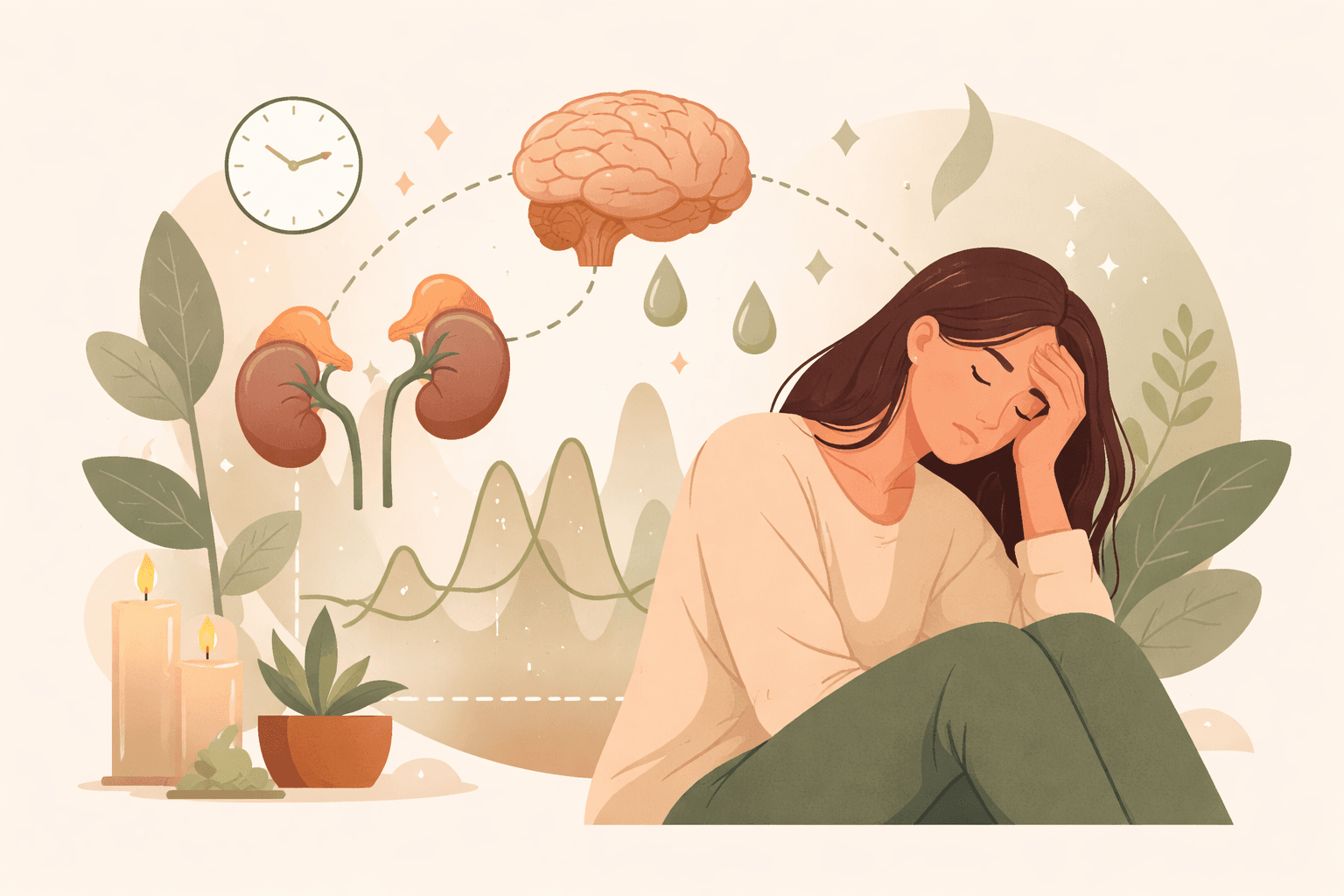
The HPA axis coordinates the stress response: the hypothalamus signals the pituitary, which prompts the adrenal cortex to release cortisol. In a healthy pattern, cortisol peaks shortly after waking (the cortisol awakening response, or CAR) and then declines across the day, reaching a low at night to support sleep (Clow et al., 2010) (Evidence: strong).
In chronic stress states, research suggests the system may recalibrate—sometimes showing initially elevated HPA activity, and with persistent stress, transitioning to a “hypocortisolic” profile characterized by flattened daily rhythms or blunted morning peaks (Miller, Chen, & Zhou, 2007; Fries et al., 2005) (Evidence: moderate).
Cortisol Patterns Reported in Burnout
- Blunted CAR and Flattened Diurnal Slope: Reviews of chronic stress and stress-related exhaustion syndromes (which include, but are not limited to, burnout) describe a tendency toward a reduced CAR and a flatter decline from morning to evening (Miller et al., 2007; Fries et al., 2005; Clow et al., 2010) (Evidence: moderate). Not all studies agree, and individual variability is common (Evidence: moderate).
- Stage-Dependent Changes: The “allostatic load” model proposes that early, ongoing stress can elevate cortisol, whereas long-standing stress may drive the system toward lower basal output and a blunted rhythm (Miller et al., 2007) (Evidence: moderate).
- Context Matters: Sleep timing, light exposure, medications, and measurement methods strongly influence salivary cortisol results, which may partly explain mixed findings across burnout studies (Clow et al., 2010) (Evidence: strong).
What This Means Clinically
- Not a Standalone Diagnostic: Research-grade measures like CAR and diurnal slope help scientists understand mechanisms, but are not diagnostic tools for burnout (Evidence: strong).
- Biomarkers Beyond Cortisol: Studies also explore DHEA-S, autonomic balance (e.g., heart rate variability), and inflammatory markers in chronic stress states, with inconsistent results to date (Evidence: emerging).
The “Adrenal Fatigue” Controversy
“Adrenal fatigue” is a popular label used to explain exhaustion, sleep problems, and brain fog. Endocrinology societies state there is no scientific basis for a distinct condition where mildly “tired” adrenals cause these symptoms, and testing marketed for “adrenal fatigue” is not validated for this purpose (Endocrine Society, 2016) (Evidence: strong).
- Symptoms Are Real, Mechanism Differs: Burnout-related fatigue and cognitive strain are well documented. However, research points to central regulation issues in the HPA axis and network-level changes (brain, immune, autonomic), rather than primary adrenal gland failure (Miller et al., 2007; Fries et al., 2005) (Evidence: moderate).
- Distinct From Adrenal Insufficiency: Adrenal insufficiency (Addison’s disease) is a rare, serious condition diagnosed by specific endocrine testing and requires medical treatment—very different from burnout-related dysregulation (Endocrine Society, 2016) (Evidence: strong).
Adaptogens and Stress Resilience: Where Do They Fit?
Adaptogens are plant extracts traditionally used to enhance resilience to stress. Modern research has examined whether they may normalize HPA activity and support subjective well-being.
Ashwagandha (Withania somnifera)
- What the research suggests: Randomized, placebo-controlled trials report reductions in perceived stress and anxiety, often with decreases in morning cortisol compared with placebo (Chandrasekhar et al., 2012; Lopresti et al., 2019) (Evidence: moderate). Systematic reviews note consistent directionality of benefit but highlight heterogeneity in extracts and methods (Pratte et al., 2014) (Evidence: moderate).
- Mechanistic notes: Preclinical and clinical data suggest ashwagandha may modulate HPA signaling and GABAergic pathways, which could align with observed cortisol changes (Evidence: emerging).
Rhodiola (Rhodiola rosea)
- What the research suggests: Trials in stress-related fatigue and burnout-like symptoms report improvements in energy, mood, and well-being relative to placebo in the short term (weeks), though not all outcomes are consistently positive (Ishaque et al., 2012) (Evidence: moderate). Narrative and mechanistic reviews describe effects on monoamines and stress signaling (Panossian & Wikman, 2010) (Evidence: emerging to moderate).
- Cautions from the evidence: Many studies are small, vary in extract standardization, and use different assessments, which limits firm conclusions (Evidence: moderate).
Important context
- No supplement can “fix” burnout without addressing workload, recovery, sleep regularity, social support, and broader psychosocial factors. Interventions that stabilize daily rhythms (consistent wake time, morning light, structured breaks) align with physiology and may support a healthier cortisol pattern over time (Evidence: moderate).
- Individuals vary; discussions with a qualified clinician can help determine appropriate, evidence-informed approaches and rule out medical conditions that can mimic burnout (Evidence: strong).
Ayurveda and TCM: Traditional Views of “Depleted Energy”
- Ayurveda: Burnout-like exhaustion often maps to aggravated vata and/or depleted ojas (vital essence). Signs may include unrefreshing sleep, scattered focus, and variable digestion. Interventions traditionally emphasize grounding routines, warm nourishing foods, breath practices, and restorative rest (Evidence: traditional).
- Traditional Chinese Medicine (TCM): Chronic overwork and stress may be framed as qi and yin deficiency, especially of the Spleen and Kidney systems, presenting with fatigue, poor concentration, and sleep disturbance. Care typically prioritizes replenishing qi and yin and calming the shen (mind-spirit) through herbs, breath/movement practices, and lifestyle rhythm (Evidence: traditional).
These traditional models emphasize rhythm, nourishment, and restoration—principles that conceptually align with modern goals to normalize circadian and HPA axis function. While not substitutes for clinical care, they can complement Western approaches when practiced safely (Evidence: traditional).
Practical Considerations for Readers
- Testing: Research tools like the CAR and diurnal slope can illuminate physiology but are not standardized for diagnosing burnout. Medical testing is essential only when symptoms suggest thyroid disorders, anemia, sleep disorders, major depression, or true adrenal insufficiency (Evidence: strong).
- Monitoring symptoms: Validated questionnaires (e.g., burnout inventories, stress and sleep scales) can help track change alongside lifestyle adjustments (Evidence: moderate).
- Interventions: Multimodal approaches—sleep regularity, light and movement exposure, psychological skills (e.g., CBT-based stress management), workload adjustments, social support—show the most promise for durable recovery (Evidence: moderate).
Bottom Line
- Burnout is associated with altered HPA axis regulation and shifts in daily cortisol rhythms, typically trending toward a blunted morning response and flatter day curve in long-standing stress, though findings are mixed (Evidence: moderate).
- The term “adrenal fatigue” is inaccurate; endocrinology does not recognize it, and burnout-related symptoms arise from network-level stress physiology rather than failing adrenal glands (Evidence: strong).
- Adaptogens like ashwagandha and rhodiola may help reduce perceived stress and fatigue and may influence cortisol patterns, but studies are heterogeneous and not a replacement for addressing root causes (Evidence: moderate).
- Traditional frameworks from Ayurveda and TCM describe burnout as depleted vital energy and disrupted constitutional balance. Their emphasis on rhythm and restoration complements modern stress physiology concepts (Evidence: traditional).
References (selected)
- Clow A, Hucklebridge F, Stalder T, Evans P, Thorn L. The cortisol awakening response: more than a measure of HPA axis function? Psychoneuroendocrinology. 2010.
- Endocrine Society. Adrenal fatigue is not an actual medical condition. 2016.
- Fries E, Hesse J, Hellhammer J, Hellhammer DH. A new view on hypocortisolism. Psychoneuroendocrinology. 2005.
- Ishaque S, Shamseer L, Bukutu C, Vohra S. Rhodiola rosea for physical and mental fatigue: A systematic review. BMC Complement Altern Med. 2012.
- Miller GE, Chen E, Zhou ES. If it goes up, must it come down? Chronic stress and the HPA axis in humans. Psychol Bull. 2007.
- Panossian A, Wikman G. Effects of adaptogens on the central nervous system and the molecular mechanisms associated with their stress—protective activity. Phytomedicine. 2010.
- Pratte MA, Nanavati KB, Young V, Morley CP. An alternative treatment for anxiety: A systematic review of ashwagandha. J Altern Complement Med. 2014.
- Chandrasekhar K, Kapoor J, Anishetty S. A prospective, randomized double-blind, placebo-controlled study of ashwagandha root extract in reducing stress and anxiety in adults. Indian J Psychol Med. 2012.
- Lopresti AL, Drummond PD, Smith SJ. A randomized, double-blind, placebo-controlled, crossover study examining the hormonal and vitality effects of ashwagandha in adults. Medicine (Baltimore). 2019.