

Promising research with growing clinical support
Hot Water vs Dual Extract: Which Mushroom Preparations May Best Support Immune Function?
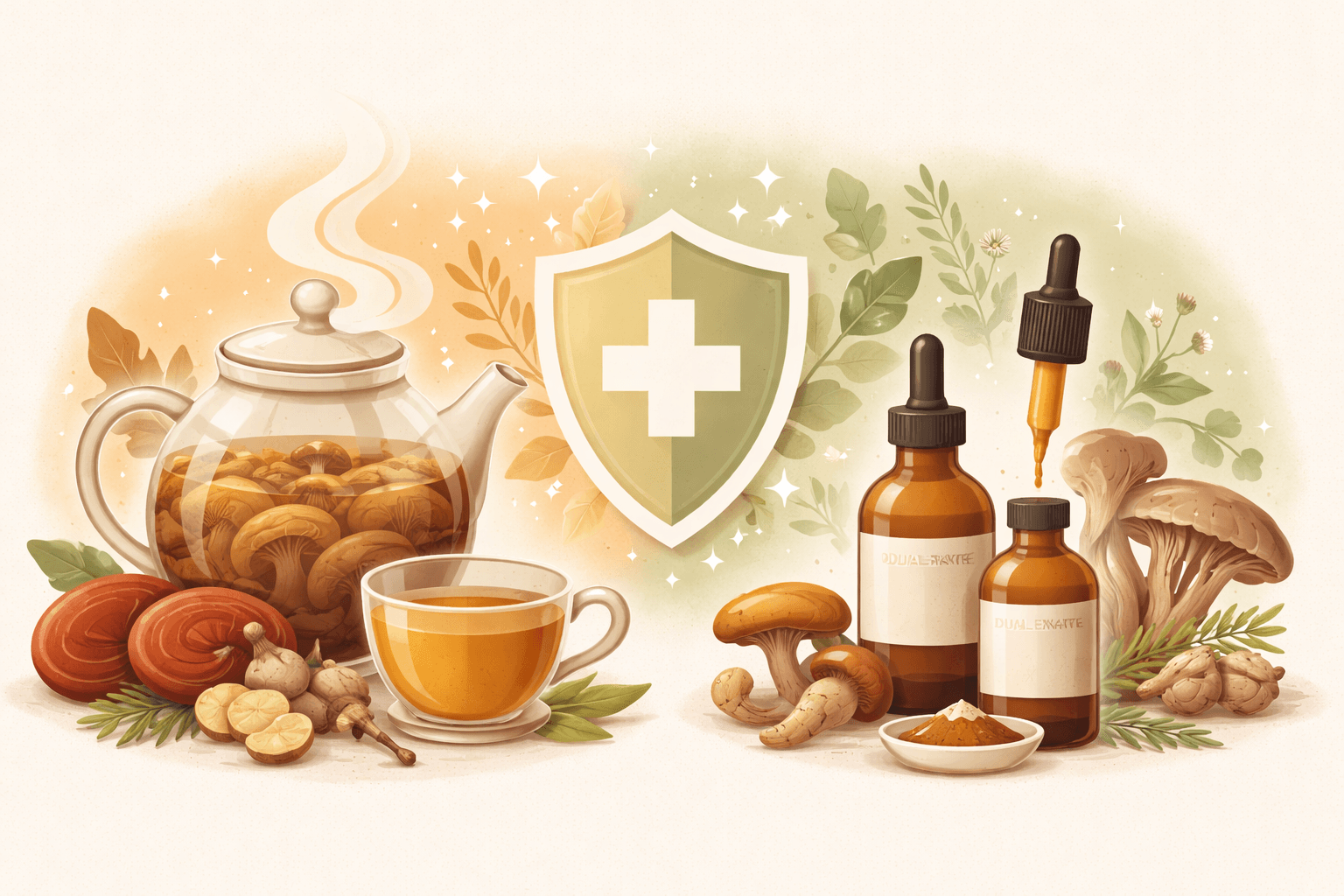
How hot water vs dual extraction changes the immune-active compounds in mushrooms like reishi and turkey tail (PSK/PSP)—and what research suggests for immune support.
This content is for informational purposes only and does not constitute medical advice. Always consult a qualified healthcare provider before starting, stopping, or changing any supplement or medication regimen.
Why extraction matters for mushroom immunology
Medicinal mushrooms are packed with immune-active compounds, but most are locked behind tough chitin cell walls. Extraction determines what actually reaches your cup—or your cells. Research suggests that water-based and alcohol-based methods pull out different families of molecules that may modulate immune activity in distinct ways (Evidence: moderate). Traditional decoctions in East Asian medicine emphasize hot-water extraction, while modern “dual extracts” combine water and alcohol to capture a wider spectrum.
This focused guide compares hot water vs dual extraction through the lens of immune function, using species like turkey tail, reishi, chaga, lion’s mane, and cordyceps as real-world examples.
The immune targets: beta‑glucans, peptides, and triterpenes
- Beta‑glucans (water-soluble): Many mushroom beta‑1,3/1,6‑glucans engage innate immune receptors such as dectin‑1, complement receptor 3, and TLR2/6, which may prime macrophages, neutrophils, dendritic cells, and natural killer (NK) cells (Goodridge et al., 2009; Netea et al., 2016). Hot water is the classic way to solubilize and preserve these polymers and related polysaccharopeptides like PSK/PSP (Evidence: strong for mechanism; moderate for clinical immune outcomes).
- Polysaccharopeptides (water-soluble): Protein‑bound beta‑glucans from turkey tail—PSK (Japan) and PSP (China)—are produced via hot water extraction and standardized fermentation. They’ve been studied extensively as adjuncts to conventional cancer therapies (Evidence: strong for oncology adjunct endpoints; moderate for general immune support).
- Triterpenes and phenolics (often alcohol-soluble): Reishi’s ganoderic acids and chaga’s inotodiol and melanin complexes are more readily captured with ethanol. These may modulate inflammatory signaling (e.g., NF‑κB, COX‑2) and contribute to immune balance rather than simple stimulation (Evidence: emerging to moderate, species‑dependent).
Hot water extracts: the backbone of mushroom immunology
Hot water extraction aligns with centuries of Traditional Chinese Medicine (TCM) practice—think long simmered lingzhi (Ganoderma lucidum) decoctions. Modern immunology helps explain why. Water extraction liberates beta‑glucans and related high‑molecular‑weight polysaccharides that interact with immune pattern-recognition receptors and may induce “trained immunity”—a state of heightened, nonspecific readiness in innate immune cells (Netea et al., 2016) (Evidence: strong for mechanism; emerging for durable clinical effects outside infection models).
- Turkey tail (Trametes versicolor) PSK/PSP: Systematic reviews and meta-analyses of randomized trials report that adding PSK to chemotherapy may improve disease-free and overall survival in gastric and colorectal cancers, and may support immune markers such as NK activity and T‑cell function (Oba et al., 2007; Sakamoto et al., 2006; Zhou et al., 2021). PSP trials have reported improved immune parameters and quality-of-life signals in some cancers (Lau et al., 2004; Ho et al., 2017). These products are derived from hot water extraction and downstream purification (Evidence: strong for oncology adjuvant settings; moderate for general immune support).
- Reishi (Ganoderma lucidum) water fractions: Small randomized and controlled studies suggest increases in certain immune parameters (e.g., NK cell activity) and potential improvements in tumor response rates when combined with standard therapy, though trial quality varies (Jin et al., 2016 systematic review). Water extracts are the most reliable source of intact beta‑glucans (Evidence: moderate).
Hot water extraction also yields fibers that may reach the colon, where gut microbes ferment them into short-chain fatty acids that can influence mucosal immunity and systemic inflammatory tone (Jayachandran et al., 2018) (Evidence: emerging).
Dual extraction: broad-spectrum immunomodulation
Dual extraction combines hot water and ethanol to capture both beta‑glucans and alcohol‑soluble compounds (e.g., triterpenes from reishi, phenolics/triterpenoids from chaga). This approach may deliver a more balanced immunological profile—supporting innate immune readiness while also tempering excessive inflammatory signaling (Evidence: emerging to moderate).
- Reishi dual extracts: Ethanol pulls ganoderic acids that may downregulate NF‑κB, COX‑2, and histamine pathways, while water extracts supply beta‑glucans. Preliminary human data indicate immune modulation without clear overstimulation, which may be relevant for individuals interested in balance rather than boost (Jin et al., 2016; in vitro/in vivo mechanistic studies) (Evidence: moderate for immune modulation; emerging for specific clinical endpoints beyond oncology adjuncts).
- Chaga dual extracts: Preclinical work shows antioxidant capacity and signaling effects on inflammasome and NF‑κB pathways from alcohol‑soluble triterpenes and phenolics, alongside water‑soluble polysaccharides (Hyun et al., 2019; Song et al., 2013) (Evidence: emerging; limited human data).
Species snapshots through the extraction lens
Turkey tail (Trametes versicolor)
- Best known actives: Water‑soluble PSK/PSP and beta‑glucans.
- Evidence: Meta-analyses and RCTs support PSK as an adjunct to chemotherapy in certain gastrointestinal cancers (Oba et al., 2007; Zhou et al., 2021). PSP trials suggest immune parameter improvements (Lau et al., 2004). These findings pertain to standardized, hot-water–derived preparations used under medical supervision (Evidence: strong for oncology adjuncts; moderate for general immune support).
- Extraction takeaway: Hot water is essential.
Reishi (Ganoderma lucidum; “lingzhi”)
- Best known actives: Beta‑glucans (water) and ganoderic acids (alcohol).
- Evidence: Systematic reviews note potential improvements in immune markers and tumor response when combined with standard therapy, though heterogeneity and small samples limit certainty (Jin et al., 2016) (Evidence: moderate).
- Extraction takeaway: Dual extract may capture both immune‑priming and inflammation‑modulating fractions.
Chaga (Inonotus obliquus)
- Best known actives: Polysaccharides (water) plus inotodiol, betulinic derivatives, and phenolics (alcohol).
- Evidence: Preclinical studies suggest antioxidant and immunomodulatory signaling; rigorous human trials are scarce (Hyun et al., 2019) (Evidence: emerging).
- Extraction takeaway: Dual extract if seeking combined antioxidant and immune‑modulating effects.
Lion’s mane (Hericium erinaceus)
- Best known actives: Hericenones (fruiting body; often alcohol‑soluble) and erinacines (mycelium; various solvents). Famous for nerve growth factor (NGF) pathways, with secondary immune-gut interactions proposed via microbiota (Mori et al., 2009; Jayachandran et al., 2018) (Evidence: emerging for immune effects; moderate for cognitive endpoints in small trials).
- Extraction takeaway: Mixed; immune-specific data remain limited.
Cordyceps (C. militaris/sinensis)
- Best known actives: Cordycepin, adenosine derivatives, polysaccharides.
- Evidence: Small human and animal studies suggest effects on exercise capacity and immune signaling, but clinical immune outcomes are not well established (Park et al., 2015) (Evidence: emerging).
- Extraction takeaway: Combination approaches are common; data remain preliminary.
Practical quality cues when choosing an extract
- Look for extraction transparency: Labels that state “hot water extract,” “ethanol extract,” or “dual extract” provide clarity on the compound spectrum (Evidence: moderate, based on chemistry and solubility).
- Ask about beta‑glucan content, not just “polysaccharides”: Starch and fillers can inflate total polysaccharides. Third‑party beta‑glucan assays are more meaningful for immune‑relevant content (Evidence: moderate).
- Standardized preparations matter in clinical literature: PSK/PSP are specific, standardized hot-water–derived products used as medical adjuncts in Asia. General turkey tail powders are not equivalent (Evidence: strong in oncology-context literature).
- Fruiting body vs mycelium: Fruiting bodies often contain higher beta‑glucans, while some mycelial products include grain residues that dilute active content. Both can be useful depending on the target compounds, but composition varies widely (Evidence: moderate; varies by species and cultivation).
Traditional perspective: Lingzhi decoctions and modern science
In TCM, lingzhi (reishi) has been decocted for centuries to “nourish Zheng qi” and harmonize the body’s defenses. Hot water extraction mirrors this tradition by prioritizing polysaccharide-rich fractions that modern immunology links to innate immune training and gut–immune crosstalk. Dual extraction represents a contemporary bridge—integrating classic water decoctions with alcohol tincturing to capture terpene families emphasized in pharmacognosy (Evidence: traditional + emerging scientific corroboration).
What this means for immune support
- If your aim is beta‑glucan–focused immune priming, research suggests hot water extracts are foundational (Evidence: moderate for human immune endpoints).
- If you’re seeking a broader immune‑balancing profile—including potential anti‑inflammatory signaling—dual extracts may offer complementary benefits (Evidence: emerging to moderate).
- For oncology contexts, the evidence base centers on standardized, hot-water–derived PSK/PSP used alongside conventional therapies in clinical trials; these findings do not generalize to all over‑the‑counter products (Evidence: strong within that specific medical setting).
Clinical decisions, especially in cancer care or immune disorders, belong with qualified healthcare teams. Research continues to refine which extraction profiles best match specific goals and populations.
Key references
- Goodridge HS et al. Dectin‑1 signaling in antifungal immunity. Nat Rev Immunol. 2009.
- Netea MG et al. Trained immunity: A program of innate immune memory. Cell Host Microbe. 2016.
- Oba K et al. Efficacy of adjuvant immunochemotherapy with PSK in gastric/colorectal cancer: meta-analyses. 2007–2012.
- Zhou X et al. Adjuvant PSK and survival in colorectal cancer: meta-analysis. 2021.
- Jin X et al. Ganoderma lucidum (reishi) as adjunct in cancer: systematic review. 2016.
- Jayachandran M et al. Mushroom polysaccharides and the gut microbiota. Int J Biol Macromol. 2018.
- Hyun CK et al. Chaga immunomodulatory and antioxidant mechanisms: preclinical evidence. 2019.
- Mori K et al. Lion’s mane and cognitive function: randomized trial in MCI. Phytother Res. 2009.
Bottom line
- Hot water extraction prioritizes beta‑glucans and polysaccharopeptides that interact with innate immune receptors and may prime immune readiness (Evidence: moderate for human outcomes).
- Dual extraction adds alcohol‑soluble triterpenes and phenolics that may help balance inflammatory signaling (Evidence: emerging to moderate).
- Turkey tail’s PSK/PSP—produced via hot water—have the strongest clinical evidence as adjuncts to conventional cancer therapy in specific settings (Evidence: strong in that context).
- Reishi benefits may be broader when both water‑ and alcohol‑soluble fractions are present, aligning with TCM practice and modern pharmacology (Evidence: moderate).
- Product transparency on extraction method and beta‑glucan content may help align choices with immune goals.
Health Disclaimer
This content is for informational purposes only and does not constitute medical advice. Always consult a qualified healthcare provider before starting, stopping, or changing any supplement or medication regimen.