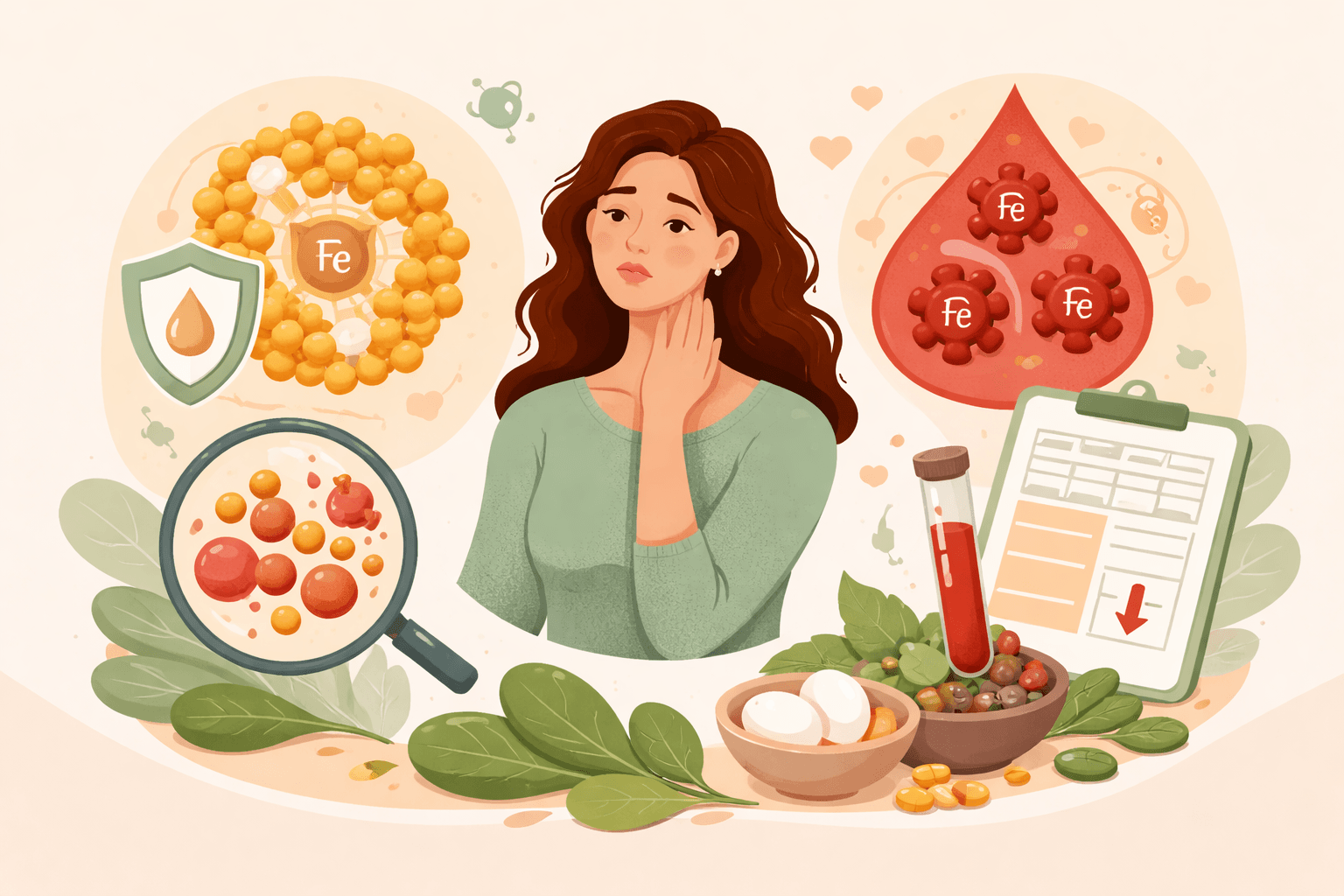
Iron deficiency is often framed as a problem only when anemia appears. But research suggests many people experience fatigue, brain fog, decreased exercise capacity, and even restless legs while their hemoglobin remains “normal.” In these cases, ferritin—a marker of iron stores—often tells the real story sooner.
Key idea: A normal hemoglobin does not rule out iron deficiency. Ferritin may flag low iron stores earlier, especially in people with symptoms but no anemia. [Evidence: strong]
What hemoglobin tells you (and what it misses)
- Hemoglobin reflects the oxygen-carrying protein in red blood cells. Anemia is diagnosed when hemoglobin drops below defined thresholds (e.g., WHO criteria). [Evidence: strong]
- By the time hemoglobin falls, iron deficiency is typically advanced; earlier stages can leave hemoglobin unchanged while iron-dependent processes in muscles, brain, skin, and nerves struggle. [Evidence: strong; Camaschella, N Engl J Med 2015; WHO, 2011]
Ferritin: your iron “savings account”
- Ferritin reflects iron storage in the body; low ferritin is highly specific for iron deficiency in the absence of inflammation. [Evidence: strong; Guyatt et al., Am J Med 1992; Camaschella, NEJM 2015]
- Thresholds vary by source and context. WHO historically uses <15 µg/L to indicate depleted stores, but many clinicians and reviews consider values <30 µg/L suggestive of deficiency, and higher cutoffs (e.g., <100 µg/L) are used when inflammation is present. C-reactive protein (CRP) and transferrin saturation (TSAT) may help interpretation. [Evidence: moderate; Pasricha et al., Lancet Haematol 2021; Cappellini et al., Am J Hematol 2020]
- Ferritin can be elevated by inflammation or liver disease even when iron is low, so it’s most informative when interpreted alongside clinical context and, in some cases, additional labs. [Evidence: strong]
Why low ferritin without anemia matters
Research suggests that non-anemic iron deficiency can affect everyday functioning, even with a “normal” hemoglobin.
- Fatigue and energy: In a randomized controlled trial of non-anemic women with low ferritin, iron supplementation reduced fatigue scores compared with placebo. [Evidence: strong; Vaucher et al., CMAJ 2012]
- Cognitive function and brain fog: A systematic review and meta-analysis of women of reproductive age found improvements in attention and concentration with iron repletion among those with low iron status. [Evidence: moderate; Falkingham et al., Am J Clin Nutr 2010]
- Restless legs syndrome (RLS): A Cochrane review concluded that iron therapy (oral or intravenous) may improve RLS severity, especially when ferritin is low. [Evidence: strong; Cochrane Database Syst Rev 2019]
- Exercise capacity: Reviews in athletes suggest that restoring low ferritin—without frank anemia—may improve aerobic performance and reduce perceived exertion, particularly in endurance-trained women. [Evidence: moderate; Burden et al., Sports Med 2015]
Who may consider discussing ferritin testing with a clinician
Certain groups are more likely to have low iron stores despite normal hemoglobin:
- People with heavy menstrual bleeding or short cycles [Evidence: strong; National prevalence data, WHO 2011]
- Endurance athletes, particularly females, due to losses in sweat, GI microbleeds, and foot-strike hemolysis [Evidence: moderate; Burden et al., Sports Med 2015]
- Frequent blood donors [Evidence: strong; Kiss et al., Transfusion 2015]
- Those with gastrointestinal conditions affecting absorption (e.g., celiac disease, IBD), or after bariatric procedures [Evidence: strong; Camaschella, NEJM 2015]
- Pregnancy and postpartum periods (increased iron demands) [Evidence: strong; WHO, 2012 guidelines]
- Plant-forward eaters with low intake of heme iron (though well-planned diets can still meet needs) [Evidence: moderate; Hurrell & Egli, Public Health Nutr 2010]
Importantly, research suggests that ferritin offers a more sensitive early signal than hemoglobin in these contexts. A clinician can help interpret ferritin with other markers (e.g., TSAT, CRP) to clarify iron status and rule out inflammation or other causes. [Evidence: strong]
Interpreting results: what studies and guidelines commonly use
- Ferritin <15 µg/L: Strongly suggests depleted iron stores in most settings. [Evidence: strong; WHO 2011]
- Ferritin <30 µg/L: Often used in clinical research and practice to indicate iron deficiency, especially in symptomatic individuals. [Evidence: moderate; Pasricha et al., 2021]
- In chronic inflammation, heart failure, or CKD, higher ferritin cutoffs (e.g., <100 µg/L) alongside low TSAT are sometimes used to define deficiency. [Evidence: moderate; Cappellini et al., 2020]
These cutoffs are drawn from research and clinical reviews; individual decisions should be personalized by a qualified clinician.
Safety first: when ferritin is high or iron overload is possible
- High ferritin does not automatically mean “good” iron status. It can reflect inflammation, liver disease, metabolic syndrome, or iron overload. [Evidence: strong]
- Hereditary hemochromatosis (often due to HFE gene variants) can cause excess iron accumulation, damaging the liver, heart, pancreas, and joints over time. TSAT is typically elevated in iron overload. [Evidence: strong; Adams & Barton, N Engl J Med 2007]
- Because both low and high iron can be harmful, research and guidelines emphasize confirming iron status with testing rather than self-supplementing based on symptoms alone. [Evidence: strong]
Food-first strategies that may support ferritin
Even when the focus is on labs, everyday food choices may help maintain iron stores over time:
- Heme vs non-heme iron: Heme iron (from animal sources) is generally absorbed more efficiently than non-heme iron (from plants). [Evidence: strong; Hurrell & Egli, 2010]
- Enhance non-heme iron: Pair plant sources with vitamin C–rich foods (citrus, bell peppers) and avoid tea/coffee with meals to reduce the impact of tannins and phytates on absorption. [Evidence: strong; Hurrell & Egli, 2010]
- Cookware matters: Cooking acidic, moist foods (like tomato sauce) in cast iron can increase the iron content of meals; community trials suggest iron cookware may improve iron status in some populations. [Evidence: moderate; Adish et al., Lancet 1999; Rappaport et al., Food Nutr Bull 2017]
Bridging traditional and modern perspectives
- Ayurveda has long described “Pandu” (a syndrome resembling iron-deficiency states) and uses iron-based preparations such as Loha Bhasma. Small modern studies and pharmacognosy analyses report variable composition and bioavailability; quality control is paramount, and safety concerns (including potential heavy metal contamination) have been raised. Robust randomized trials remain limited. [Evidence: emerging/traditional; Thatte & Dahanukar, J Postgrad Med 1986; WHO 2013 monographs]
- Traditional East Asian medicine describes “blood deficiency” patterns with fatigue, dizziness, and pale complexion. While not identical to laboratory-defined iron deficiency, these frameworks historically emphasize blood-nourishing diets (e.g., organ meats, dark leafy greens). Modern laboratory testing (ferritin, TSAT) provides objective context alongside traditional observations. [Evidence: traditional]
Putting it together: a practical path
- If you have persistent fatigue, brain fog, restless legs, or reduced exercise tolerance—and especially if you’re in a higher-risk group—research suggests that ferritin may provide earlier insight than hemoglobin alone. [Evidence: strong]
- Because ferritin can be influenced by inflammation, pairing it with TSAT and, when relevant, CRP may improve accuracy. [Evidence: strong]
- Consider food-first approaches to support iron status, and avoid unmonitored iron intake given the risk of iron overload in some individuals. [Evidence: strong]
Bottom line
- Hemoglobin alone can miss early iron deficiency. Ferritin is an earlier, more sensitive marker of iron stores. [Evidence: strong]
- Non-anemic iron deficiency may contribute to fatigue, brain fog, restless legs, and reduced exercise capacity—and these symptoms may improve when iron status is corrected. [Evidence: strong to moderate]
- Testing strategy matters. Research and reviews commonly use ferritin cutoffs around <15–30 µg/L (and higher in inflammatory states), interpreted with TSAT/CRP and clinical context. [Evidence: moderate]
- Food and traditional practices—such as pairing plant iron with vitamin C and, in some cases, using iron cookware—may help support iron stores over time, though results vary. [Evidence: moderate]
- Because both deficiency and overload carry risks, individualized evaluation with appropriate testing is essential before taking iron. [Evidence: strong]
Selected references
- Camaschella C. Iron-deficiency anemia. N Engl J Med. 2015.
- World Health Organization. Haemoglobin concentrations for the diagnosis of anaemia. 2011.
- Vaucher P et al. Effect of iron supplementation on fatigue in nonanemic menstruating women with low ferritin. CMAJ. 2012.
- Falkingham M et al. The effects of oral iron on cognition and fatigue in women of reproductive age: systematic review and meta-analysis. Am J Clin Nutr. 2010.
- Wang J et al. Iron for the treatment of restless legs syndrome. Cochrane Database Syst Rev. 2019.
- Burden RJ et al. Iron deficiency and sport performance: a review. Sports Med. 2015.
- Cappellini MD et al. Iron deficiency across chronic inflammatory conditions. Am J Hematol. 2020.
- Adish AA et al. Effect of iron pots on the iron status of Ethiopian women. Lancet. 1999.
- Hurrell R, Egli I. Iron bioavailability and dietary reference values. Public Health Nutr. 2010.
- Adams PC, Barton JC. Hemochromatosis. N Engl J Med. 2007.