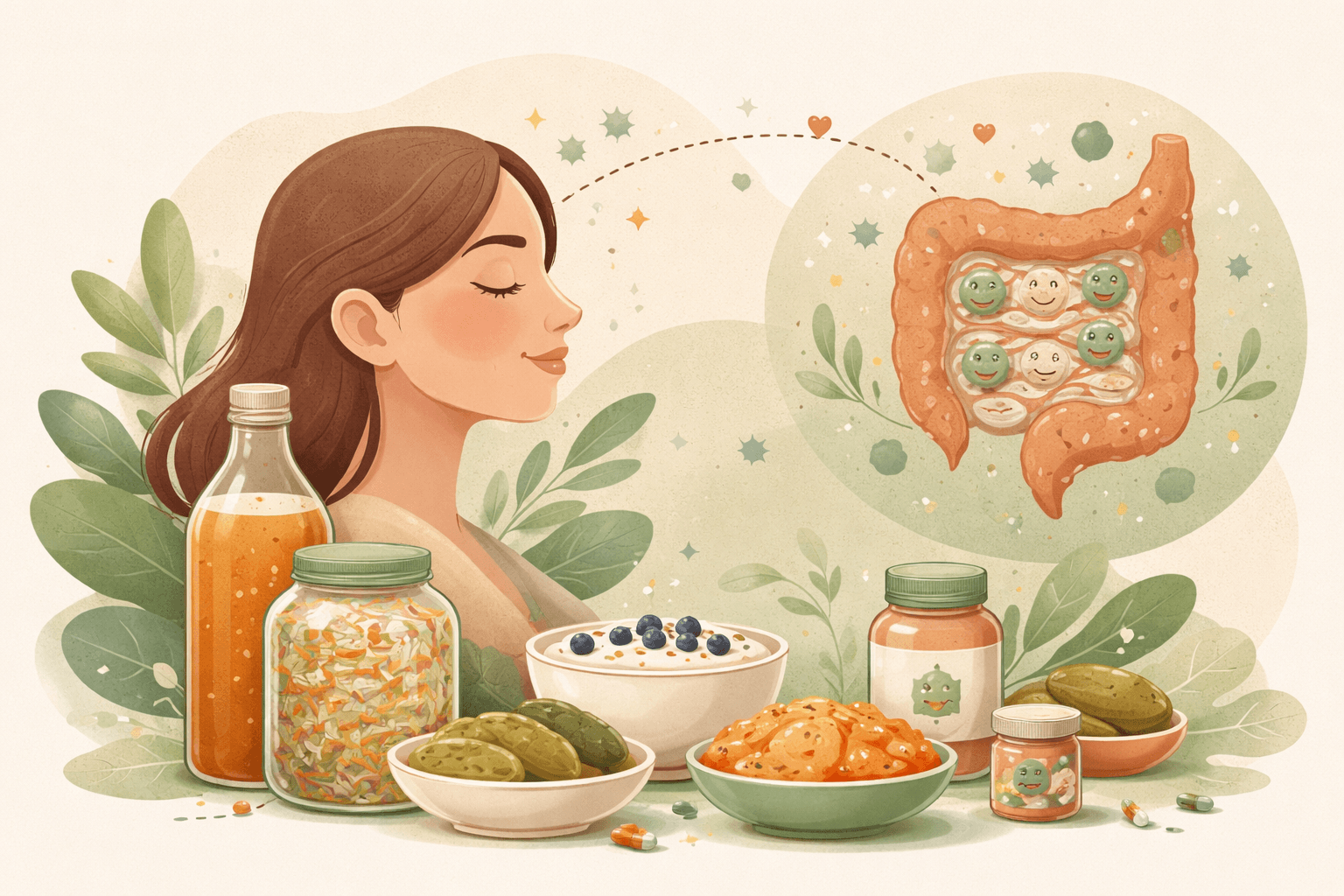
Psychobiotics are probiotics that may influence mood, stress, and cognitive processes via the gut–brain axis. A focused question many readers ask is: can everyday fermented foods act like “proto‑psychobiotics” and support mental well‑being? Here’s what current research suggests about fermented foods and mood, the strains most studied for anxiety and depression, and how ancient fermentation traditions might intersect with modern neuroscience.
What are psychobiotics?
Psychobiotics are specific live microorganisms that, when ingested in adequate amounts, may confer mental health benefits through immune, neural, and endocrine pathways (evidence: emerging-to-moderate). Research has concentrated on Lactobacillus and Bifidobacterium strains because they are common gut commensals and frequent residents of fermented foods.
- Key idea: benefits are strain-specific. Effects observed for one strain (for example, Bifidobacterium longum NCC3001) cannot be generalized to other strains or species (evidence: strong, based on multiple RCTs demonstrating differential effects by strain).
The vagus nerve connection
One of the most discussed routes from gut to brain is the vagus nerve, a bidirectional superhighway linking intestinal signals to brain regions involved in stress and emotion. In a seminal preclinical study, Lactobacillus rhamnosus JB‑1 altered GABA receptor expression and reduced anxiety- and depression-like behavior in mice; these effects disappeared when the vagus nerve was cut (Bravo et al., PNAS, 2011) (evidence: strong for mechanism in animals; emerging for translation to humans). Human neuroimaging studies suggest probiotics can modulate brain activity related to emotion processing, consistent with vagal and immune signaling pathways (evidence: moderate; small RCTs with fMRI endpoints).
Which strains have human evidence for anxiety or depression?
While this article centers on fermented foods, it helps to anchor expectations with strain-specific clinical findings from supplements—many of which feature microbes also found in traditional ferments.
Bifidobacterium longum NCC3001: In adults with IBS and concurrent mild-to-moderate depression, a 6‑week randomized, placebo-controlled trial reported greater reductions in depressive symptoms and changes in limbic activity on fMRI compared with placebo (Pinto‑Sánchez et al., Gastroenterology, 2017) (evidence: moderate-to-strong for depressive symptoms in IBS; uncertain generalizability to other groups).
Lactobacillus helveticus R0052 + Bifidobacterium longum R0175: In healthy volunteers, this combination reduced psychological distress and cortisol in randomized, placebo-controlled trials (Messaoudi et al., Br J Nutr, 2011; follow-up 2011/2014) (evidence: moderate for stress-related symptoms in healthy adults).
Lactobacillus casei Shirota: Several randomized trials in stressed populations (e.g., students during exams) reported reductions in stress-related somatic symptoms and cortisol, and mood benefits in subgroups with lower baseline mood (Benton et al., Eur J Clin Nutr, 2007; Nishida et al., Beneficial Microbes, 2017) (evidence: moderate for stress; mixed for generalized anxiety/depression).
Meta-analyses: Pooled analyses suggest small but statistically significant improvements in depressive symptoms with probiotics, with less consistent effects for anxiety (Ng et al., Nutrients, 2018; Liu et al., J Affect Disord, 2019; Chao et al., Psychiatry Res, 2020) (evidence: moderate for depressive symptoms; limited for anxiety).
Fermented foods as proto‑psychobiotics
Traditional ferments—yogurt, kefir, kimchi, sauerkraut, miso, tempeh, natto, and others—often contain Lactobacillus and Bifidobacterium species along with yeasts and fermentation-specific microbes. They also deliver fermentation metabolites (such as organic acids, bioactive peptides, and, in some cases, gamma‑aminobutyric acid, GABA) that may influence the gut–brain axis (evidence: emerging for mood effects in humans).
Microbes and metabolites: Certain kimchi- and kefir-associated Lactobacillus strains can synthesize GABA, a calming neurotransmitter, during fermentation (Kim et al., Food Microbiology, 2014; Yoon et al., J Microbiol Biotechnol, 2015) (evidence: strong for metabolite production in vitro/food matrices; emerging for clinical mood outcomes).
Diversity and inflammation: In a randomized dietary intervention, a high–fermented foods diet increased gut microbial diversity and reduced multiple inflammatory markers compared with a high-fiber diet (Wastyk et al., Cell, 2021). Lower systemic inflammation is often associated with better mood states, suggesting an indirect route to mental well‑being (evidence: strong for immune effects; emerging for direct mood outcomes in this context).
Observational links to anxiety: Among young adults, higher habitual intake of fermented foods was associated with fewer social anxiety symptoms, particularly in those with higher trait neuroticism (Hilimire et al., Psychiatry Res, 2015) (evidence: emerging; observational design cannot infer causality).
Fermented milk trials: Clinical trials using fermented milk containing Lactobacillus casei Shirota (an organism also present in some traditional ferments) reported reduced exam-related stress markers and improvements in certain mood measures in subgroups (Benton et al., 2007; Nishida et al., 2017) (evidence: moderate for stress-related outcomes; effects may depend on baseline mood and context).
What this means for kimchi, kefir, and miso
Kimchi: Lactic acid bacteria such as Lactobacillus brevis and Lactobacillus plantarum dominate many kimchi ferments and may produce GABA and other bioactives during fermentation (evidence: strong for microbial composition and metabolites; emerging for mood effects in humans).
Kefir: A symbiotic community of bacteria and yeasts can yield a diverse array of Lactobacillus and Bifidobacterium strains and bioactive peptides with potential neuromodulatory properties (evidence: strong for composition; emerging for mental health outcomes).
Miso: A soybean ferment driven by Aspergillus oryzae alongside lactic acid bacteria; population studies in Japan link higher intake of fermented soy products (miso, natto) with lower prevalence of depressive symptoms, though confounding is likely (e.g., diet patterns, lifestyle) (Kan et al., Public Health Nutr, 2020) (evidence: emerging; observational).
Taken together, fermented foods may act as “proto‑psychobiotics”—delivering live microbes and metabolites that engage gut–brain pathways similarly to certain studied supplements, though with far greater variability by food, preparation, and storage (evidence: emerging).
How might fermented foods influence mood? Key pathways
Microbial signaling via the vagus nerve: Ferments that introduce Lactobacillus/Bifidobacterium may enhance gut–brain communication through vagal afferents, as shown in animal studies; human data are suggestive but incomplete (evidence: strong in animals; emerging in humans).
Immune modulation: Fermented foods can lower inflammatory tone (Cell 2021 trial), which may relate to improved mood given the inflammation–depression link (evidence: strong for inflammation effects; moderate for inflammation–mood association).
Metabolite delivery: GABA, short-chain fatty acids, and peptides produced during fermentation may affect neurotransmission and the stress response (evidence: moderate in preclinical models; emerging in humans).
Microbiome diversity and resilience: Regular consumption of a variety of ferments may increase microbial diversity, which is often associated with metabolic and immune resilience that could translate to stress coping (evidence: strong for diversity effects in RCT; emerging for mood translation).
Bridging traditional wisdom and modern research
Across East Asia, the Caucasus, the Balkans, and the Middle East, fermentation has long been used to preserve foods and “settle the stomach.” Contemporary data now suggest plausible biological routes from fermented foods to the brain, echoing traditional claims of calm and vitality (evidence: traditional for historical use; emerging-to-moderate for mechanistic alignment with modern psychobiotic science).
Practical considerations and caveats
Strain and product variability: Not all ferments contain the strains studied in clinical psychobiotic trials, and live microbe counts can vary widely by brand, batch, and storage (evidence: strong). Pasteurization after fermentation can inactivate microbes, though metabolites may remain (evidence: strong).
Context matters: Benefits in trials often appeared in individuals under stress or with specific conditions (e.g., IBS with depressive symptoms), suggesting that baseline state may influence responsiveness (evidence: moderate).
Safety: Fermented foods are generally well tolerated, but those with compromised immunity or specific medical conditions should discuss raw ferments with a clinician. Ferments are not a replacement for treatments of anxiety, depression, or other mental health conditions (evidence: strong consensus).
Bottom line
- Research suggests certain probiotics—especially specific Lactobacillus and Bifidobacterium strains—may modestly improve depressive symptoms and stress responses, likely via immune and vagal pathways (evidence: moderate).
- Fermented foods such as kimchi, kefir, and miso may function as “proto‑psychobiotics,” delivering microbes and metabolites that engage the gut–brain axis, with supportive though still preliminary human data for mood (evidence: emerging).
- Traditional fermentation practices align with modern mechanisms: microbial signaling, inflammation reduction, and bioactive metabolite provision may collectively influence how we feel (evidence: traditional for use; emerging-to-moderate for mechanisms).
- For mental health, fermented foods may be a supportive component of a broader lifestyle and clinical plan, rather than a standalone solution (evidence: strong consensus).