Cortisol Patterns in Burnout: HPA Axis Dysregulation vs “Adrenal Fatigue”
Burnout feels biological for many people: wired at night, flat in the morning, and emotionally threadbare. Research suggests those sensations often reflect changes in the stress-response network—the hypothalamic–pituitary–adrenal (HPA) axis—and in day–night cortisol rhythms. At the same time, the popular label “adrenal fatigue” is not accepted by endocrinology, even though the symptoms are real. This article focuses on what is known (and not yet settled) about cortisol patterns in burnout, and how evidence around adaptogens like ashwagandha and rhodiola may fit in.
Key point: Burnout appears to involve regulation problems across the HPA axis and circadian systems rather than the adrenal glands “wearing out.” (Evidence level: moderate)
HPA Axis 101: From Acute Survival to Chronic Strain
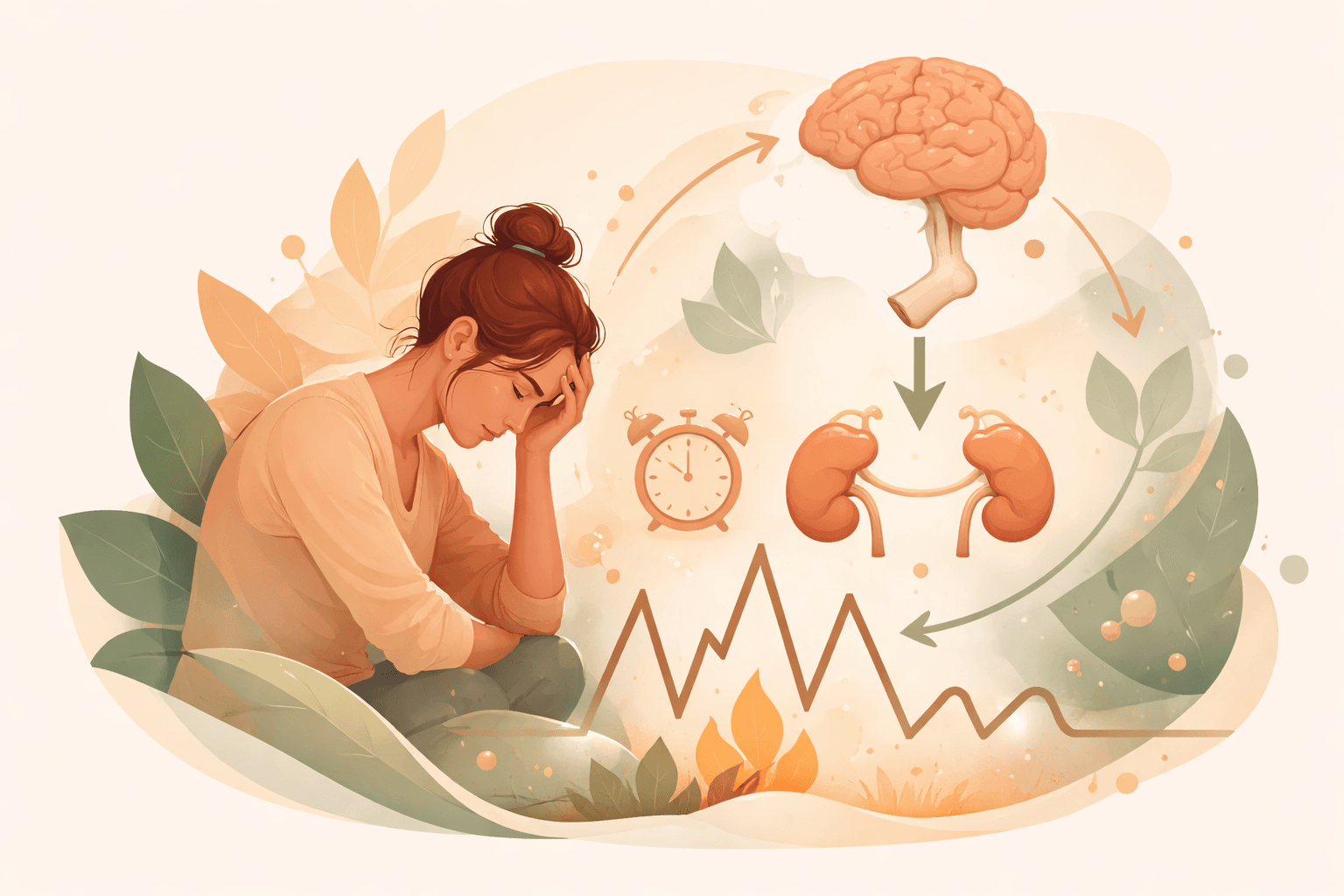
The HPA axis helps the body respond to challenges. Stress signals from the brain trigger CRH (hypothalamus) → ACTH (pituitary) → cortisol (adrenals). Cortisol mobilizes energy, tempers inflammation, and supports alertness, then feeds back to the brain to turn the response down. Under acute stress, that loop is adaptive; under chronic psychosocial load (high demands, low control, poor recovery), research suggests the feedback can become dysregulated—a state often called “allostatic load.” (Evidence level: strong; supported by decades of psychoneuroendocrinology and systematic reviews on chronic stress physiology)
What Changes in Burnout: Cortisol’s Daily Rhythm
Cortisol follows a diurnal curve: a sharp rise in the first 30–45 minutes after waking (the cortisol awakening response, CAR), then a gradual decline to a low at night. In burnout, several patterns have been reported:
- Flatter diurnal slope: lower morning values and/or higher evening values, reducing the contrast across the day. (Evidence level: moderate)
- Altered CAR: some studies show a blunted CAR in chronic exhaustion, whereas early-stage stress or overcommitment may produce an elevated CAR. (Evidence level: moderate)
- Context matters: findings vary with measurement method (saliva, serum, hair), population (clinical burnout vs occupational stress), and the chronicity of symptoms. (Evidence level: strong for heterogeneity)
A meta-analysis on HPA-axis functioning in burnout reported small but significant alterations consistent with dysregulation rather than uniform “high” or “low” cortisol; effects were strongest for a flattened diurnal slope and altered CAR, with notable between-study variability (Psychoneuroendocrinology, 2018). (Evidence level: moderate)
Hair cortisol, a marker of longer-term cortisol output, has shown mixed results: some chronic stress cohorts display elevated hair cortisol, while more severe exhaustion or trauma-related conditions can show lower levels, possibly reflecting a downshifted HPA set point after prolonged strain (systematic reviews, 2017–2021). (Evidence level: moderate)
Takeaway: Burnout is less a single cortisol number and more a rhythm problem—an HPA–circadian mismatch that can feel like daytime fatigue and nighttime restlessness. (Evidence level: moderate)
The “Adrenal Fatigue” Debate: Why It’s Not a Diagnosis
Although many people use “adrenal fatigue” to describe burnout-like symptoms, endocrinology does not recognize it as a clinical entity. A 2016 systematic review concluded there is no substantiating evidence for “adrenal fatigue” as a diagnostic condition and found salivary cortisol panels insufficient to validate the concept (BMC Endocrine Disorders, 2016). (Evidence level: strong)
This does not negate symptoms. Rather, it clarifies mechanism: the adrenals are generally capable of producing cortisol, but the upstream control system and its timing may be dysregulated. Importantly, this is distinct from true adrenal insufficiency (Addison’s disease or secondary adrenal failure), which involves frank hormone deficiency and requires urgent medical care. (Evidence level: strong)
Adaptogens and Stress Resilience: Where Do They Fit?
Adaptogens are botanicals historically used to support stress resilience. Two are frequently studied in relation to perceived stress, fatigue, and sometimes cortisol.
Ashwagandha (Withania somnifera): Randomized controlled trials in stressed adults report reductions in perceived stress and anxiety, along with decreases in morning cortisol compared with placebo. Systematic reviews and meta-analyses published in 2021–2022 conclude that ashwagandha may benefit stress and sleep quality, with small-to-moderate effects and generally favorable safety profiles in the short term. (Evidence level: moderate)
Rhodiola (Rhodiola rosea): Trials in fatigue and stress-related exhaustion suggest improvements in subjective fatigue, mental performance under stress, and mood symptoms. Systematic reviews (2016–2022) note potential benefits but also highlight modest sample sizes, variable preparations, and heterogeneity in outcomes; cortisol effects are less consistently reported than with ashwagandha. (Evidence level: moderate)
Mechanistically, research suggests adaptogens may modulate stress mediators (e.g., CRH/ACTH signaling, monoamines, and inflammatory pathways), supporting a more flexible HPA response rather than simply “boosting” or “lowering” cortisol. (Evidence level: emerging)
Important note: Trials vary in product standardization, duration, and participant characteristics. Findings support potential adjunctive use for stress-related symptoms, not a cure for burnout. (Evidence level: moderate)
Bridging Traditional Perspectives: Qi, Ojas, and Vata
Traditional systems describe a pattern that overlaps with modern accounts of burnout:
Traditional Chinese Medicine: Qi deficiency—particularly of Spleen and Kidney—may present with fatigue, poor concentration, sleep disturbance, and reduced stress tolerance. Interventions aim to “tonify” qi and regulate the sleep–wake cycle. (Evidence level: traditional)
Ayurveda: Depletion of ojas (vital essence) and vitiation of vata may manifest as mental restlessness, variable digestion, and low stamina. Approaches emphasize nourishment, routine, calming breath practices, and rasayana botanicals (rejuvenatives), a category that includes ashwagandha. (Evidence level: traditional)
These frameworks are not interchangeable with biomedical diagnoses, but they converge on a theme: restoring rhythm, nourishment, and resilience. (Evidence level: traditional)
How This Perspective Helps Make Sense of Symptoms
Considering burnout as HPA-axis and circadian dysregulation organizes common experiences:
- Morning sluggishness with late-day “second wind” aligns with a flattened cortisol slope and circadian delay. (Evidence level: moderate)
- Increased sensitivity to stressors and brain fog are consistent with altered stress feedback and sleep disruption. (Evidence level: moderate)
- Variable lab results (sometimes normal single-time-point cortisol) fit with a problem of timing and reactivity rather than constant deficiency. (Evidence level: strong for concept; timing dependence is well-documented in cortisol research)
It also frames why multidimensional strategies studied in burnout—sleep regularity, light exposure timing, structured recovery breaks, psychological support, physical activity tailored to capacity, and, where appropriate, adaptogens—may gradually improve resilience by nudging the HPA–circadian system back toward healthier rhythms. (Evidence level: moderate; supported by systematic reviews on sleep regularity and stress reduction, and RCTs for select adaptogens)
What Testing Can and Can’t Tell You
Research-grade assessments (e.g., diurnal saliva profiles, awakening response protocols, hair cortisol) provide insight into population patterns but are not standardized for diagnosing burnout in individual patients. Single random cortisol measurements are particularly limited for assessing rhythm. Clinical evaluation for persistent fatigue often considers other conditions (thyroid dysfunction, anemia, sleep disorders, depression) that can mimic burnout. (Evidence level: strong for limitations of single cortisol measures; moderate for utility of diurnal protocols in research)
Bottom Line
- Burnout is linked to HPA-axis dysregulation and altered cortisol rhythms—often a flatter day–night pattern—rather than “adrenal glands wearing out.” (Evidence level: moderate)
- “Adrenal fatigue” is not a recognized medical diagnosis; a 2016 systematic review found no evidence to support it. Symptoms are real, but mechanisms are better explained by regulation and circadian timing changes. (Evidence level: strong)
- Adaptogens such as ashwagandha and rhodiola may help with perceived stress and fatigue, and ashwagandha has lowered morning cortisol in multiple RCTs; effects are modest and preparations vary. (Evidence level: moderate)
- Ayurvedic and TCM traditions frame burnout-like states as depleted vital energy (qi, ojas) or vata imbalance, emphasizing restoration of rhythm and resilience—concepts that parallel modern stress physiology. (Evidence level: traditional)
Overall, research supports viewing burnout through the lens of systems regulation—HPA axis and circadian health—while acknowledging the lived reality of fatigue, mood strain, and reduced stress tolerance. This perspective opens space for evidence-informed, multi-pronged approaches that aim to restore rhythm rather than chase a single hormone number.