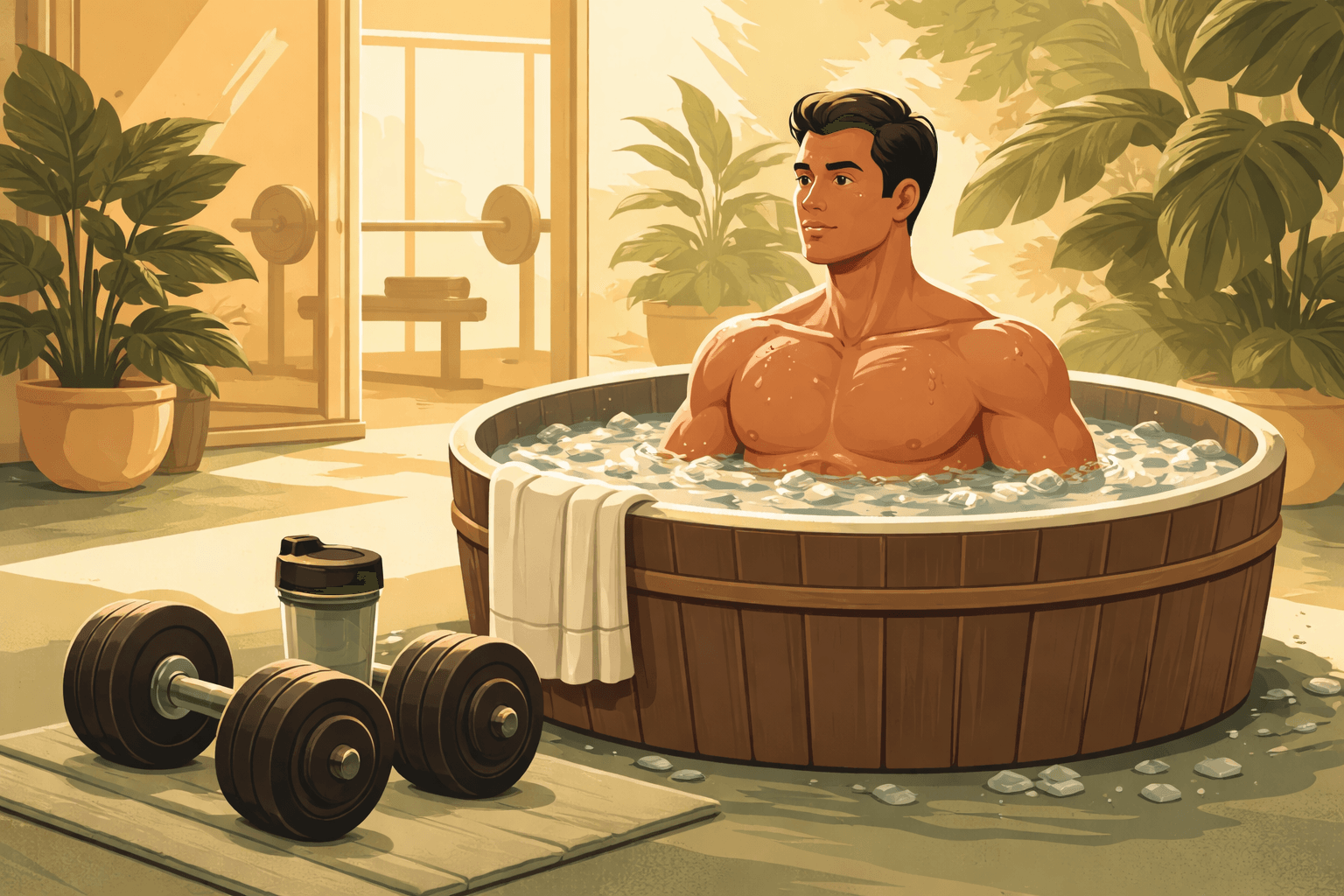
Cold Plunges After Lifting: Do They Blunt Muscle Gains?
Do cold plunges after lifting blunt muscle gains? Research on post-workout ice baths, DOMS, and training adaptations, plus contrast therapy and tradition.
·8 min read
This content is for informational purposes only and does not constitute medical advice. Always consult a qualified healthcare provider before starting, stopping, or changing any supplement or medication regimen.
Introduction
Cold plunges and ice baths have exploded in popularity, helped along by high-profile voices in performance science and wellness podcasts. Many lifters now finish a resistance workout with a quick dunk to “reduce inflammation” and “speed recovery.” But a key question remains: does jumping into cold water right after strength training blunt the very adaptations you trained for—namely, muscle size and strength?
This focused review summarizes what research suggests about immediate post-lifting cold exposure (cold water immersion, or CWI) and long-term strength and hypertrophy, how this differs from endurance adaptations, and where contrast therapy may fit. It also nods to Nordic and breath-focused traditions that have shaped modern practice.
Key takeaways are highlighted with evidence levels: strong, moderate, emerging, or traditional.
What happens when you plunge right after lifting?
Acute molecular signaling may shift: Muscle growth is driven in part by mTORC1 signaling and subsequent myofibrillar protein synthesis following resistance exercise. Research suggests that applying cold immediately post-exercise may dampen this signaling cascade. A randomized study found that regular post-exercise CWI reduced myofibrillar protein synthesis and satellite cell activity compared with active recovery (Roberts et al., The Journal of Physiology, 2015). Evidence level: moderate to strong.
Inflammation is modulated, not simply “reduced”: Cold exposure may acutely lower markers associated with muscle damage and perceived soreness, but inflammation also plays a role in orchestrating adaptation. Reviews note that blunting the inflammatory response right after lifting may partly explain smaller hypertrophy outcomes with chronic post-exercise CWI (Peake et al., and Fyfe, Broatch & Petersen, Sports Medicine, 2019). Evidence level: moderate.
Does cold after lifting change long-term strength and size?
Resistance training adaptations may be attenuated: A 12-week randomized trial reported that lifters who consistently used CWI immediately after sessions gained less muscle mass and had smaller strength improvements versus those performing active recovery (Roberts et al., 2015). While sample sizes were modest, findings align with mechanistic data. Evidence level: moderate.
Meta-analyses and systematic reviews support caution: Synthesis papers suggest that when CWI is applied immediately after most or all resistance sessions, hypertrophy and some strength gains may be modestly reduced over time (Fyfe, Broatch & Petersen, Sports Medicine, 2019; broader systematic reviews 2019–2021). The size of the effect appears small-to-moderate and likely depends on training status, frequency, and total exposure. Evidence level: moderate.
In short, if maximizing muscle size and strength is the primary goal, research suggests routine, immediate post-lifting cold immersion may blunt some training adaptations. The effect is not universal or large in all studies, but it is consistent enough to merit consideration.
Is endurance training different?
Mitochondrial and endurance-related signaling may be maintained—or even enhanced: After endurance exercise, some studies show that CWI may augment markers of mitochondrial biogenesis such as PGC-1α expression (Ihsan et al., The Journal of Physiology, 2014). Systematic reviews indicate that endurance performance adaptations are less likely to be compromised by post-exercise cold compared with resistance training, and in some contexts recovery may be improved. Evidence level: emerging to moderate.
Bottom line for modality differences: Cold right after lifting may dampen anabolic signaling, while cold after endurance exercise appears less problematic and could sometimes support recovery signaling.
What about soreness, fatigue, and next-day performance?
Perceived soreness and subjective recovery may improve: Multiple systematic reviews and meta-analyses report small-to-moderate reductions in delayed-onset muscle soreness (DOMS) and perceived fatigue in the 24–72 hours after intense exercise with CWI (Leeder et al., British Journal of Sports Medicine, 2012; Hohenauer et al., Sports Medicine, 2015). Short-term performance recovery outcomes are mixed but may be slightly improved for repeated-sprint or high-intensity efforts in the short window. Evidence level: moderate.
Context matters: Athletes in congested competition schedules or during peaking phases may prioritize being ready for the next session even if long-term hypertrophy is not maximized. Evidence level: moderate (context-specific).
Contrast therapy vs. ice baths alone
Contrast water therapy (alternating warm and cold) may provide similar short-term soreness relief to CWI: A systematic review reported that contrast therapy can reduce DOMS and aid subjective recovery (Bieuzen, Bleakley & Costello, Sports Medicine, 2013). Evidence level: moderate for soreness outcomes.
Long-term adaptation data for contrast therapy are limited: Fewer studies have examined whether routine post-lifting contrast therapy blunts hypertrophy like CWI may. Current evidence is insufficient to draw firm conclusions. Evidence level: emerging.
Cold shock proteins and brown fat activation: cool, but not your hypertrophy engine
Cold shock proteins (e.g., RBM3) and brown adipose tissue activation are interesting mechanistic phenomena linked to thermoregulation and metabolic flexibility. While these pathways may have health or energy expenditure implications, they are not clearly tied to improving strength or muscle size after lifting sessions. Evidence level: emerging.
Timing seems pivotal
The “when” may be as important as the “what”: Research suggests the risk of blunting hypertrophy is most relevant when cold is applied immediately after lifting. Whether delaying cold exposure by several hours meaningfully mitigates this effect has not been rigorously tested across diverse populations. Conceptually, separating cold from the key post-exercise anabolic window may reduce interference, but direct evidence is limited. Evidence level: emerging.
Traditional and Eastern-aligned perspectives
Nordic sauna-cold cycles: Long-standing traditions in Nordic countries blend heat and cold for relaxation, mood, and social ritual. These cycles may support perceived recovery and well-being even without clear hypertrophy benefits. Evidence level: traditional for practice; emerging to moderate for specific recovery outcomes.
Breathwork and the Wim Hof Method: Breath-focused cold practices emphasize autonomic balance and resilience. Research on breathwork suggests potential benefits for stress perception and affect, which may indirectly support recovery behaviors (sleep, consistency). Direct effects on resistance adaptations remain uncertain. Evidence level: emerging to traditional.
Where this leaves lifters
If your main goal is muscle size and maximal strength: Research suggests avoiding routine, immediate post-lifting cold exposure, because it may modestly attenuate hypertrophy and strength adaptations over time. Evidence level: moderate.
If your goal is to feel less sore and ready for the next session during dense schedules: Short-term use of cold or contrast therapy may help perceived recovery, even if there’s a trade-off with maximal hypertrophy in some contexts. Evidence level: moderate.
If you enjoy cold for mood, alertness, or tradition: These are valid reasons, and many people report benefits. Consider how timing relative to strength sessions aligns with your goals. Evidence level: traditional to emerging.
What the hype gets right—and wrong
The Huberman effect: Popular discussions have helped many people explore cold exposure as a deliberate practice. Where messaging sometimes overreaches is in assuming benefits generalize across goals. The literature suggests a nuanced picture: helpful for soreness and possibly endurance recovery, but potentially counterproductive for strength and hypertrophy when used immediately post-lifting. Evidence level: moderate.
Bottom Line
Immediate post-lifting cold exposure may blunt hypertrophy and some strength gains when used habitually (moderate evidence).
CWI and contrast therapy may reduce soreness and improve subjective recovery in the short term (moderate evidence).
Endurance adaptations appear less likely to be impaired by post-exercise cold and may sometimes show enhanced mitochondrial signaling (emerging to moderate evidence).
Mechanisms likely include dampened anabolic signaling and altered inflammatory processes after resistance exercise (moderate evidence).
Timing and context are key levers: separating cold exposure from strength sessions may help align the practice with goals, though direct evidence is limited (emerging evidence).
Traditional Nordic cycles and breath-focused methods may support well-being and stress management, which can indirectly aid recovery behaviors (traditional to emerging evidence).
As with most recovery tools, the value of cold exposure depends on your primary objective. For lifters chasing maximum size and strength, research suggests caution with immediate post-workout plunges. For athletes prioritizing short-term readiness or those seeking mood and resilience benefits, cold may still have a place—ideally used in a way that matches the training goal.
References (selection)
Roberts, L. A., et al. Post-exercise cold water immersion attenuates acute anabolic signaling and long-term adaptations in muscle to strength training. The Journal of Physiology, 2015.
Fyfe, J. J., Broatch, J. R., & Petersen, A. C. Post-exercise cold water immersion: applications for training adaptation. Sports Medicine, 2019.
Hohenauer, E., et al. Cold-water or partial-body cryotherapy? Systematic review and meta-analysis on recovery after exercise. Sports Medicine, 2015.
Leeder, J. D., et al. Cold water immersion and recovery from exercise-induced muscle damage: a systematic review and meta-analysis. British Journal of Sports Medicine, 2012.
Ihsan, M., et al. Post-exercise cold water immersion enhances PGC-1α and VEGF expression in human skeletal muscle after endurance exercise. The Journal of Physiology, 2014.
Bieuzen, F., Bleakley, C. M., & Costello, J. T. Contrast water therapy and exercise-induced muscle damage: a systematic review. Sports Medicine, 2013.
This content is for informational purposes only and does not constitute medical advice. Always consult a qualified healthcare provider before starting, stopping, or changing any supplement or medication regimen.
Overview
Cold exposure practices—ice baths, cold plunges, and cryotherapy—have surged in popularity, boosted by high-profile voices like Andrew Huberman discussing focus, mood, and recovery. For lifte
# Cold Exposure for Recovery: Sorting Hype from Evidence on Ice Baths, Cryotherapy, and Contrast Therapy
Cold plunges and ice baths have surged from locker-room rituals to living-room tubs, thanks in
Cryotherapy. Cryo Therapy, Cryotherpy, Cryotherapy Treatment. ## Overview
**Cryotherapy** refers to the therapeutic use of cold exposure for health-related purposes. The term covers a broad range of approaches, from **localized ice application**, cold water immersion, and contrast therapy to **whole-body cryotherapy (WBC)** chambers that expose the body to ver
Contrast Therapy. Hot Cold Therapy, Contrast Hydrotherapy. ## Contrast Therapy Overview
**Contrast therapy** is a recovery and conditioning modality that alternates **heat and cold exposure** over a defined period of time. It may involve switching between hot and cold water immersion, alternating hot and cold packs, moving between a sauna and a cold plunge
Overview
L‑glutamine is the most abundant free amino acid in human blood and skeletal muscle. During intense training or illness, the body’s demand for glutamine rises as muscles, the gut lining, and
Best Supplements for Athletic Recovery: An Evidence‑Based Guide to What Works, Dosage & Safety. If you’re training hard and still waking up sore, the question becomes: which are the best supplements for athletic recovery, and when do they actually help beyond food, sleep, and smart programming? Research suggests the biggest wins come from getting the fundamentals right—adequate protein and car