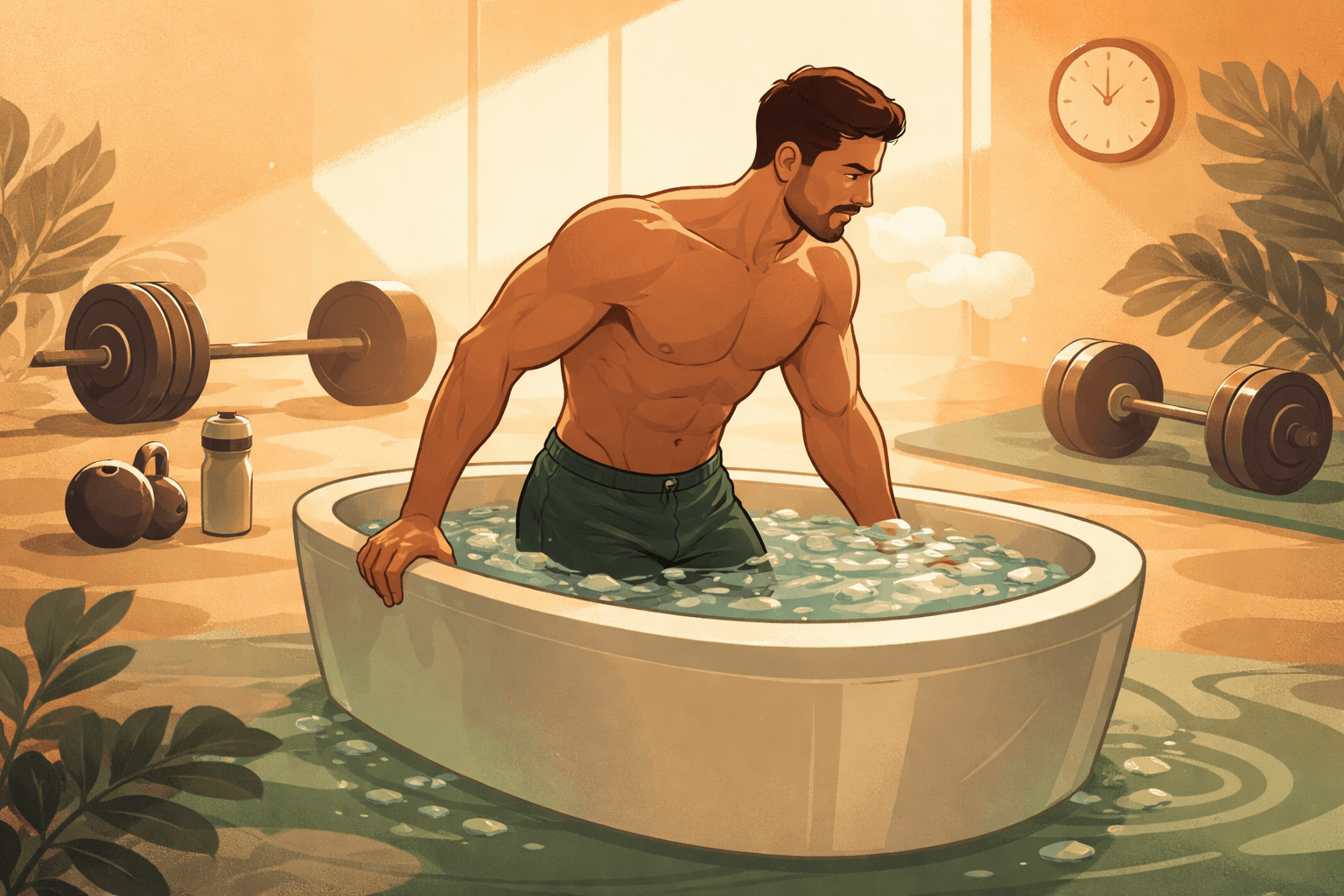
Cold exposure after workouts—ice baths, cold plunges, and cryotherapy—has surged in popularity, helped by high-profile voices like Andrew Huberman. For athletes chasing faster recovery, the appeal is clear. But when the goal is building muscle and strength, research suggests routine cold exposure immediately after lifting may blunt some of the very adaptations you’re training for.
This focused review examines what the science says about post-strength-training cold exposure and long-term gains in muscle size and strength, what mechanisms may be involved, how endurance adaptations compare, and where traditional practices like Nordic cold traditions and the Wim Hof Method fit in.
What the research says about hypertrophy and strength
Repeated cold water immersion after resistance training may reduce muscle hypertrophy over weeks to months (Evidence: moderate to strong). In a 12-week randomized controlled trial, young men who performed lower-body strength training and immediately used cold water immersion after each session showed smaller increases in muscle mass and strength compared with an active recovery group (Journal of Physiology, 2015; Roberts et al.).
Similar trials and mechanistic studies report that post-exercise cold exposure can dampen anabolic signaling pathways implicated in muscle growth (mTOR, p70S6K) and reduce satellite cell activity (Evidence: moderate). Acute studies show lower post-exercise muscle protein synthesis signaling after cold exposure compared with thermoneutral recovery (Sports Medicine, 2016; Ihsan et al., review). Over time, these acute effects may translate into smaller hypertrophy gains.
Strength improvements may also be attenuated with routine post-lift cold exposure (Evidence: moderate). In the 12-week trial referenced above, participants using cold immersion after every session saw smaller gains in isometric and dynamic strength than controls. Other controlled trials have observed similar trends, though effect sizes vary (Journal of Physiology, 2015; Roberts et al.; European Journal of Applied Physiology, 2015; Yamane et al.).
Put simply: if your primary goal is maximizing muscle size and strength, consistently getting very cold right after lifting may not align with that objective. The magnitude of the effect seems modest to moderate but potentially meaningful over months of training.
Mechanisms: why might cold blunt adaptation?
Reduced muscle temperature and blood flow (Evidence: strong). Cold exposure rapidly decreases tissue temperature and constricts blood vessels, which can lower delivery of oxygen, nutrients, and anabolic hormones to recovering muscle (Sports Medicine, 2016; Ihsan et al., review). This may reduce the “anabolic window” signaling environment.
Dampened inflammatory signaling that helps remodeling (Evidence: moderate). Some inflammation after resistance training is part of the remodeling process. By suppressing inflammatory mediators and immune cell infiltration, cold may decrease downstream signals involved in muscle repair and growth (Frontiers in Physiology, 2017; Peake et al., review).
Acute reductions in mTOR-related signaling and satellite cell activity (Evidence: moderate). Experimental work shows that post-exercise cold can reduce phosphorylation of mTOR pathway targets and markers of satellite cell activation, both necessary for hypertrophy (Journal of Physiology, 2015; Roberts et al.).
It’s important to recognize that these mechanisms may be beneficial for short-term soreness or swelling, yet counterproductive if repeated chronically right after resistance sessions when long-term adaptation is the priority.
What about endurance or mixed training?
Endurance performance adaptations appear less consistently affected (Evidence: limited to moderate). Some studies report that post-exercise cold exposure after sprint or endurance intervals does not impair improvements in time trial performance or VO2-related markers across several weeks, while others suggest modest decrements in vascular or strength-related outcomes (Medicine & Science in Sports & Exercise, 2014; Broatch et al.; European Journal of Applied Physiology, 2015; Yamane et al.).
Mitochondrial signaling effects are mixed (Evidence: emerging). Cold can increase catecholamines and PGC-1α-related signals in some contexts, yet reduced muscle temperature and blood flow may counterbalance those effects post-exercise. Current evidence is heterogeneous and study designs vary (Sports Medicine, 2016; Ihsan et al., review).
In practice, athletes prioritizing endurance performance may find post-session cold less risky for long-term adaptation than strength athletes, though the evidence base is not uniform.
Acute recovery vs. long-term adaptation
Cold exposure can reduce perceptions of soreness and may transiently restore neuromuscular function within hours to 1–2 days (Evidence: strong for DOMS relief; moderate for performance). Systematic reviews report small-to-moderate benefits for delayed-onset muscle soreness (DOMS) and small, short-lived benefits for strength and power recovery within 24–72 hours (Cochrane Review, 2012; Hohenauer et al., 2015, systematic review and meta-analysis).
However, these short-term benefits may trade off with long-term gains if cold exposure is used immediately and repeatedly after resistance sessions (Evidence: moderate to strong for hypertrophy/strength blunting over months). This creates a programming question: Is the priority faster turnaround between close competitions, or maximizing adaptation over a training block?
Ice baths vs. cryotherapy and context
Whole-body cryotherapy (WBC) is less studied for training adaptations than cold water immersion (Evidence: emerging). Early trials suggest WBC may similarly blunt inflammatory signaling, but direct evidence on long-term hypertrophy or strength outcomes is limited compared with water immersion. Mechanisms—vasoconstriction, reduced muscle temperature—are directionally similar.
Contrast therapy (alternating hot and cold) may balance perceived recovery with a smaller temperature debt in muscle (Evidence: emerging). A few studies suggest comparable DOMS relief to cold alone, but evidence is insufficient to conclude it avoids adaptation trade-offs. More direct, long-term trials are needed.
Traditional and modern perspectives
Nordic traditions and contrast bathing (sauna followed by cold exposure) have long been used for resilience and perceived well-being (Evidence: traditional). These practices emphasize circulatory stimulation and mental toughness over specific training adaptations.
The Wim Hof Method combines cold exposure, breathwork, and mindset. Research suggests it may modulate immune and stress responses and improve perceived stress resilience (Evidence: emerging), but its impact on long-term strength or hypertrophy adaptations remains unproven in controlled training studies.
When cold may help—and when to be cautious
Evidence-grade summary of key claims
- Routine cold exposure immediately after resistance training may blunt hypertrophy and strength gains over months (Evidence: moderate to strong).
- Mechanisms likely involve reduced muscle temperature/blood flow, dampened inflammatory and anabolic signaling, and lower satellite cell activity (Evidence: moderate).
- Cold can reduce DOMS and may modestly aid short-term performance recovery within 24–72 hours (Evidence: strong for soreness; moderate for acute performance).
- Endurance adaptations appear less consistently affected than hypertrophy, with mixed findings (Evidence: limited to moderate).
- Whole-body cryotherapy and contrast therapy have less direct evidence on long-term adaptations than cold water immersion (Evidence: emerging).
Bottom line
Cold exposure is a powerful tool—but like any tool, timing and context matter. Research suggests that repeatedly getting very cold right after lifting may dampen the anabolic processes that drive muscle size and strength. If your priority is maximal adaptation in a strength or hypertrophy block, cautious use—or alternative recovery strategies—may better fit your goals. If you need to turn around quickly between events or manage soreness midseason, short-term cold exposure may help you feel and perform better in the near term. Traditional practices and modern methods can support resilience and well-being, but the data linking them to long-term strength gains remain limited. As always, align recovery choices with the phase of training and the outcome you care about most.
References
- Roberts LA, Raastad T, Markworth JF, et al. Post-exercise cold water immersion attenuates anabolic signaling and satellite cell activity in human skeletal muscle and blunts long-term gains in muscle mass and strength. Journal of Physiology. 2015.
- Ihsan M, Watson G, Abbiss CR. What are the physiological mechanisms for post-exercise cold water immersion in the recovery from prolonged endurance and intermittent exercise? Sports Medicine. 2016 (review).
- Yamane M, Teruya H, Nakano M, Ogai R, Ohnishi N, Kosaka M. Postexercise leg and forearm cooling impairs training-induced strength and endurance gains. European Journal of Applied Physiology. 2015.
- Broatch JR, Petersen A, Bishop DJ. Postexercise cold water immersion benefits are not greater than the placebo effect. Medicine & Science in Sports & Exercise. 2014.
- Hohenauer E, Costello JT, Stoop R, et al. Cold water immersion and recovery from strenuous exercise: a systematic review and meta-analysis. International Journal of Sports Physiology and Performance. 2015.
- Peake JM, Roberts LA, Figueiredo VC, et al. The effects of cold water immersion on markers of inflammation and cell stress after prolonged exercise in humans. Frontiers in Physiology. 2017 (review).
- Cochrane Review: Bleakley CM, et al. Cryotherapy for acute soft tissue injuries and exercise recovery. Cochrane Database of Systematic Reviews. 2012 (recovery outcomes).
- Additional narrative reviews on cold exposure, signaling, and adaptation are consistent with these findings but highlight context and heterogeneity across protocols.