Is “Adrenal Fatigue” Really Burnout? HPA Axis Dysregulation and Cortisol Patterns
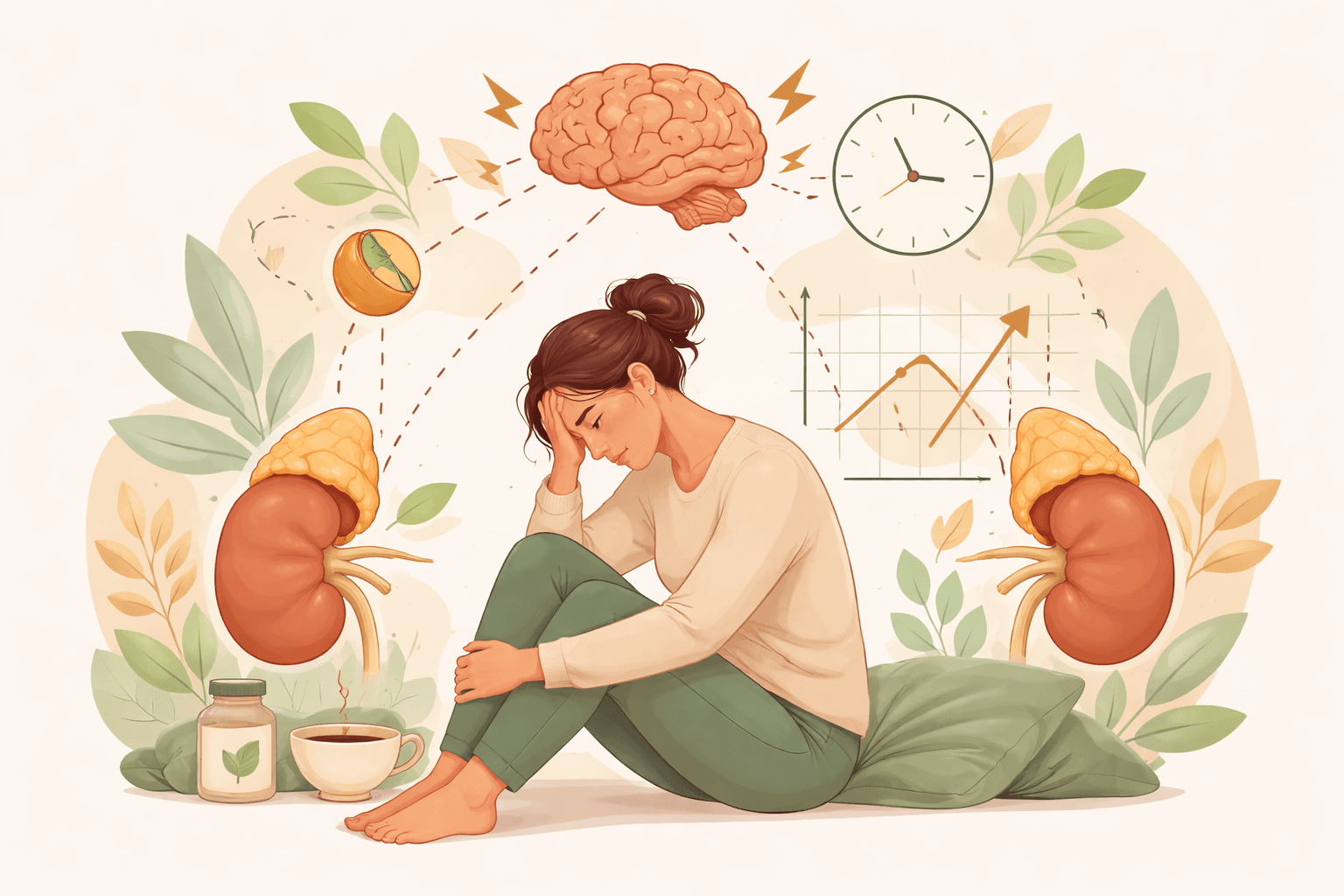
Burnout is often described online as “adrenal fatigue,” a term suggesting the adrenal glands are worn out. Endocrinology does not recognize adrenal fatigue as a medical diagnosis. Yet the exhaustion, sleep problems, brain fog, and stress intolerance people report are very real. Research increasingly frames these experiences through the lens of the brain–body stress system—specifically the hypothalamic–pituitary–adrenal (HPA) axis—and how its cortisol rhythms change under chronic stress and burnout.
This article focuses on what research suggests about HPA axis dysregulation in burnout, how it differs from true adrenal insufficiency, what cortisol biomarkers do (and don’t) show, and where traditional frameworks like Ayurveda and Chinese medicine converge conceptually with modern findings.
The HPA Axis and Healthy Cortisol Rhythms
- The HPA axis orchestrates the stress response: the brain (hypothalamus and pituitary) signals the adrenals to release cortisol. (Evidence: strong; physiology texts and consensus guidelines)
- In healthy adults, cortisol follows a daily (diurnal) pattern: a sharp rise within ~30–45 minutes after waking—the cortisol awakening response (CAR)—followed by a gradual decline to low levels at night. (Evidence: strong; chronobiology research and consensus)
These rhythms help regulate energy, alertness, glucose, inflammation, and sleep timing. Disruption can leave people feeling “wired and tired,” fatigued yet unable to restore energy. (Evidence: moderate; observational studies)
What Studies Show in Burnout
Research suggests burnout is linked to altered HPA axis signaling—not adrenal gland failure. Findings vary by study design, population, and timing, but several patterns emerge:
- Blunted or altered CAR: Meta-analytic and systematic reviews report that people with chronic work-related stress or clinical burnout often show a reduced CAR or atypical rise. (Evidence: moderate; Psychoneuroendocrinology and Neuroscience & Biobehavioral Reviews meta-analyses)
- Flatter diurnal cortisol slope: Compared with healthy controls, some studies find a less steep decline from morning to evening, associated with fatigue, poor sleep, and mood symptoms. (Evidence: moderate; systematic reviews of diurnal cortisol in chronic stress/burnout)
- Total cortisol output differences: Results are mixed—some cohorts show lower overall daytime cortisol under chronic stress (hypocortisolism), while others show higher or unchanged output, possibly reflecting different stages of adaptation. (Evidence: emerging; heterogeneous observational data)
- Hair cortisol concentration (HCC): Because hair accumulates cortisol over weeks, it offers a longer view. Reviews report inconsistent HCC findings in burnout—some show elevated levels (ongoing stress load), others lower levels (downregulated HPA output), again hinting at stage- or person-specific responses. (Evidence: emerging; systematic reviews of HCC in chronic stress)
Taken together, burnout appears less like a simple “high cortisol” or “low cortisol” state and more like a recalibration of the entire stress network in response to prolonged demands—an allostatic adaptation that may trade short-term survival for long-term wear and tear. (Evidence: moderate; allostatic load framework and biomarker studies)
Why “Adrenal Fatigue” Isn’t the Right Term
- Endocrine societies distinguish clearly between adrenal insufficiency (Addison’s disease or secondary adrenal insufficiency), which is rare, dangerous if untreated, and diagnosable with validated dynamic tests, and nonspecific fatigue states. (Evidence: strong; clinical guidelines)
- A 2016 systematic review of 58 studies concluded there is no substantiation for “adrenal fatigue” as a condition, noting inconsistent testing methods and poor alignment with diagnostic endocrinology. The authors recommended abandoning the term. (Evidence: strong; BMC Endocrine Disorders, 2016)
That does not negate people’s symptoms. It reframes them: the problem in burnout is not that adrenals “wear out,” but that the brain–adrenal conversation can become dysregulated under chronic stress, sleep disruption, circadian misalignment, and emotional load. (Evidence: moderate; HPA axis research)
What About Cortisol Tests?
Cortisol can be measured in saliva, blood, urine, or hair, each capturing different time windows. Research suggests:
- Single time-point measurements are hard to interpret due to natural day-to-day variability. (Evidence: strong; chronobiology research)
- Multi-sample assessments across the day are more informative for patterns (CAR, diurnal slope) but still not diagnostic for burnout. (Evidence: moderate; observational studies)
- Hair cortisol offers a longer-term index but shows mixed results in burnout. (Evidence: emerging; systematic reviews)
In short, while cortisol patterns may reflect how the stress system is adapting, there is no universally accepted cortisol “signature” of burnout, and no test can currently diagnose it. (Evidence: strong for lack of diagnostic standard; consensus statements)
Adaptogens and Stress Resilience: What Trials Suggest
Adaptogens are plant extracts studied for potential stress-buffering effects. Two of the most researched in relation to perceived stress and fatigue are ashwagandha (Withania somnifera) and rhodiola (Rhodiola rosea).
- Ashwagandha: Randomized controlled trials in adults with chronic stress have reported reductions in perceived stress and modest decreases in morning or serum cortisol compared with placebo. Systematic reviews of RCTs suggest small-to-moderate benefits on stress and anxiety symptoms, with generally good short-term tolerability. (Evidence: moderate; multiple RCTs and systematic reviews including Journal of Alternative and Complementary Medicine 2014; Medicine (Baltimore) 2019; 2021–2023 meta-analyses)
- Rhodiola: Trials in stress-related fatigue and mild symptoms of burnout report improvements in fatigue, mood, and concentration versus placebo, though studies are often small and vary by extract and outcome measures. Reviews characterize the evidence as promising but limited by heterogeneity. (Evidence: emerging to moderate; Phytomedicine and other systematic reviews)
These botanicals may help some people feel more resilient under stress, potentially via modest effects on HPA signaling, neurotransmitters, and energy metabolism. They are not substitutes for addressing workload, sleep, light exposure, and recovery practices that shape the HPA axis daily. (Evidence: moderate; integrative stress research)
Note: Adaptogen studies use standardized extracts under controlled conditions. Real-world responses vary, and research does not support them as treatments for medical conditions. This article does not provide dosage guidance or medical advice.
Traditional Lenses: Qi, Vata, and “Vital Energy”
Long before cortisol was measurable, traditional systems described patterns resembling burnout:
- Traditional Chinese Medicine (TCM): Burnout-like presentations may align with qi deficiency (often of Spleen or Lung) or Kidney qi/yang deficiency, marked by fatigue, poor concentration, low motivation, and cold intolerance. The goal is to restore balanced qi flow and strengthen root energy through herbs, diet, movement, and rest. (Evidence: traditional; classical TCM doctrine)
- Ayurveda: Many report features of aggravated Vata (irregularity, restlessness, sleep disturbance) and depleted ojas (vital essence linked to resilience and immunity). Stabilizing routines, breathwork, and nourishing practices are emphasized to rebuild vitality. (Evidence: traditional; classical Ayurvedic texts)
These frameworks converge with modern stress science on the importance of regularity, restoration, and gentle tonification after chronic overexertion. Emerging research also suggests mind–body practices common to these traditions—such as yoga, meditation, and breath training—may modestly lower perceived stress and influence cortisol rhythms. (Evidence: moderate for perceived stress; emerging to moderate for cortisol indices; meta-analyses in Stress and Frontiers in Physiology)
Evidence Snapshot (Claims and Confidence)
- Burnout involves HPA axis dysregulation rather than adrenal gland failure. (Evidence: strong for rejecting adrenal fatigue as diagnosis; moderate for HPA alterations)
- Burnout is associated with altered CAR and flatter diurnal cortisol slopes in some groups. (Evidence: moderate; systematic reviews/meta-analyses)
- Hair cortisol findings in burnout are inconsistent. (Evidence: emerging)
- Ashwagandha may modestly reduce perceived stress and morning cortisol in stressed adults. (Evidence: moderate; RCTs and meta-analyses)
- Rhodiola may improve stress-related fatigue and concentration. (Evidence: emerging to moderate; small RCTs and reviews)
- Mind–body practices may reduce perceived stress and may nudge cortisol patterns toward healthier rhythms. (Evidence: moderate for perceived stress; emerging to moderate for cortisol changes)
Bottom Line
“Adrenal fatigue” is not recognized by endocrinology, and the adrenal glands are typically not failing in burnout. Instead, research points to HPA axis dysregulation and altered cortisol rhythms as the body adapts to chronic stress. Biomarkers like the cortisol awakening response, diurnal slope, and hair cortisol provide partial windows into this adaptation but are not diagnostic on their own.
For stress resilience, trials suggest certain adaptogens—especially ashwagandha—and mind–body practices may help some people feel and function better, while traditional frameworks (Ayurveda and TCM) emphasize restoring vital energy through regularity and recovery. Addressing sleep–wake regularity, light exposure, workload, and supportive relationships remains central to recalibrating the stress system over time. (Evidence overall: moderate)